


Your closet is full, but you still stand there most mornings with nothing to wear. That's the problem a capsule wardrobe fixes. Learning how to build a capsule wardrobe men actually rely on means cutting your rotation down to pieces that fit well, mix easily, and hold up over years, not months.
This guide walks you through the exact process: auditing what you own, choosing a color palette that lets everything pair together, and picking the core categories (tees, shirts, pants, outerwear) that cover work, weekends, and everything between. You'll get a realistic item count to aim for and a sequence for building it out without overspending on trends you'll drop next season.
We'll also talk about why fabric quality matters more than most style guides admit. A relaxed tee in heavy Supima cotton, like the one we build at SÖMNAD, holds its shape wash after wash in a way a thin blend never will. That's the whole point of a capsule: fewer pieces, better ones, worn constantly instead of stored.
Why every man needs a capsule wardrobe
Most men own more clothes than they wear. Studies on closet usage consistently find that people wear roughly 20% of their wardrobe about 80% of the time. That means the other 80% of your closet is dead weight: clothes taking up space, costing you decision time every morning, and doing nothing for how you actually look. A capsule wardrobe flips that ratio by design. Instead of owning dozens of items you rarely touch, you own 30 to 40 pieces you wear on repeat, all chosen to work together.
A capsule wardrobe isn't about owning less for its own sake. It's about owning only what earns its place in your rotation.
The real cost of a cluttered closet
Decision fatigue is real, and it compounds. Every morning you spend staring at mismatched shirts and pants that don't pair is a morning you start distracted before you've even left the house. Researchers who study choice overload have shown that too many options doesn't make people happier with their decisions, it makes them less confident and more likely to second-guess themselves. Your closet shouldn't be another source of that friction. When every top matches every bottom, getting dressed stops being a decision and becomes a habit.
There's also a financial argument that most style content skips. Fast fashion pieces feel cheap to buy but expensive to maintain, since a $15 tee that pills and stretches out after eight washes gets replaced constantly. Compare that to a heavyweight cotton tee that holds its shape for years. The cost per wear on the expensive piece ends up lower, often by a wide margin, once you track it over 12 months instead of judging it at the register.
Built for how men actually dress
Men's style, more than women's, tends to run on repetition. Look at any man you'd call well-dressed and you'll usually find he wears variations on the same five or six outfits, not fifty different looks. That's not a lack of imagination, it's efficiency. A capsule wardrobe formalizes that instinct instead of fighting it. You pick a small set of colors and silhouettes that all work together, and every combination becomes a safe bet.
Here's what a functioning capsule wardrobe does for you in practical terms:
- Cuts your morning routine down to minutes, since any top pairs with any bottom
- Reduces total spending over time by replacing cheap, frequent purchases with fewer, better ones
- Simplifies packing for trips, because everything mixes and matches by default
- Keeps your look consistent, so people associate a clean, put-together style with you specifically
- Frees up closet space and mental space at the same time
Quality over quantity, not less for the sake of less
A capsule isn't about deprivation. It's about redirecting the money and closet space you'd spend on 40 mediocre items into 15 to 20 excellent ones. This is where fabric and construction start to matter more than most men realize until they've felt the difference. A 300g Supima cotton tee, for example, sits heavier on the body, holds its shape through repeated washing, and doesn't go sheer or baggy after a summer of wear the way a lightweight blend does. That durability is what makes the whole capsule concept work financially, since you're not rebuying the same tee every few months.
Think of your wardrobe the same way you'd think of tools in a garage. You don't need forty wrenches, you need six good ones that fit the jobs you actually do. The rest of this guide walks through exactly which pieces belong in that toolkit, starting with an honest look at what's already hanging in your closet.
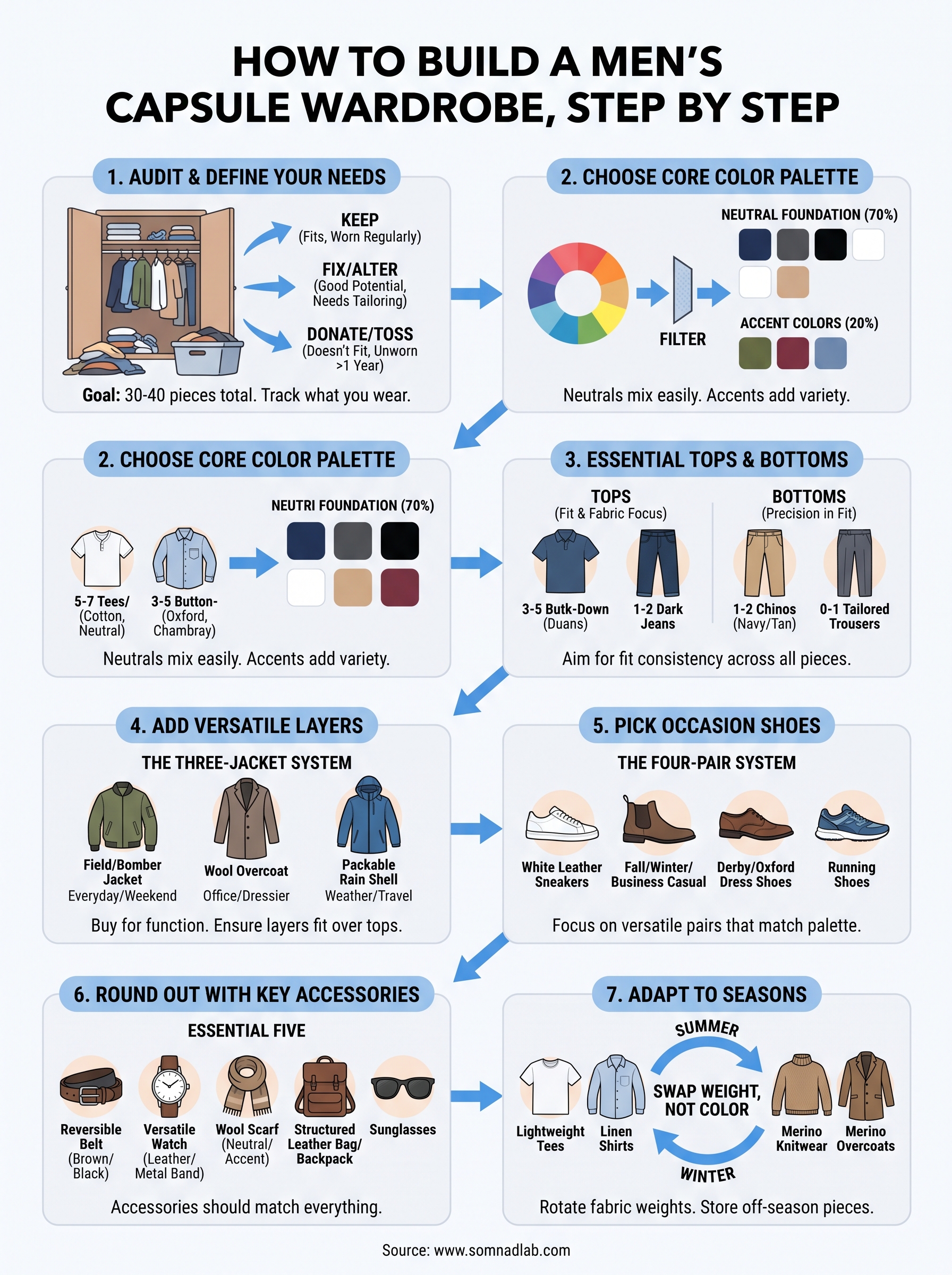
Step 1. Audit your closet and define your needs
Before you buy a single new item, empty your closet completely. Pull everything out, including the stuff crammed in drawers and the bag of clothes you keep meaning to donate. Lay it all on your bed or floor so you can see the full scope of what you actually own. This step feels tedious, but skipping it is the most common reason capsule wardrobes fail before they start, since you end up buying pieces that duplicate what you already have or ignoring gaps you didn't know existed.
Sort into three piles
As you go through each item, sort it into one of three categories. Be honest with yourself here, since the point is to expose what's actually working, not to justify keeping things out of guilt.
- Keep: fits well, gets worn regularly, still looks good after washing
- Fix or alter: good material or fit potential, but needs tailoring, a repair, or a wash to earn its spot back
- Donate or toss: doesn't fit, hasn't been worn in over a year, or is visibly worn out
The clothes you haven't worn in a year aren't waiting for the right occasion. They're just taking up space.
Once you've sorted everything, count what's left in your keep pile. That number tells you how much room you have left before you hit your target capsule size of 30 to 40 pieces.
Track what you actually wear
Memory lies about this more than you'd expect. For two weeks, keep a simple note on your phone or a sticky note on your closet door and log every outfit you wear. At the end of two weeks, look at the pattern. You'll almost always find you're rotating the same five or six combinations, which tells you exactly which silhouettes and colors deserve a spot in your capsule and which ones you've been holding onto out of habit.
Define your lifestyle needs
A capsule wardrobe only works if it matches how you actually spend your days. Write down a rough breakdown of your week: how many days you're in an office versus remote, how often you go out, and what your weekends look like. If you're in business casual five days a week, your capsule needs more button-downs and chinos. If you work from home and see friends on weekends, you'll lean harder on quality tees and jeans. Be specific about climate too, since a capsule built for Chicago winters looks different from one built for Miami. This audit is the foundation everything else in this guide builds on, so don't rush it.
Step 2. Choose your core color palette
Every piece you buy from here forward gets filtered through one question: does it match at least three other things I already own? That's only possible if you lock in a color palette before you start shopping. Skip this step and you'll end up with a closet full of good individual pieces that clash with everything else, the exact opposite of what a capsule wardrobe promises. Color coordination is what turns a pile of clothes into a system, and it's the single biggest lever for making 30 pieces feel like 300 outfit combinations.
Start with a neutral foundation
Neutrals do the heavy lifting in any capsule. Pick two or three base colors from navy, charcoal gray, black, white, and tan, and build at least 70% of your wardrobe around them. Navy and charcoal pair with almost anything, including each other, which makes them the safest starting point if you're building from scratch. Neutral colors don't compete with each other, so any top from this group works with any bottom, which is the entire mechanism that makes learning how to build a capsule wardrobe men actually stick to worth the effort.
Neutrals aren't boring, they're the reason everything in your closet can talk to everything else.
Layer in one or two accent colors
Once your neutrals are locked, add one or two accent colors that reflect your actual taste, like olive green, burgundy, or a muted blue. Keep these accents to sweaters, jackets, and accessories rather than everyday basics, so they add variety without breaking the system you just built. Accent colors should show up in roughly 20% of your pieces, enough to avoid boredom without producing an item that only pairs with one other thing in your closet.
Use a simple palette reference
Before you shop, write your palette down somewhere you'll actually check it, like a note on your phone. A quick reference keeps you from impulse-buying a color that doesn't belong.
| Base neutral | Pairs naturally with | Suggested accent |
|---|---|---|
| Navy | White, gray, tan | Burgundy or olive |
| Charcoal gray | Black, white, navy | Muted blue |
| Black | Gray, white | Deep green |
| White | Everything above | Any accent |
| Tan or khaki | Navy, white, charcoal | Olive |
Once you've settled on this palette, treat it as a filter for every future purchase. If a shirt or jacket doesn't fit into this chart, it doesn't belong in your capsule, no matter how much you like it on the hanger.
Step 3. Build your essential tops and bottoms
With your palette locked, it's time to fill in the pieces you'll actually wear five days a week. Tops and bottoms make up the bulk of any capsule, so this is where fit and fabric quality matter most. Buy the wrong tee here and you'll feel it every single day, since these are the items touching your skin and taking the most washes. Fit consistency across every piece is the goal, meaning a shirt or pair of pants should look intentional whether you pair it with anything else in your closet.
Tees and long-sleeve staples
Start with tees, since they're the most-worn item in almost every man's rotation. Aim for five to seven crew or v-neck tees in your neutral colors, split between heavier options for cooler months and lighter ones for summer. A 300g Supima cotton tee holds its shape through dozens of washes in a way a thin cotton-poly blend never will, which matters more once you're wearing the same handful of shirts on repeat instead of rotating through forty. Add two or three long-sleeve tees or henleys in the same palette for layering under jackets or wearing alone on cooler days.
A tee that survives fifty washes without stretching out is worth three times the price of one you'll toss after ten.
Button-downs for work and going out
Next, add three to five button-down shirts that cover both office days and dinner plans. Oxford cloth in white and light blue covers business casual, while a chambray or flannel option in your accent color handles weekend wear. Keep the fit trim through the chest and shoulders without being tight, since a boxy button-down undercuts even the best fabric.
Pants that anchor every outfit
Bottoms need less variety than tops but more precision in fit. Build around three to four pairs total, split roughly like this:
| Bottom | Quantity | Best for |
|---|---|---|
| Dark wash jeans | 1-2 | Weekends, casual layering |
| Chinos (navy, tan) | 1-2 | Business casual, dinners |
| Tailored trousers | 0-1 | Office, formal events |
Each pair should hem cleanly at your shoe without breaking heavily, and the waist should sit without a belt doing the real work. Get one pair tailored if you're between sizes, since a $20 alteration fixes a fit problem no amount of fabric quality can solve on its own.
Step 4. Add versatile outerwear and layers
With tops and bottoms sorted, outerwear is what carries your capsule through temperature swings and dressier occasions without adding real bulk to your closet. Most men over-buy jackets, ending up with five options that all serve the same purpose while leaving actual gaps uncovered. Layering pieces should each solve a different problem: warmth, rain, or a step up in formality. Buy for function first, and the palette work you did earlier means every layer will already match what's underneath it.
The three-jacket system
You need fewer jackets than you think. Three well-chosen pieces cover almost every situation a capsule wardrobe needs to handle, from a cold commute to a dinner that calls for something sharper than a hoodie.
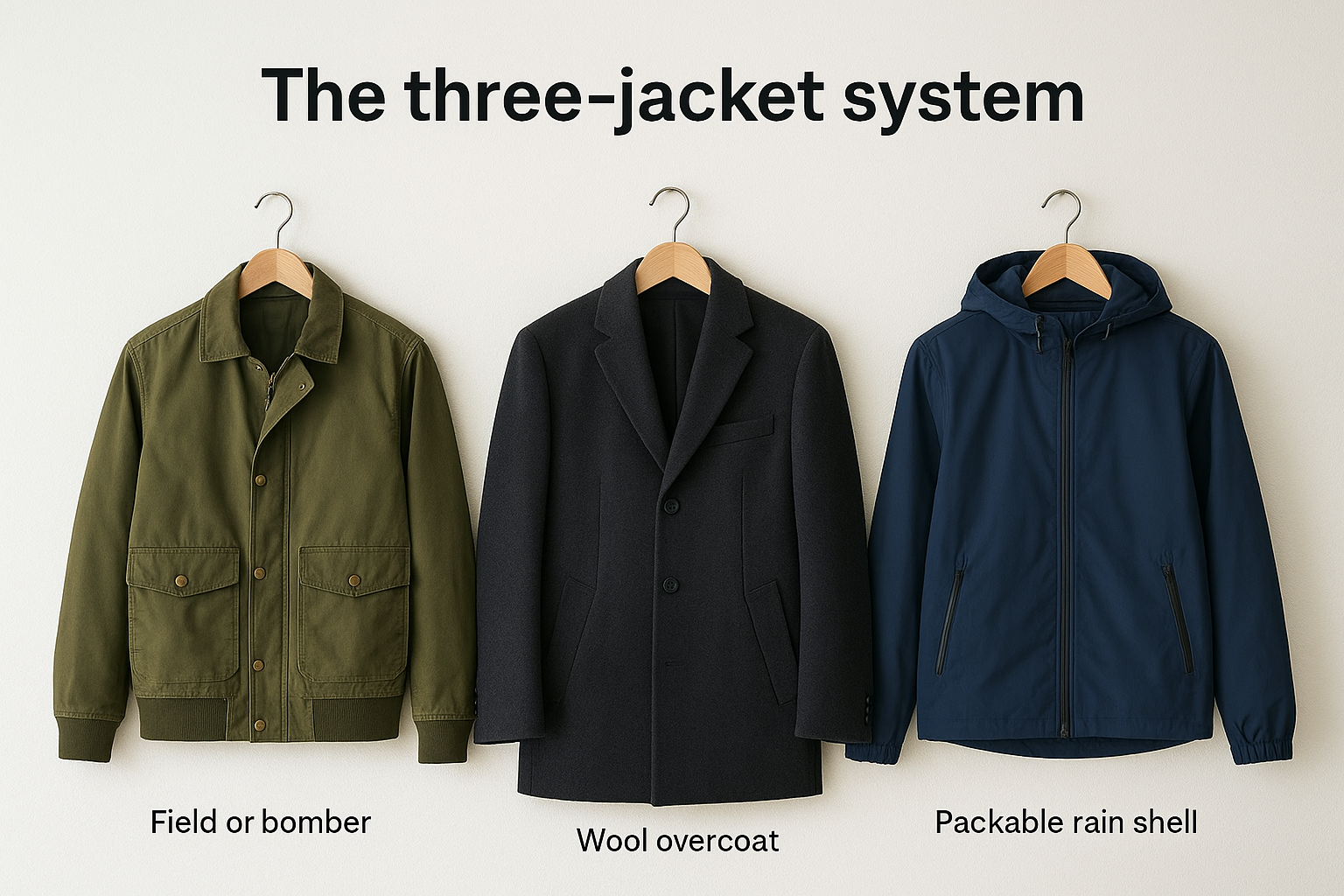
| Jacket type | Best for | Ideal fabric |
|---|---|---|
| Field or bomber jacket | Everyday, casual weekends | Waxed cotton or nylon |
| Wool overcoat | Office, dressier occasions | Wool or wool blend |
| Packable rain shell | Unpredictable weather, travel | Waterproof nylon |
Aim for one jacket per category rather than duplicates. A single well-made wool overcoat in charcoal or navy pulls double duty for work and evenings out, which is exactly the kind of overlap a capsule wardrobe rewards.
One great overcoat that works for the office and dinner beats three jackets that only handle one situation each.
Sweaters and knitwear for in-between weather
Between a tee and a full jacket, you need something for the 55-to-65-degree range that makes up half the year in most climates. Two or three knitwear pieces, a merino crewneck and a cardigan or quarter-zip, cover that gap without adding real bulk. Stick to your accent colors here since sweaters sit at the top layer and get seen the most, making them a natural place to add personality without breaking your palette.
Fit rules that make layering work
Layering only looks intentional when each piece fits its role in the stack. A jacket needs enough room to sit over a sweater without pulling across the shoulders, but not so much room that it looks borrowed when worn alone over a tee. Test every outerwear piece both ways, over a light layer and over nothing, before you commit to buying it. If it only looks right in one scenario, it's not earning a spot in a capsule built around versatility, and you're better off saving that money for a piece that does both jobs well.
Step 5. Pick shoes for every occasion
Shoes get ignored in most capsule wardrobe plans, then quietly wreck the whole system when a guy owns eight pairs that all look slightly different but serve the same purpose. Footwear choices need the same discipline you applied to shirts and jackets: pick a small number of pairs, each solving a distinct problem, and make sure every pair works with the color palette you already locked in. Three to four pairs is the target, not ten.
The four-pair system
Most men's daily life breaks down into four scenarios, and each one calls for a different shoe. Cover these four and you've handled roughly everything short of black-tie events.
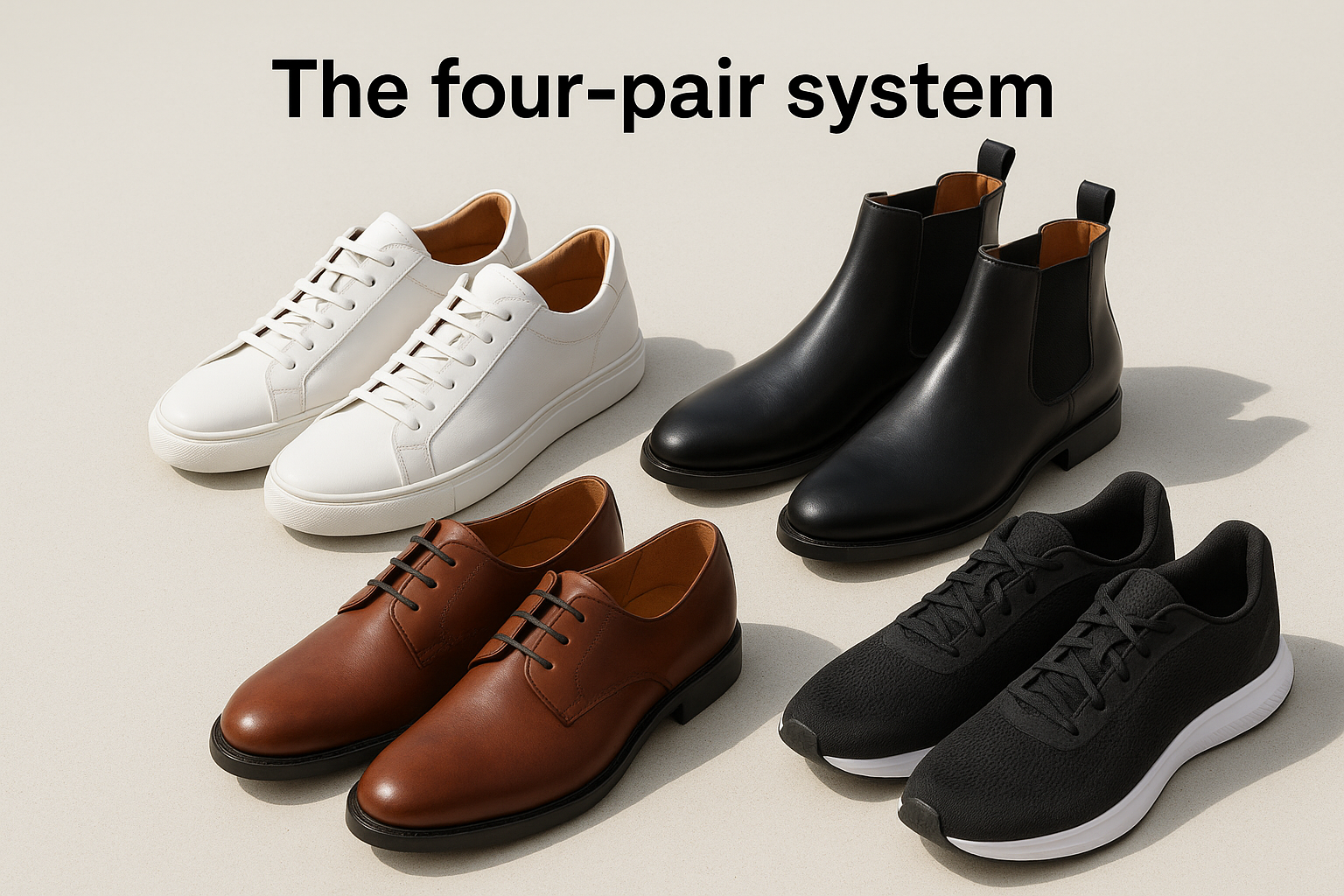
| Shoe type | Best for | Ideal material |
|---|---|---|
| White leather sneakers | Everyday, casual weekends | Full-grain leather |
| Chelsea boots | Fall/winter, business casual | Leather or suede |
| Derby or oxford dress shoes | Office, formal occasions | Leather |
| Running or training shoes | Workouts, errands | Mesh or knit |
A clean pair of white leather sneakers does more work than any other shoe in this list, since it pairs with jeans, chinos, and even tailored trousers on a casual Friday. If you only buy one pair this year, make it that one.
One pair of well-made white sneakers will outdress three pairs of trendy shoes you'll stop wearing by next season.
Buy for the sole, not just the upper
Cheap shoes fail at the sole long before the leather wears out, so check construction before you check the color. A Goodyear-welted or Blake-stitched sole can be resoled, which means a $200 pair of oxfords can last a decade with occasional cobbler visits, while a glued sole gets tossed the moment it separates. The Federal Trade Commission's care labeling rules require accurate material disclosure, so check the label for full-grain leather versus "leather-look" synthetics before you buy.
Match shoes to your existing palette
Stick to brown and black leather for dress shoes and boots, plus white for sneakers, since those three colors run through every pairing you built in Step 2. Avoid colored sneakers or patterned boots unless they genuinely reflect your accent color choices, because a shoe that only matches one outfit breaks the math that makes a capsule wardrobe function. Rotate pairs daily rather than wearing the same shoes two days straight, since letting leather and cushioning rest between wears extends the life of every pair by months, sometimes years.
Step 6. Round it out with key accessories
Accessories finish a capsule wardrobe, but they also cause the most closet clutter if you let them multiply unchecked. Keep this category small and deliberate, since a drawer full of ties, belts, and watches you never reach for defeats the whole purpose of the system you've built so far. Five or six well-chosen pieces cover nearly every situation a capsule wardrobe needs to handle, and each one should earn its place the same way a shirt or jacket did in earlier steps.
The essential five
Start with the pieces that see daily use before adding anything decorative. A reversible leather belt in brown and black saves you from buying two separate belts, and it matches every pair of shoes from Step 5 without extra thought. Add one quality watch with a leather or metal band that works from the office to dinner, since a single versatile piece beats a drawer of novelty watches you'll wear twice.
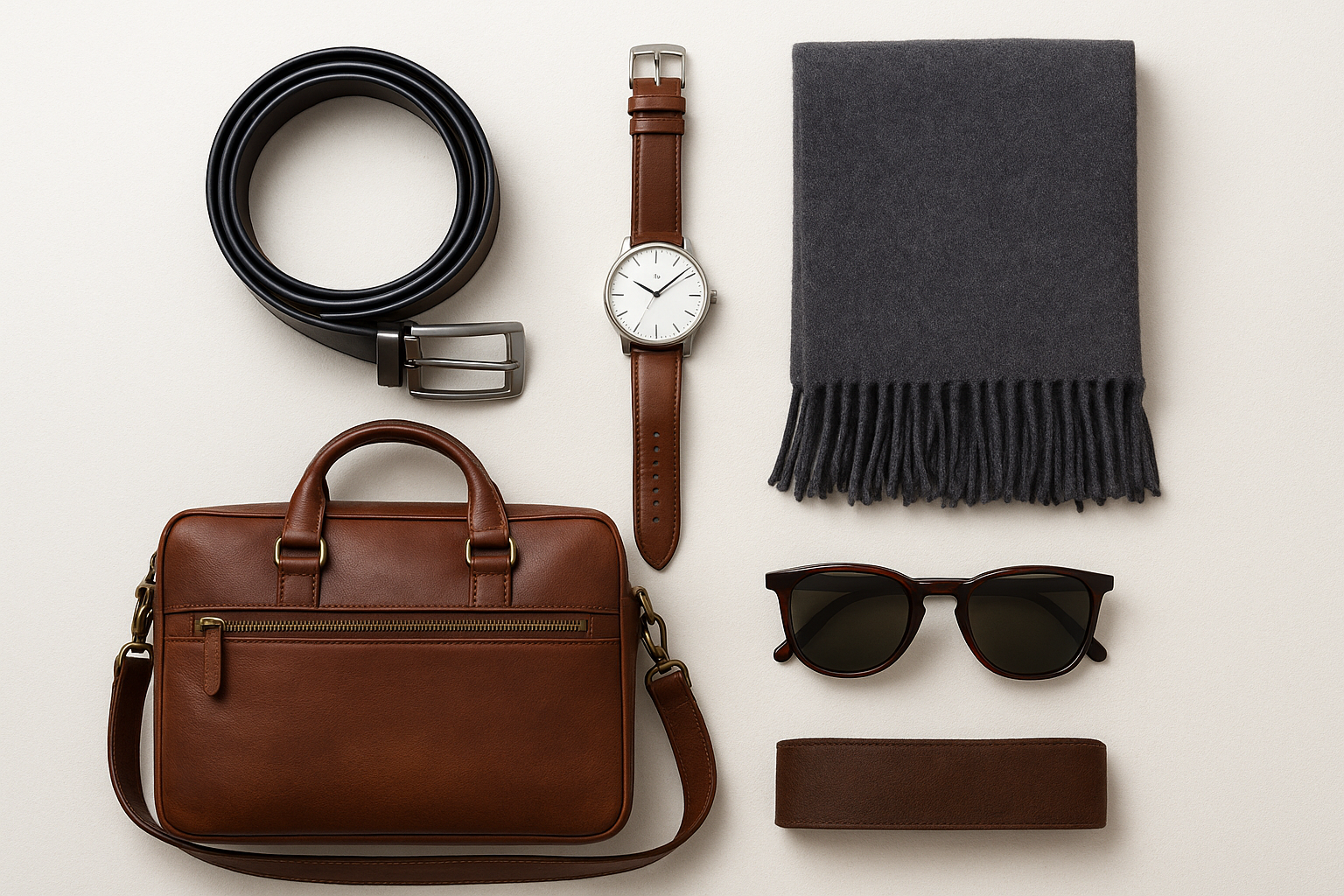
- Reversible belt (brown/black) for dress shoes and boots
- One versatile watch with a leather or metal band
- Wool scarf in a neutral or accent color for cold months
- Structured leather bag or backpack for commuting and travel
- Sunglasses with a classic frame shape that won't date quickly
An accessory earns its spot by matching everything, not by standing out on its own.
Cold-weather accessories
Winter accessories deserve their own short list, since a scarf, gloves, and a beanie in the wrong color will clash with the palette you locked in during Step 2. Choose a wool scarf in charcoal, navy, or your chosen accent color, and pick leather gloves in brown or black to match your belt and shoes. A ribbed beanie in a neutral tone rounds this out without adding a fourth color to track. These three pieces cost little compared to a jacket, but they extend the wearability of your existing outerwear through the coldest months.
Bags that actually get used
A single well-made bag replaces the backpack, tote, and duffel most men accumulate without ever fully using any of them. Look for full-grain leather or waxed canvas construction, since both materials age well and hide scuffs better than synthetic alternatives. One bag that transitions from commuting to weekend travel does more real work than three specialized options gathering dust in a closet. If you travel often, a slightly larger structured bag that still reads as professional will outperform a dedicated laptop bag and a separate weekend bag combined, cutting your accessory count without cutting function.
Before adding any accessory to your rotation, run it through the same filter you used for clothing: does it pair with at least three other items you already own? If the answer is no, it's decoration, not a functional piece of your capsule.
Step 7. Adapt your wardrobe to the seasons
A true capsule wardrobe doesn't mean wearing the exact same 35 pieces in January and July. Seasonal rotation is what keeps your capsule functional year-round without doubling its size. The trick is swapping fabric weight and layering depth while keeping the same color palette and silhouettes you locked in earlier. You're not building a second wardrobe, you're adjusting the one you already have.
Swap weight, not color
The cleanest way to handle seasons is rotating heavier and lighter versions of the same items rather than buying entirely new categories. A 300g Supima cotton tee that anchors your summer rotation gets layered under a flannel or sweater once temperatures drop, so the same piece works twice as hard across two seasons. Fabric weight is the lever here, not a new color or cut, which keeps everything matching what you already built in Step 2.
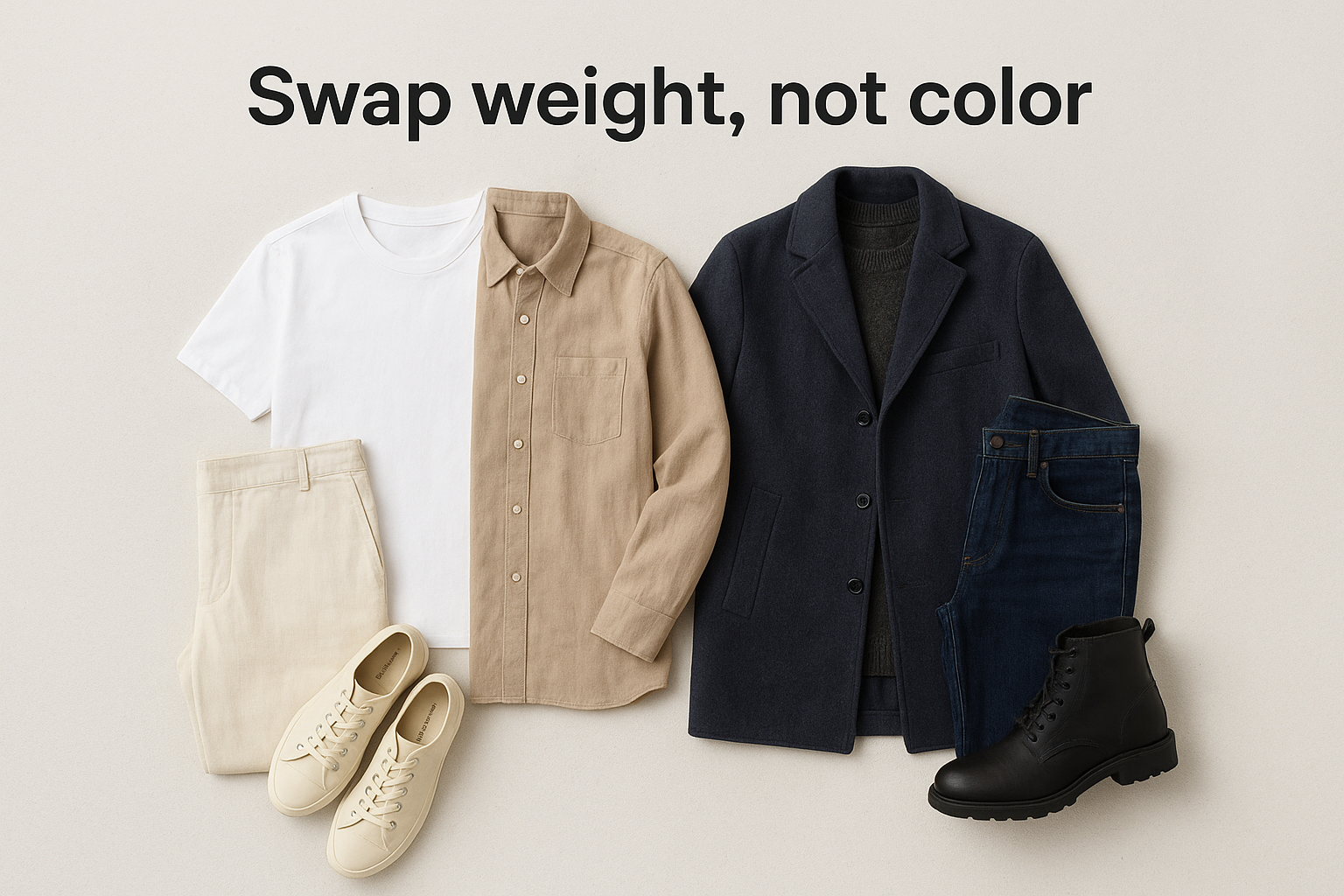
| Season | Swap in | Swap out |
|---|---|---|
| Summer | Lightweight tees, linen shirts, canvas sneakers | Wool sweaters, heavy overcoats |
| Winter | Merino knitwear, wool overcoat, leather boots | Short-sleeve tees, canvas shoes |
| Spring/Fall | Light layers, field jacket, chinos | Extreme heavyweight or lightweight pieces |
The best capsule wardrobes don't grow with the seasons, they rotate.
Store what you're not wearing
Once a season ends, store the off-season pieces instead of leaving them mixed into your everyday rotation. A vacuum bag or a separate shelf for winter knitwear keeps your active closet lean, which matters since decision fatigue creeps back in the moment you're staring at 50 items instead of 35. This also protects fabric, since heavy wool stored properly during summer humidity lasts longer than wool left hanging in a crowded closet all year.
Build a transitional layer for shoulder seasons
Spring and fall are where most capsule wardrobes break down, since the temperature swings 20 degrees between morning and afternoon. Solve this with two or three transitional pieces you can add or remove without changing the outfit underneath: a field jacket over a tee, a light sweater under a shell. These pieces do double duty across three seasons instead of one, which is exactly the kind of overlap a capsule wardrobe rewards. Keep a mental note of which combinations worked last year, since shoulder-season dressing rewards repetition more than any other stretch of the calendar.
Making your capsule wardrobe last
You now have a real process: audit what you own, lock a color palette, fill in tops and bottoms, layer smart, and round it out with shoes and accessories that actually match. That's how to build a capsule wardrobe men stick with for years, not a Pinterest board you abandon by March. The system only holds up if the pieces underneath it do, which is why fabric and construction matter as much as the plan itself.
Start small if you need to. Replace one worn-out tee with a heavier, better-made version, then build outward from there instead of buying everything at once. A 300g Supima cotton tee that survives fifty washes without stretching out is the kind of foundation piece worth starting with. Shop the SÖMNAD tee and see what a capsule wardrobe feels like when the basics are actually built to last.