


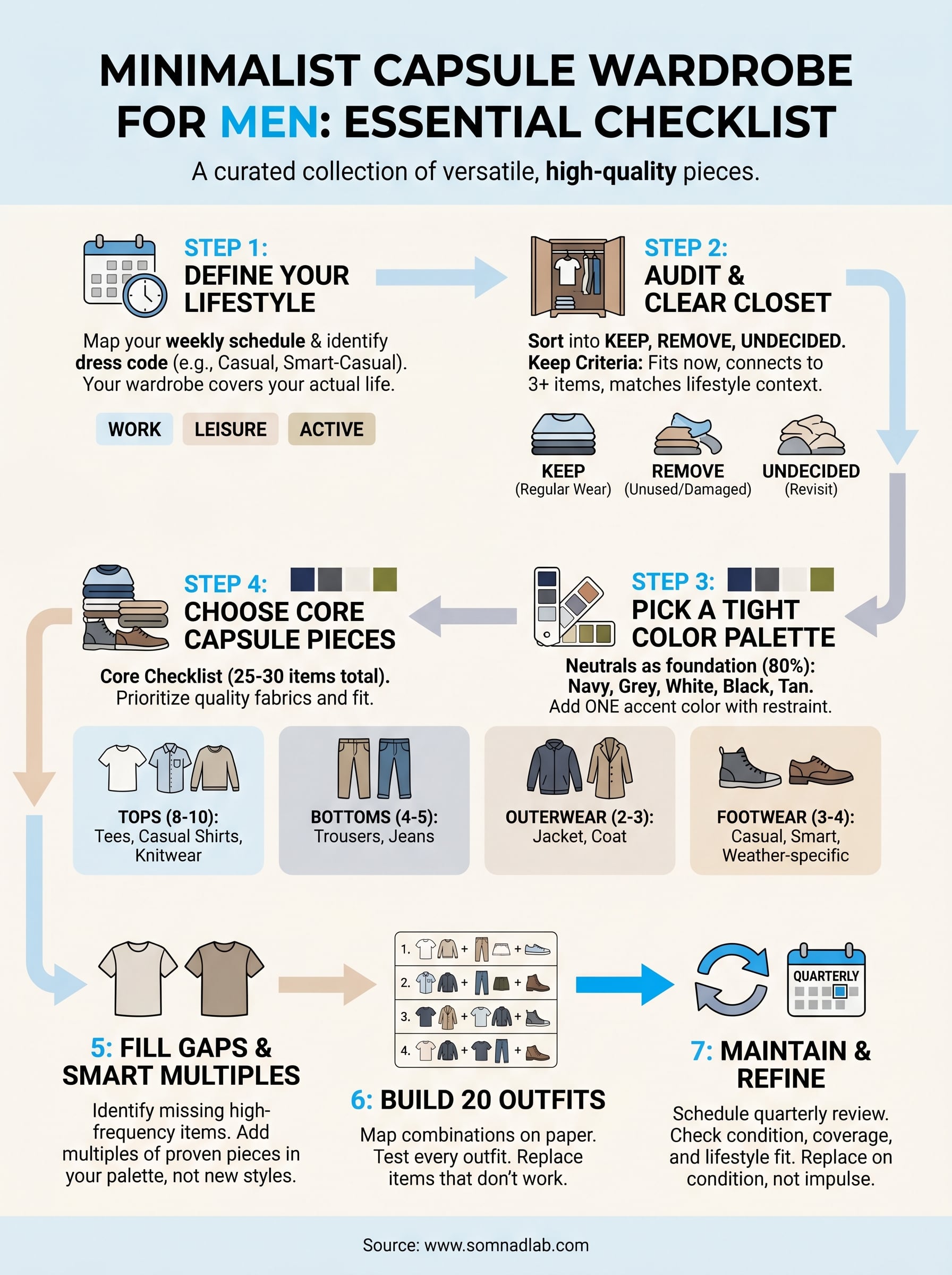
Most men own far more clothes than they actually wear. A handful of items get picked up on repeat while the rest collects dust. A minimalist capsule wardrobe for men strips away that dead weight and replaces it with a tight rotation of versatile, high-quality pieces that work together without effort.
The challenge isn't just owning fewer clothes, it's owning the right ones. That means knowing exactly how many tees, pants, jackets, and shoes you need, what materials to prioritize, and how each piece connects to everything else in your closet. Get this wrong and you end up with gaps. Get it right and getting dressed takes about thirty seconds, every single day.
This guide gives you a complete checklist for building a capsule wardrobe from scratch, specific item counts, fabric recommendations, and the reasoning behind each pick. At SÖMNAD, we design premium everyday essentials built on the same principle this whole approach runs on: less, but better. Fewer items, superior materials, no logos or filler. That philosophy shapes everything below, so whether you're starting fresh or trimming down what you already own, you'll walk away with a clear, actionable plan.
What a minimalist capsule wardrobe is
A minimalist capsule wardrobe is a curated collection of versatile clothing pieces that all work together, covering every situation you actually face without duplication or filler. The concept dates back to the 1970s when London boutique owner Susie Faux coined the term to describe a core set of timeless, high-quality items that wouldn't go out of style. Instead of a closet packed with impulse buys and forgotten purchases, you own a smaller number of pieces you genuinely reach for every day.
For men specifically, a minimalist capsule wardrobe typically lands between 25 and 40 items total, covering tops, bottoms, outerwear, footwear, and basics. That number feels tight if you're used to a full closet, but it works because every single item earns its place. Nothing sits unused. Every piece connects to at least three or four other items in the collection, which multiplies your outfit options dramatically without multiplying what you own.
The difference between minimalism and just owning less
Owning fewer clothes doesn't automatically make a capsule wardrobe. You could own ten items that don't work together at all and end up with fewer outfit options than someone with forty well-chosen pieces. The key distinction is intentional selection: every item you keep should serve a clear purpose and combine with the rest of your wardrobe without friction. That's what separates a capsule from a half-empty closet.
A capsule wardrobe isn't about restriction. It's about removing decisions that don't matter so you can focus on the ones that do.
Think of it as a system rather than a number. A navy crewneck, a white tee, and charcoal chinos can generate more outfits than a drawer full of pieces that clash with everything else. The goal is cohesion and utility, not minimalism for its own sake.
What counts as a capsule piece
A piece earns its spot in a minimalist capsule wardrobe men build when it passes three tests. First, it needs to work in at least three different outfit combinations you'd actually wear. Second, it should be made from a durable, quality material that holds its shape and color after repeated washing. Third, it needs to fit your real life, not a version of your life you're hoping to have.
| Test | What to ask |
|---|---|
| Versatility | Does it combine with at least 3 other pieces you own? |
| Quality | Will it look the same after 50 washes? |
| Relevance | Do you wear it at least once a week in a typical month? |
If a piece fails any one of these, it's a candidate for removal regardless of what it cost or how long you've owned it. Sentimental attachment and sunk-cost thinking are the two biggest reasons men end up with cluttered closets despite genuinely wanting to simplify.
The typical capsule breakdown
A practical capsule for most men organizes around five categories: tops, bottoms, outerwear, footwear, and accessories. Within each category, you keep only what you actually rotate through on a regular basis. A starting framework looks like this:
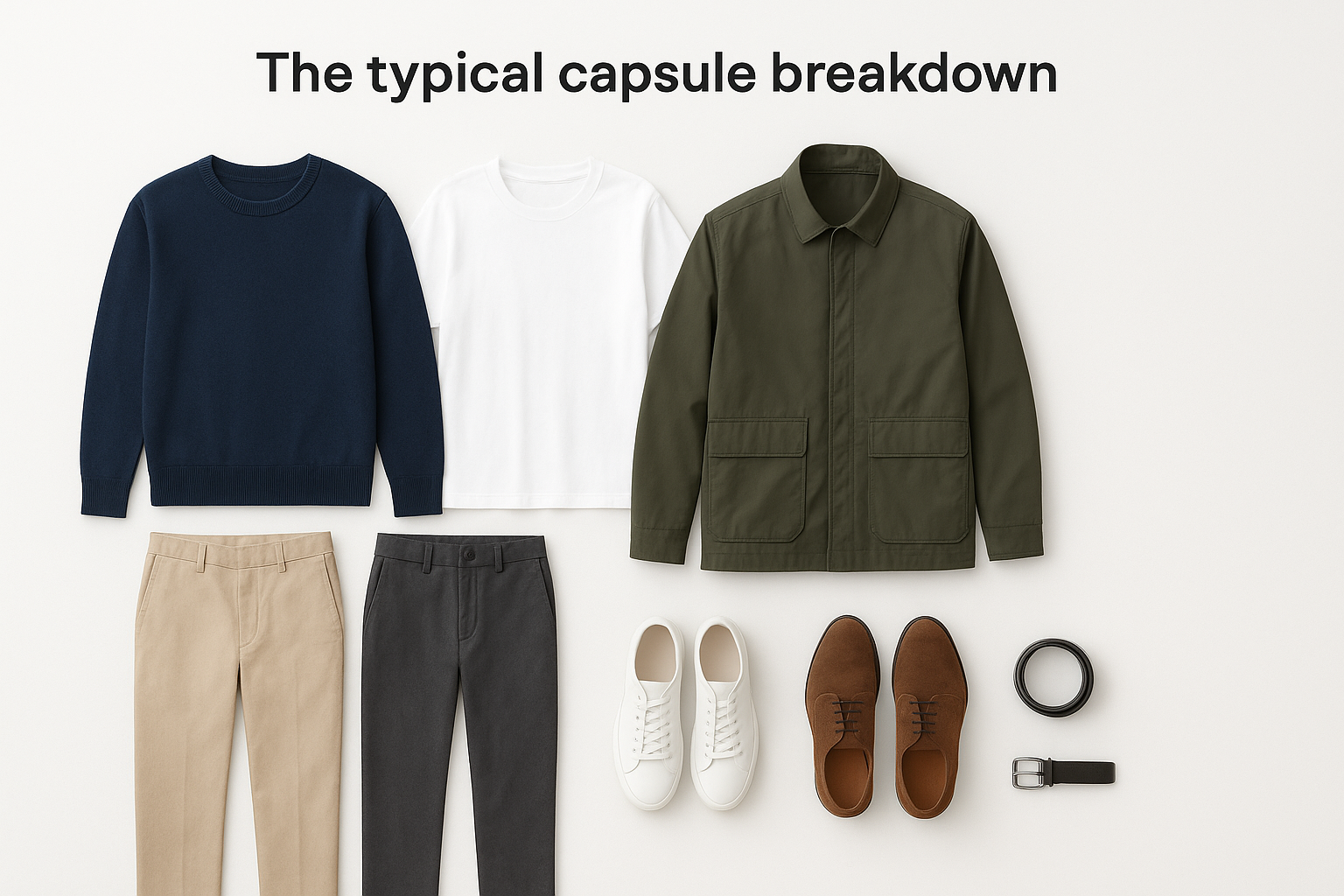
- Tops: 8 to 10 items (tees, casual shirts, knitwear)
- Bottoms: 4 to 5 items (trousers, jeans, shorts if your climate calls for them)
- Outerwear: 2 to 3 items (a jacket, a coat, and an optional mid-layer)
- Footwear: 3 to 4 pairs (casual, smart-casual, and one weather-specific option)
- Accessories: 2 to 3 items (belt, watch, bag)
That puts you at roughly 23 to 30 pieces before accounting for climate-specific additions. These numbers flex based on your lifestyle and dress code, which is exactly what Step 1 walks you through.
Step 1. Define your lifestyle and dress code
Before you pull a single item from your closet, you need to understand how you actually spend your time. Most men who try to build a minimalist capsule wardrobe men are proud of skip this step and end up with a collection that looks clean on paper but doesn't serve their real life. Your wardrobe exists to cover your actual schedule, not an idealized version of it.
Map your weekly schedule
The fastest way to get this right is to track a typical week by writing down what you do each day and what you wear. You don't need a spreadsheet; a simple note on your phone works fine. What you're looking for is the distribution of your time across different contexts: work, exercise, errands, social events, and anything else that shows up regularly.
Use this template:
| Context | Days per week | Dress requirement |
|---|---|---|
| Office or workplace | ||
| Remote work or home | ||
| Gym or outdoor activity | ||
| Casual social (bars, dinners) | ||
| Formal events | ||
| Errands and weekends |
Fill this in honestly. If you work from home four days a week and visit an office once, your capsule should skew heavily toward casual and smart-casual pieces, not office-first items that only get worn occasionally.
Identify your dress code
Once you know where your time goes, you can match your capsule categories to those contexts. Four basic dress code tiers cover most men: casual, smart-casual, business casual, and formal. The goal is to cover every tier you genuinely use and skip the ones you don't.

A capsule built around a dress code you don't actually live produces the same result as a cluttered closet: pieces you never reach for.
For most men working in relaxed or hybrid environments, a sensible split looks like this:
- Casual (50 to 60% of your pieces): tees, relaxed trousers, clean sneakers
- Smart-casual (25 to 30%): chinos, a structured shirt, leather or suede footwear
- Business casual or formal (10 to 20%): only include these if your schedule genuinely calls for them
Knowing this distribution before you choose specific items prevents the most common capsule mistake: buying pieces that don't connect to your real daily rotation. Every item you add from Step 4 onward should map back to at least one context you identified here.
Step 2. Audit and clear your closet
The audit is where most men stall. Pulling everything out feels overwhelming, so they skip it and try to add new pieces on top of an existing mess. Don't do that. A clear, honest look at what you currently own is the only foundation a minimalist capsule wardrobe men can actually build on long-term. Pull everything out of your closet, drawers, and storage boxes and lay it flat on your bed or floor so you can see every single item at once before making a single decision.
Sort into three piles
Start by creating three distinct groups: keep, remove, and undecided. Don't agonize over individual items at this stage. Move quickly and trust your gut reaction. The "keep" pile holds items you reach for regularly and genuinely enjoy wearing. The "remove" pile holds anything worn out, ill-fitting, or untouched for six months or more. The "undecided" pile gets revisited at the end, not mid-sort, so you can maintain momentum through the whole closet without getting stuck on one piece.
| Condition | Pile |
|---|---|
| Worn regularly, fits well, good condition | Keep |
| Worn fewer than 3 times this year | Remove |
| Worn occasionally, unsure about fit or function | Undecided |
| Damaged, faded, or misshapen | Remove |
| Fits a lifestyle context from Step 1 | Keep |
Apply the keep criteria
Once you have your three piles, go back to the "keep" and "undecided" groups and hold each item against three direct questions. Does it fit your body right now, not ten pounds from now? Does it connect with at least three other items you're keeping? Does it match at least one context you mapped out in Step 1?
If an item fails any one of these questions, it leaves the closet regardless of what you paid for it.
Any item that clears all three stays. Anything that doesn't moves to the remove pile. Your undecided items will almost always fall into the remove category once you apply this filter honestly and without negotiation.
Remove items the right way
Clearing your closet isn't just about deciding what goes. How you handle removal matters because it makes the decision feel final and breaks the habit of pulling things back out weeks later. Pack removed items into bags immediately after completing the audit and donate, sell, or dispose of them within 48 hours. The longer those bags stay in your home, the higher the chance you'll second-guess yourself and undo the whole process.
Step 3. Pick a tight color palette
Color is the invisible architecture of a minimalist capsule wardrobe men build that actually functions under pressure. When every item you own shares a common color logic, you can grab pieces at random and they combine without thought. When your closet has no color system, you end up making decisions that eat into exactly the time and energy a capsule is supposed to save you. Pick your palette before you buy a single new piece, and treat it as a firm constraint, not a loose preference you adjust whenever something catches your eye.
Start with neutrals as your foundation
Neutrals carry the majority of the work in any effective palette. Navy, white, black, charcoal grey, and tan cover the vast majority of combinations you'll need without clashing against each other. A practical starting point is to choose two to three core neutrals that you actually gravitate toward in your existing wardrobe, not colors you think you should like. If you rarely reach for black but consistently wear navy, build from navy. Your palette should reflect real behavior, not aspiration.
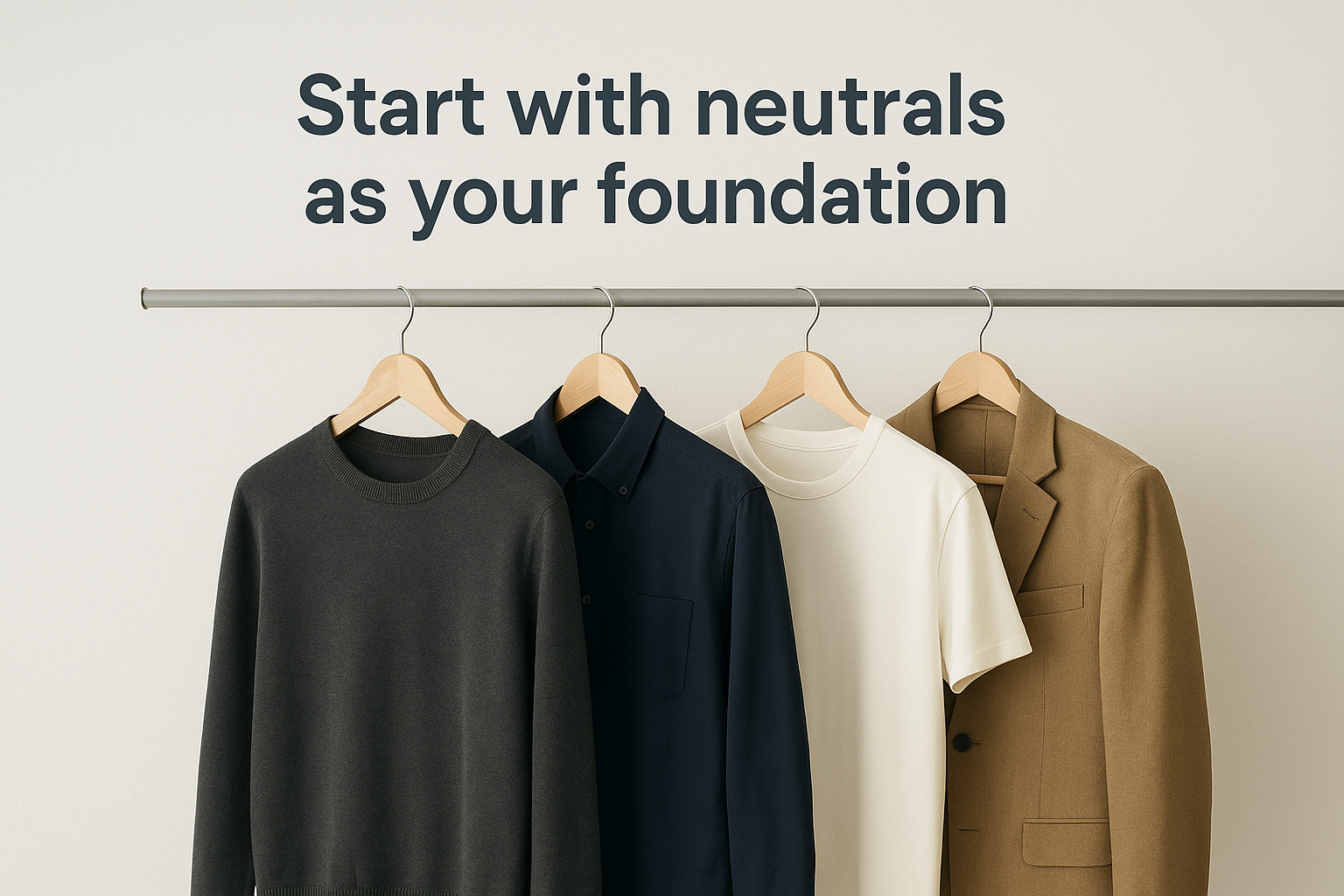
Your neutrals should account for at least 80% of every item in your capsule.
A solid three-color neutral base might look like this:
| Role | Color |
|---|---|
| Primary neutral | Charcoal grey |
| Secondary neutral | Navy |
| Light neutral | Off-white or ecru |
This combination works across every season and every dress code tier you mapped out in Step 1, which makes it a strong foundation for most men regardless of lifestyle.
Add one accent color with restraint
One accent color gives your capsule a point of difference without breaking the system. Olive, camel, burgundy, and slate blue all sit close enough to neutral territory that they integrate without friction. Pick one accent only, and apply it selectively to two or three pieces at most, typically a casual overshirt, a trouser, or a knit layer. That single addition provides enough visual variation across your outfits without creating pieces that only work in one specific combination.
Check every new item against your palette
Before anything enters your capsule, hold it against your established colors. If it combines cleanly with at least three pieces you already own, it qualifies. If it requires you to purchase additional items just to make it work, it doesn't belong in the collection. A single off-palette item creates a ripple effect that forces more purchases and gradually unravels the system you built across the previous two steps. Run this check every time, without exception, and you'll keep your capsule tight and functional long-term.
Step 4. Choose your core capsule pieces
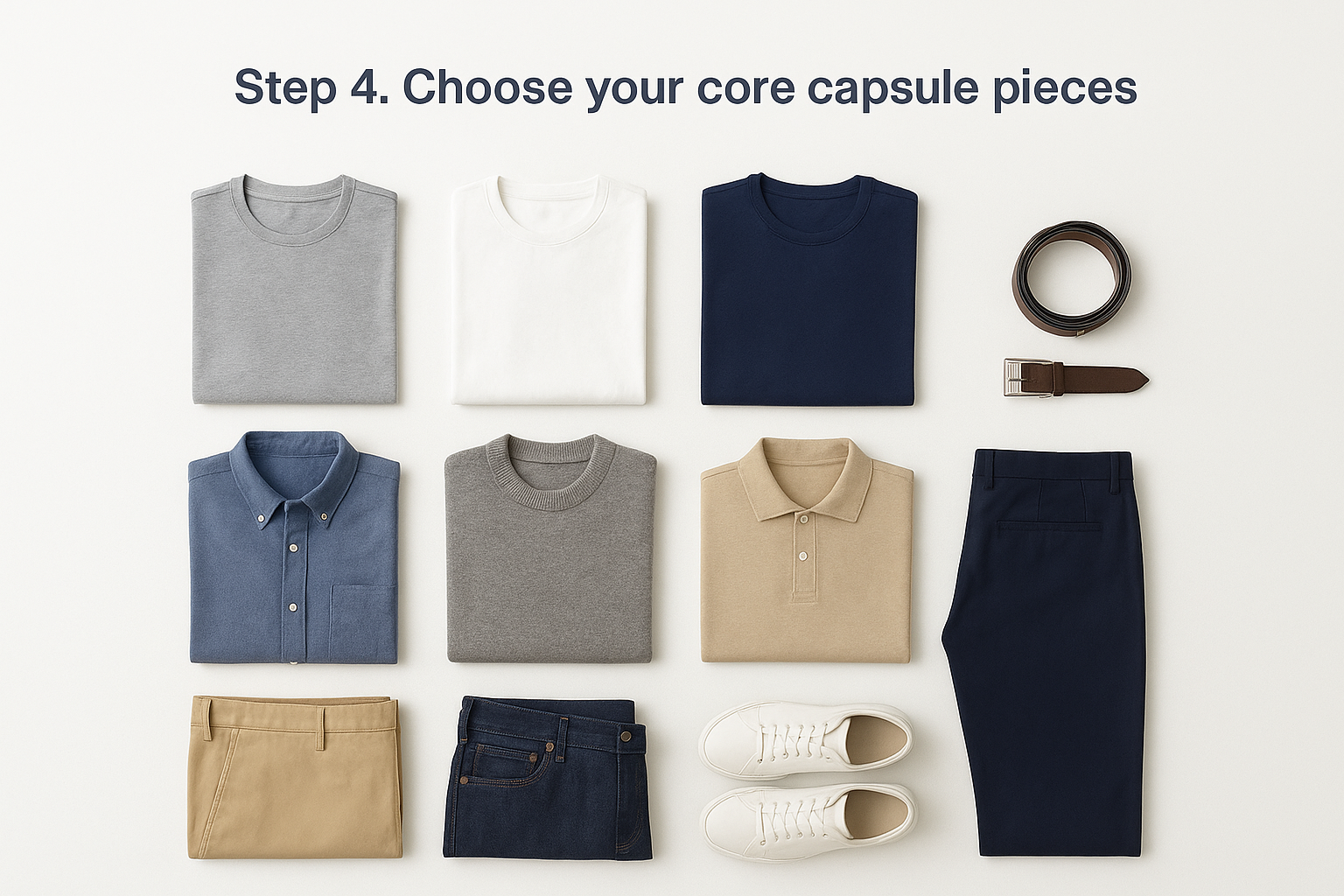
This is where your capsule takes shape. Every decision you've made in the previous three steps feeds directly into this one: your lifestyle context, your cleared closet, and your color palette all determine which pieces actually belong here. The core of any minimalist capsule wardrobe men build that functions consistently comes down to 25 to 30 specific items distributed across five categories. Use the framework below as your starting checklist, then trim or adjust based on what your Step 1 lifestyle audit revealed.
Tops: the foundation of daily wear
Tops take up the most slots in your capsule because they're the most visible part of your outfit and the category where quality differences show up fastest. Prioritize fabrics that hold their shape through repeated washing, specifically heavyweight cotton (280g or above), merino wool, or a quality linen depending on your climate. A well-made tee in 300g Supima cotton, for example, drapes cleanly, doesn't shrink, and maintains structure wash after wash in a way that cheaper alternatives simply don't.
The fabric weight and fiber quality of your tops determines how long your capsule stays functional before items need replacing.
Your top allocation should look like this:
| Item | Quantity | Notes |
|---|---|---|
| Plain crew-neck or v-neck tees | 3 | Your two core neutrals + one accent or light neutral |
| Long-sleeve tees | 2 | Layer under shirts or wear alone |
| Casual button-up shirt | 2 | One solid, one subtle texture |
| Crewneck knit or sweatshirt | 2 | Mid-layer for cooler months |
| Polo or smart casual shirt | 1 | Covers smart-casual context from Step 1 |
Bottoms, outerwear, and footwear
Bottoms require the fewest pieces relative to the outfit combinations they generate, which makes quality a sound investment here. Two pairs of well-fitting chinos in different neutrals, one pair of dark indigo jeans, and a tailored casual trouser cover nearly every context you mapped in Step 1 without redundancy. Fit is non-negotiable in this category: a slightly wrong rise or leg width undermines even the best fabric.
For outerwear, keep it to two or three pieces at most: a versatile overshirt or light jacket, a heavier coat for cold months, and an optional weatherproof layer if your climate demands it. Footwear follows the same logic. Three to four pairs, a clean white or minimal sneaker, a leather or suede casual shoe, and one weather-resistant boot, cover every outfit combination your capsule produces without excess.
| Category | Item count | Priority |
|---|---|---|
| Bottoms | 4 to 5 | Fit first, fabric second |
| Outerwear | 2 to 3 | Versatility across dress codes |
| Footwear | 3 to 4 | One per context from Step 1 |
| Accessories | 2 to 3 | Belt, watch, or bag only if used daily |
Step 5. Fill gaps with smart multiples
After completing your core checklist in Step 4, your capsule may still have functional gaps: outfit combinations that break down because one category is under-represented or a single high-frequency item carries too much load. Smart multiples solve this without bloating your wardrobe. A multiple isn't a duplicate for its own sake; it's a second version of a piece that earns significant rotation because your lifestyle demands it, not because you couldn't decide between two options.
Identify what's missing
Before you buy anything, run a simple gap check against your Step 1 lifestyle map. Look at your highest-frequency contexts and count how many pieces you have covering each one. If you work from home five days a week and only own two tee shirts, washing cycles alone will degrade those items faster than any other part of your wardrobe. A gap is any context where fewer than two items cover the same functional role, because a single piece with no backup creates both a care problem and a coverage problem.
Use this template to run your gap check:
| Context (from Step 1) | Items covering it | Gap? |
|---|---|---|
| Daily casual | ||
| Smart-casual | ||
| Outerwear | ||
| Active or outdoor | ||
| Formal (if applicable) |
Any row with fewer than two items in your most-used contexts is a confirmed gap worth filling.
How to buy smart multiples
Once you know where the gaps are, buy the same item in a different color within your palette rather than introducing a new silhouette. If your plain crew-neck tee earns daily rotation, a second version in your other core neutral adds outfit variation without adding complexity to the system. The same logic applies to bottoms: a second pair of well-fitting chinos in a different neutral doubles your outfit count without requiring any new decision-making when you get dressed.
Adding multiples of proven pieces compounds your wardrobe's output without compounding the mental load of owning more.
Resist the pull toward buying an entirely new item type just to fill a gap. If your capsule feels thin on smart-casual options, the answer is usually one additional item in that tier, not three. One deliberate addition at a time keeps your minimalist capsule wardrobe men build tight and prevents the slow drift back toward a cluttered, incoherent closet.
Step 6. Build 20 outfits from your capsule
Owning the right pieces isn't enough if you never prove the system works. Building 20 outfits from your capsule before you need them forces you to verify that every item earns its place and exposes any remaining gaps before they cost you a rushed morning decision. This step turns your carefully selected pieces into a tested, reliable rotation rather than a theoretical checklist.
Map combinations on paper first
Before you open your closet, write down every item you kept from Steps 4 and 5 grouped by category: tops, bottoms, outerwear, footwear. Then start combining them systematically across categories rather than pulling together outfits you already default to. The goal is to surface combinations you wouldn't normally reach for, which is exactly where a well-built minimalist capsule wardrobe men construct tends to generate the most value. A pairing you've never tried often turns out to be a reliable go-to once you actually see it together.
Mapping outfits in advance removes the last source of daily decision fatigue that a capsule is designed to eliminate.
Use a simple grid format:
| Outfit | Top | Bottom | Outer layer | Footwear |
|---|---|---|---|---|
| 1 | White tee | Charcoal chinos | None | White sneaker |
| 2 | White tee | Dark jeans | None | Leather shoe |
| 3 | White tee | Charcoal chinos | Overshirt | Sneaker |
| 4 | Long-sleeve tee | Dark jeans | None | Boot |
| 5 | Long-sleeve tee | Casual trouser | Knit layer | Leather shoe |
| 6 | Casual shirt | Chinos | None | Leather shoe |
| 7 | Casual shirt | Dark jeans | None | Boot |
| 8 | Casual shirt | Chinos | Coat | Leather shoe |
| 9 | Knit or sweatshirt | Dark jeans | None | Sneaker |
| 10 | Knit or sweatshirt | Casual trouser | Coat | Boot |
| 11 | Polo | Chinos | None | Leather shoe |
| 12 | Polo | Dark jeans | Overshirt | Sneaker |
| 13 | Second tee | Casual trouser | Knit layer | Boot |
| 14 | Second tee | Dark jeans | None | Sneaker |
| 15 | Second tee | Chinos | Coat | Leather shoe |
| 16 | Long-sleeve tee | Chinos | Overshirt | Boot |
| 17 | Button-up | Casual trouser | None | Leather shoe |
| 18 | Button-up | Dark jeans | Knit layer | Boot |
| 19 | Polo | Casual trouser | Coat | Leather shoe |
| 20 | Knit layer | Chinos | None | Sneaker |
Fix what doesn't work before you need it
Run through each row and physically try on any combination you're uncertain about. If a pairing doesn't hold up in practice, note why: wrong fit relationship between the top and bottom, footwear that pulls the outfit in the wrong direction, or a color clash your palette check missed. Replace the underperforming item rather than keeping it and working around it. A capsule that produces 20 confirmed, wearable outfits from roughly 25 to 30 pieces is operating exactly as it should.
Step 7. Maintain and refine your capsule
Building a strong capsule is a one-time effort; keeping it functional is an ongoing habit. Without a maintenance routine, small additions accumulate, items degrade without replacement, and you drift back toward the cluttered closet you started with. The good news is that maintaining a minimalist capsule wardrobe men refine over time takes less effort than building it in the first place, as long as you treat it as a scheduled practice rather than something you'll handle whenever it feels necessary.
Schedule a quarterly review
Set a specific date on your calendar four times a year to audit your capsule, ideally at the start of each season. This review doesn't require pulling everything out the way your initial audit did. Instead, work through a short checklist that covers the three areas most likely to drift: item condition, outfit coverage, and lifestyle fit. A 20-minute review on a fixed schedule prevents the slow accumulation of pieces that no longer belong.
Use this quarterly review checklist:
| Review area | Question to ask |
|---|---|
| Condition | Does each item still hold its shape and color? |
| Coverage | Do your 20 outfits from Step 6 still hold up? |
| Lifestyle fit | Has your weekly schedule changed since Step 1? |
| Color palette | Did any off-palette item enter your closet? |
| Multiples | Are any high-frequency items approaching end of life? |
A capsule that gets reviewed on a schedule stays tight. One that gets reviewed only when it feels broken is already broken.
Replace items on condition, not calendar
When an item fails the condition check, replace it immediately rather than waiting for a natural shopping window. Delaying replacement leads to wearing a degraded piece that pulls your outfits down, which is exactly the slow quality erosion a capsule is designed to prevent. When you replace a piece, buy the same item you already know works before considering an alternative. If your heavyweight cotton tee has held up through two years of weekly wear, replacing it with an identical version is a better decision than experimenting with something new.
Refinement works on the same logic. If your lifestyle changes significantly, for example a new job or a move to a different climate, revisit Step 1 before making any additions rather than reacting to the change by buying pieces impulsively. One focused update to your lifestyle map produces a targeted, deliberate list of what to add or remove. That process keeps your capsule aligned with your actual life rather than a version of it that no longer exists.
Next steps
You now have a complete system for building a minimalist capsule wardrobe men can rely on every day. Start with Step 1 this week, map your actual schedule honestly, and work through each step in order rather than skipping ahead to buying new pieces. The audit and palette steps do more work than most people expect, and rushing past them produces the same cluttered result you started with.
Once your capsule is built, schedule your first quarterly review three months out so the maintenance habit starts immediately. A capsule that gets reviewed stays tight; one that gets ignored drifts. Every addition you make from this point forward should pass the same three tests: versatility, quality, and lifestyle fit.
For the premium everyday essentials your capsule needs as its foundation, pieces built on superior fabric and clean construction without logos or filler, visit SÖMNAD and see what belongs in your rotation.