


Most people own far more clothing than they actually wear. The average American has dozens of items sitting untouched in their closet, yet still feels like they have nothing to put on. Learning how to build a minimalist wardrobe solves that problem, not by restricting your options, but by making every piece count.
The idea is straightforward: own fewer clothes, but make sure each one earns its place. That means choosing pieces built from quality materials that hold up over time, not fast-fashion fillers you'll replace in three months. It means investing in versatile basics that layer well, mix easily, and look sharp without trying too hard. This is exactly the philosophy behind SÖMNAD, premium everyday essentials designed to be the foundation of a wardrobe you actually use. No logos, no excess, just fabric and fit done right.
This guide walks you through the entire process step by step. You'll learn how to audit what you already own, identify the core pieces every minimalist wardrobe needs, settle on a cohesive color palette, and build a capsule collection that works across seasons and occasions. Whether you're starting from scratch or trimming down an overstuffed closet, you'll finish with a clear framework to simplify your style for good.
What a minimalist wardrobe is and what counts
A minimalist wardrobe is a curated collection where every piece serves a clear purpose. It has nothing to do with owning the smallest number of items possible or stripping your style down to basics you hate. The real goal is a closet where you can reach in, pull something out, and build an outfit without hesitation. Quality replaces quantity as the deciding factor, and every item stays because it works, not because you forgot to remove it or feel guilty about what it cost.
The difference between minimalist and just having fewer clothes
Many people confuse a minimalist wardrobe with simply owning less. Those are not the same thing. You could reduce your closet to 15 items and still end up with 15 pieces that don't coordinate well, fit poorly, or wear out after a few months. A genuine minimalist wardrobe is built on intentionality. Each item earns its place by pairing with at least three other pieces you already own, fitting your actual daily life, and being made from materials that hold up through repeated washing and heavy use rather than losing shape after the first season.
A minimalist wardrobe isn't defined by a number. It's defined by how well each piece serves you.
Contrast that with someone who owns 70 items but keeps adding similar tops in slightly different shades because nothing ever feels quite right. The size of the closet is not the issue. The absence of a selection system is. When you understand how to build a minimalist wardrobe the right way, you build a framework for buying and keeping, not just a one-time decluttering session.
What counts as a minimalist wardrobe piece
Not every plain or neutral-toned item qualifies as a real minimalist wardrobe piece. A piece earns its place when it meets three criteria: it fits your lifestyle without requiring alterations to how you live, it pairs with the majority of what you already own, and it holds its construction over time. A 300g Supima cotton tee qualifies. A thin polyester shirt in a neutral color does not, regardless of how clean it looks on a hanger.
Here's a breakdown of the five core categories that make up a functional minimalist wardrobe:
| Category | Examples | Role |
|---|---|---|
| Core tops | Quality tees, fitted long-sleeves | Daily foundation |
| Bottoms | Straight-leg trousers, dark jeans | Versatile base |
| Layers | Structured jacket, lightweight knit | Adaptability across weather |
| Shoes | White sneakers, leather boots | Complete any outfit |
| Outerwear | Wool coat, simple parka | Seasonal utility |
Each category should contain only the pieces you actually reach for, not the ones you keep around for hypothetical occasions. If a category has more than two or three items doing the same job, that's a sign you're holding onto excess rather than curating with intent.
What doesn't belong
Knowing what to exclude matters just as much as knowing what to keep. Single-use pieces, meaning items you only wear to one type of event or in one very narrow context, add bulk without adding flexibility to your rotation. Trend-driven items that won't look intentional in two years are also out. The goal is timeless over trend-chasing, and that applies equally to silhouette, color, and the quality of what you buy.
Pieces that demand specific care conflicting with your real routine also don't belong. If you own dry-clean-only items you'd realistically never take to a cleaner, they will sit unworn and take up space. A wardrobe only works when you'll actually wear and maintain what's in it. Every item you keep should be something you'd reach for without thinking, not something you hold onto out of obligation.
Step 1. Define your lifestyle, climate, and style rules
Before you buy or remove a single item, you need a clear picture of how you actually live and what your wardrobe needs to support. This step is where most people skip ahead and end up building a capsule collection that looks good on paper but doesn't match real life. Knowing how to build a minimalist wardrobe that truly works starts with asking honest questions about your daily routine, your environment, and the aesthetic limits you want to hold to.
Map your actual daily life
Your wardrobe should reflect the life you live, not the one you imagine living. If you work remotely five days a week and spend weekends outdoors, building a wardrobe loaded with tailored trousers makes little practical sense. Spend five minutes writing out a typical week: where you go, what you do, and how dressed up each situation actually requires you to be. This snapshot becomes your filter for every decision that follows.
Use this simple template to map your lifestyle before you touch your closet:
| Context | Days per week | Dress level needed |
|---|---|---|
| Work (remote or office) | Casual / Smart casual / Formal | |
| Social outings | Casual / Smart casual | |
| Exercise or outdoor activity | Athletic / Rugged casual | |
| Travel | Versatile, packable | |
| Formal or special occasions | Dressed up |
Fill this in honestly. If formal occasions appear once or twice a year, they don't need three dedicated pieces in your core rotation.
Set your climate and style rules
Your local climate directly controls which categories and weights of fabric you actually need. Someone in Minneapolis needs real outerwear and layering pieces that can handle cold months. Someone in Austin needs breathable fabrics and lighter layers year-round. Write down your two or three dominant seasons and use that list to decide how many items from each category you actually need.
Your climate is non-negotiable. Your wardrobe needs to match the weather you live in, not the one that looks good in photos.
Style rules work the same way. Pick two or three words that describe the aesthetic you want to hold, such as clean, relaxed, and structured. Every piece you consider should pass that test. This gives you a fast rejection mechanism so you stop buying things that feel right in a store but never make it into rotation once they're home.
Step 2. Audit your closet and edit without a full purge
Pull everything out and put it somewhere visible. A full closet audit gives you an accurate picture of what you actually own rather than what you think you own. Most people discover they have multiples of the same item in slightly different versions, pieces they've never worn with tags still on, and basics worn so thin they've stopped reaching for them. Before you can learn how to build a minimalist wardrobe that holds up over time, you need an honest inventory of what your current collection actually contains.
Sort everything into three categories
Lay out every item and sort it into three clear groups: keep, remove, and hold. This approach prevents the all-or-nothing method that leads to regret purchases a few weeks later.
| Category | Criteria | What to do |
|---|---|---|
| Keep | Fits well, worn in the last 90 days, pairs with 3+ other items | Goes back in the closet |
| Remove | Doesn't fit, worn out, or untouched for over a year | Donate, sell, or discard |
| Hold | Seasonal, sentimental, or uncertain | Box it for 30 days |
The hold box is the most important tool in this process. Items you don't reach for in 30 days tell you everything you need to know: they don't belong in your rotation.
If you haven't worn it in a year and can't name three outfits it builds, it isn't earning its space.
How to decide what stays
A piece earns its place in your closet by passing two checks. First, it has to fit your body right now, not after some future change. Clothes that fit poorly get avoided regardless of quality or cost. Second, it has to work with at least three other pieces you're keeping. If you can't immediately name those combinations, the item is creating dead weight in your wardrobe.
Pay close attention to fabric condition during this step. A premium cotton tee that still holds its shape and weight belongs in the keep pile even if you've worn it frequently. A thin, pilling piece in a neutral color that looks clean on a hanger but loses structure the moment you put it on does not. The condition of a piece matters as much as its style when you're building a rotation meant to last.
Step 3. Choose a color palette you can actually mix
Your color palette is the architecture behind a wardrobe that actually works together. Without a defined palette, you end up with pieces that look fine on their own but refuse to coordinate as a group. This is one of the most practical steps in learning how to build a minimalist wardrobe, because a well-chosen palette turns a small collection into dozens of usable combinations without adding a single new item.
Build your palette around neutrals first
Neutrals do the heavy lifting in any functional minimalist wardrobe. White, black, navy, grey, and camel pair with nearly everything else in your closet, which means each neutral piece you own multiplies the outfit combinations available to you. Start by picking two or three neutrals that match your skin tone well and that you'll actually reach for consistently.
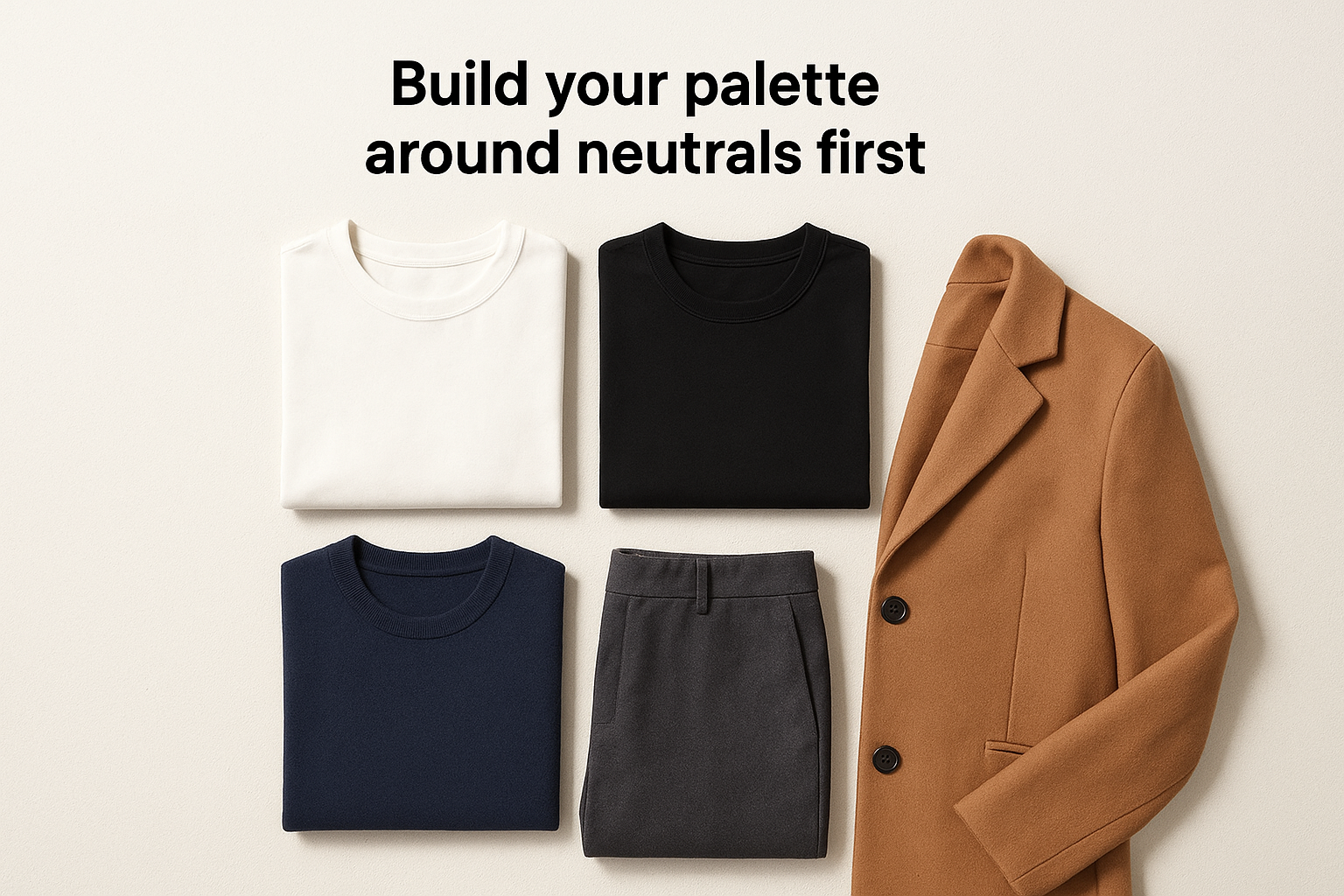
Your neutrals are not boring filler. They are the connective tissue that makes your entire wardrobe function.
Use this palette template as your starting point:
| Palette tier | Color options | Role in your wardrobe |
|---|---|---|
| Base neutrals | White, off-white, black, charcoal | Tops, bottoms, shoes |
| Soft neutrals | Navy, stone, camel, taupe | Layers, outerwear |
| Optional accent | Olive, burgundy, slate blue | One or two pieces max |
Keep your base neutrals as the majority of what you own, roughly 70 to 80 percent of your total collection. This ratio makes mixing effortless because almost any combination you pull together will work visually.
Add one accent tone with intention
Once your neutrals are in place, you can introduce a single accent tone that still coordinates across the rest of your palette. Olive, burgundy, and slate blue are strong choices because they read as understated rather than loud, and each one pairs naturally with the neutrals listed above. Pick one that genuinely appeals to you, not one that looks good in a color palette photo you saw somewhere online.
Limit your accent tone to one or two pieces total, such as a jacket or a long-sleeve layer. When you keep the accent rare, it adds visual contrast without creating coordination problems. If you find yourself wanting to add a second accent color, treat that as a signal to reassess your base neutrals first. A palette that requires constant additions usually means the foundation is not doing its job yet.
Step 4. Build your core staples, layers, and shoes
With your palette locked in and your closet cleared out, you can now build the actual foundation. This is where knowing how to build a minimalist wardrobe shifts from theory into a concrete shopping and selection process. Every item you add from this point forward should have a defined role, meaning it fills a gap in your five categories rather than duplicating what you already own.
Start with core tops and bottoms
Your tops and bottoms form the base layer of everything you wear, so quality of construction matters more here than anywhere else in your wardrobe. A well-made basic tee in heavyweight cotton, like a 300g Supima option, holds its shape and drape through repeated wear in a way that thinner alternatives simply do not. Pick two to three tops per neutral color you chose in your palette step and stop there.
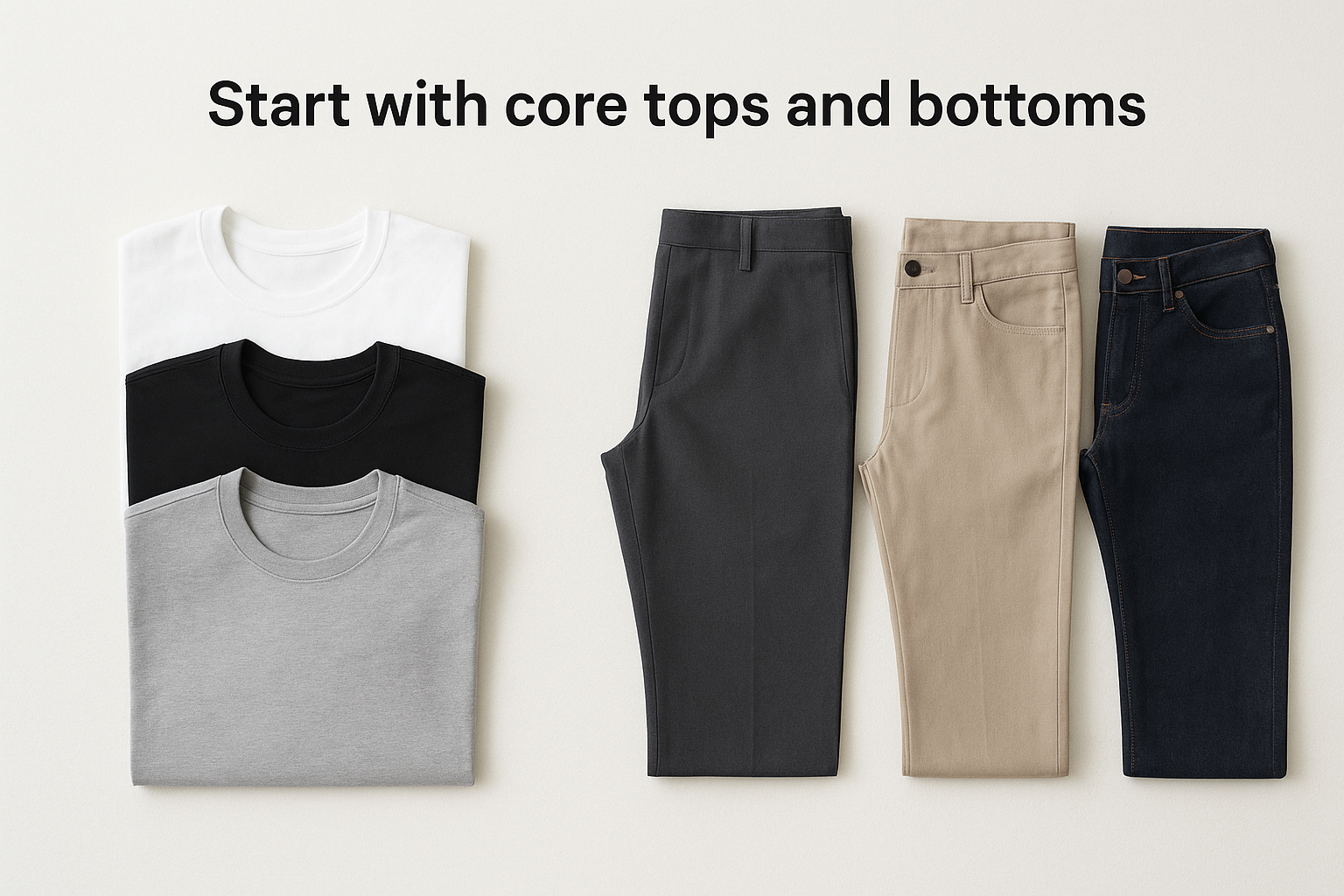
The difference between a rotation that feels endless and one that feels thin is almost always the quality of the base layer, not the number of pieces.
For bottoms, one pair of well-fitted straight-leg trousers in a dark neutral and one pair of clean dark jeans will cover the vast majority of your daily contexts. A second pair of trousers in a lighter neutral, like stone or camel, rounds out your bottom options without creating overlap.
| Item type | Recommended quantity | Suggested colors |
|---|---|---|
| Heavyweight tees | 3 to 4 | White, black, grey |
| Long-sleeve tops | 2 | White, navy |
| Straight-leg trousers | 2 | Charcoal, stone |
| Dark jeans | 1 | Indigo or black |
Build your layers deliberately
Layers give your wardrobe the flexibility to work across weather and dress levels without adding bulk. One structured jacket, one lightweight knit in a soft neutral, and one piece of outerwear suited to your actual climate cover nearly every situation. Avoid buying multiple items that perform the same thermal function just because they look slightly different.
Choose shoes that cover every context
Three pairs of shoes cover the full range of most minimalist wardrobes: white leather sneakers, clean leather boots or loafers, and one casual low-profile shoe for active days. Each pair should coordinate with your neutrals without requiring specific outfit planning. If a shoe only works with one or two pieces you own, it is not carrying its weight in the rotation.
Step 5. Create outfit formulas and a weekly rotation
Owning the right pieces is only half the work. Without a system for putting them together, even a well-curated collection leads to the same morning hesitation you were trying to avoid. Outfit formulas are the practical tool that makes understanding how to build a minimalist wardrobe pay off every day, turning your small collection into a reliable set of combinations you can cycle through without thinking.
Build your outfit formulas
An outfit formula is a repeatable structure, not a fixed set of pieces. It defines the pattern, such as "one tee, one layer, one trouser, one shoe," and lets you swap within your neutrals to create variations. Since every piece you kept already works with your palette, each swap produces a new outfit without breaking coordination. You don't need dozens of items to get dozens of usable combinations.
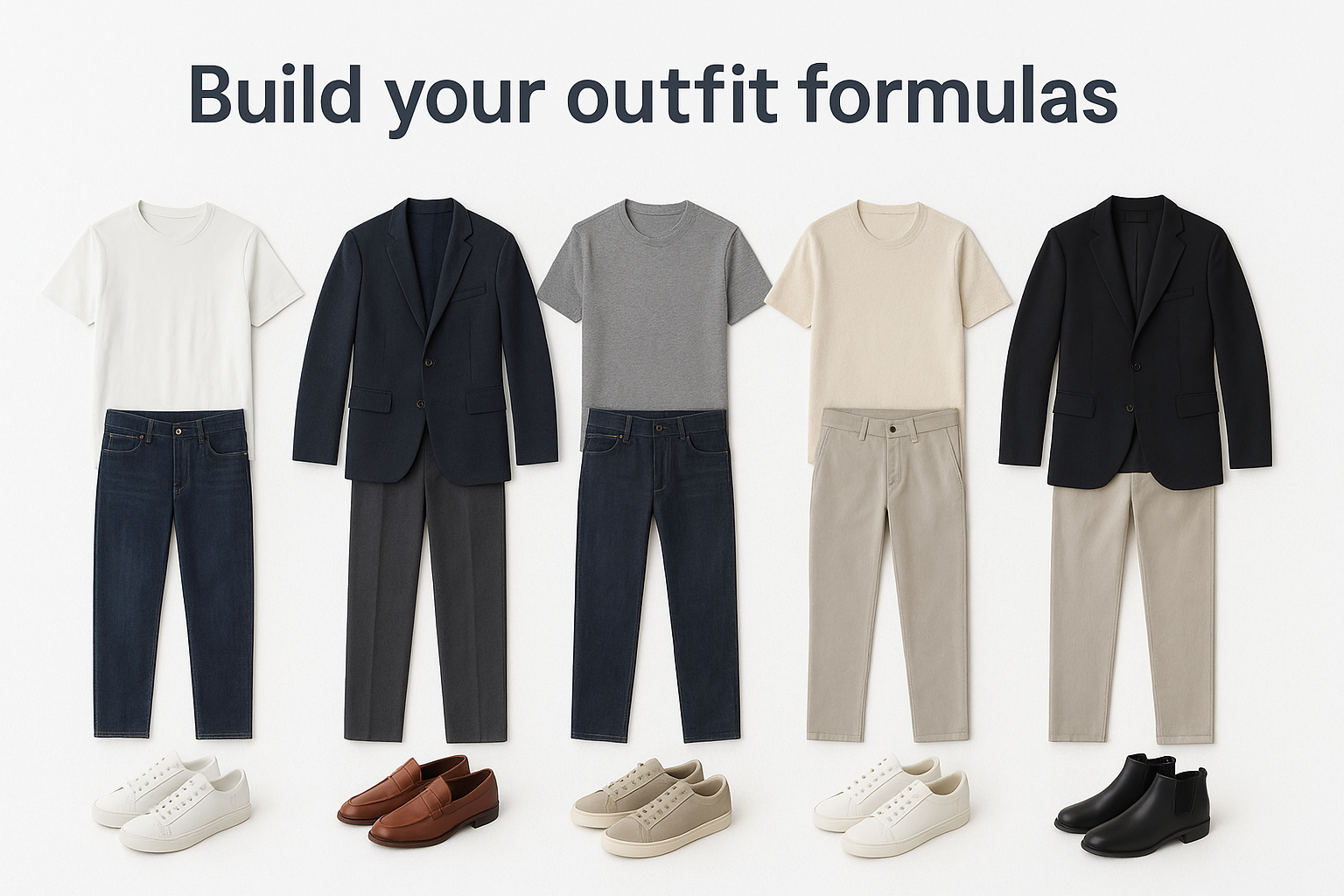
Once you have five solid formulas, a ten-piece wardrobe functions like a wardrobe three times its size.
Use this template to map your core formulas before you start each week:
| Formula | Top | Layer | Bottom | Shoe |
|---|---|---|---|---|
| Casual daily | White tee | Lightweight knit | Dark jeans | White sneakers |
| Smart casual | Navy long-sleeve | Structured jacket | Charcoal trousers | Leather loafers |
| Relaxed weekend | Grey tee | None | Dark jeans | Low-profile casual |
| Travel | Off-white tee | Lightweight knit | Stone trousers | White sneakers |
| Elevated casual | White long-sleeve | Structured jacket | Stone trousers | Leather boots |
Fill in your own pieces for each slot. The formula stays the same; the specific items rotate as you cycle through your collection across the week.
Set up a weekly rotation
A weekly rotation prevents you from defaulting to the same two outfits while the rest of your wardrobe goes unused. At the start of each week, assign a formula to each day based on your schedule from Step 1. If Monday and Tuesday are remote workdays, casual formulas cover both. Wednesday's lunch with a client calls for smart casual. Mapping this out takes ten minutes once and removes every morning decision for the rest of the week.
Rotate which physical pieces fill each formula slot week to week. If you used your white tee in Formula 1 on Monday, pull your grey tee for the same slot next Monday. This keeps your entire collection in active use, distributes wear evenly across your pieces, and extends the lifespan of each item significantly compared to repeatedly defaulting to one or two favorites.
Step 6. Fill gaps on purpose and stop impulse buys
You've built the foundation, but the work isn't finished once you close your closet door. The part that determines whether your minimalist wardrobe stays clean or quietly bloats back up is how you handle every purchase from this point forward. Filling gaps on purpose means shopping from a list of real needs rather than reacting to what looks appealing in a store or in an online cart. This single discipline separates people who maintain a functional minimal collection from those who cycle through decluttering sessions every six months.
Impulse buying doesn't feel impulsive in the moment. It feels like solving a problem. The gap audit keeps you honest.
Identify real gaps before you shop
A gap in your wardrobe is a missing piece that prevents you from completing a formula you identified in Step 5. It is not a slight variation of something you already own, and it is not an item that caught your eye because it looked interesting. Before you open a browser or walk into a store, run through your outfit formulas and identify which specific slot you cannot currently fill with the pieces you own.
Use this gap audit checklist before any purchase:
| Question | Answer required to buy |
|---|---|
| Which outfit formula is missing this piece? | Name the specific formula |
| What existing piece does this replace or complete? | Name the piece |
| Does it work with at least 3 items I already own? | Yes |
| Does it match my palette from Step 3? | Yes |
| Am I buying this because I need it or because I want variety? | Need it |
If you cannot answer the first two questions with specifics, you are not filling a gap. You are shopping for entertainment, which is how a minimalist wardrobe loses its function over time.
Use a buying filter before every purchase
A buying filter is a short set of non-negotiable criteria you apply to every item before purchasing, no exceptions. Knowing how to build a minimalist wardrobe is straightforward, but keeping it that way requires a repeatable rejection system so the small decisions stay consistent.
Apply this filter to every item you consider:
- It fills a named gap from your formula checklist above
- The fabric and construction justify repeated wear, not just one season
- It exists in your defined color palette without requiring new combinations
- You would still want it if it had no brand name or logo on it
Run any item through all four points. If it fails even one, skip it and move on. Items that pass the filter earn their place. Everything else stays on the shelf.
Keep it simple over time
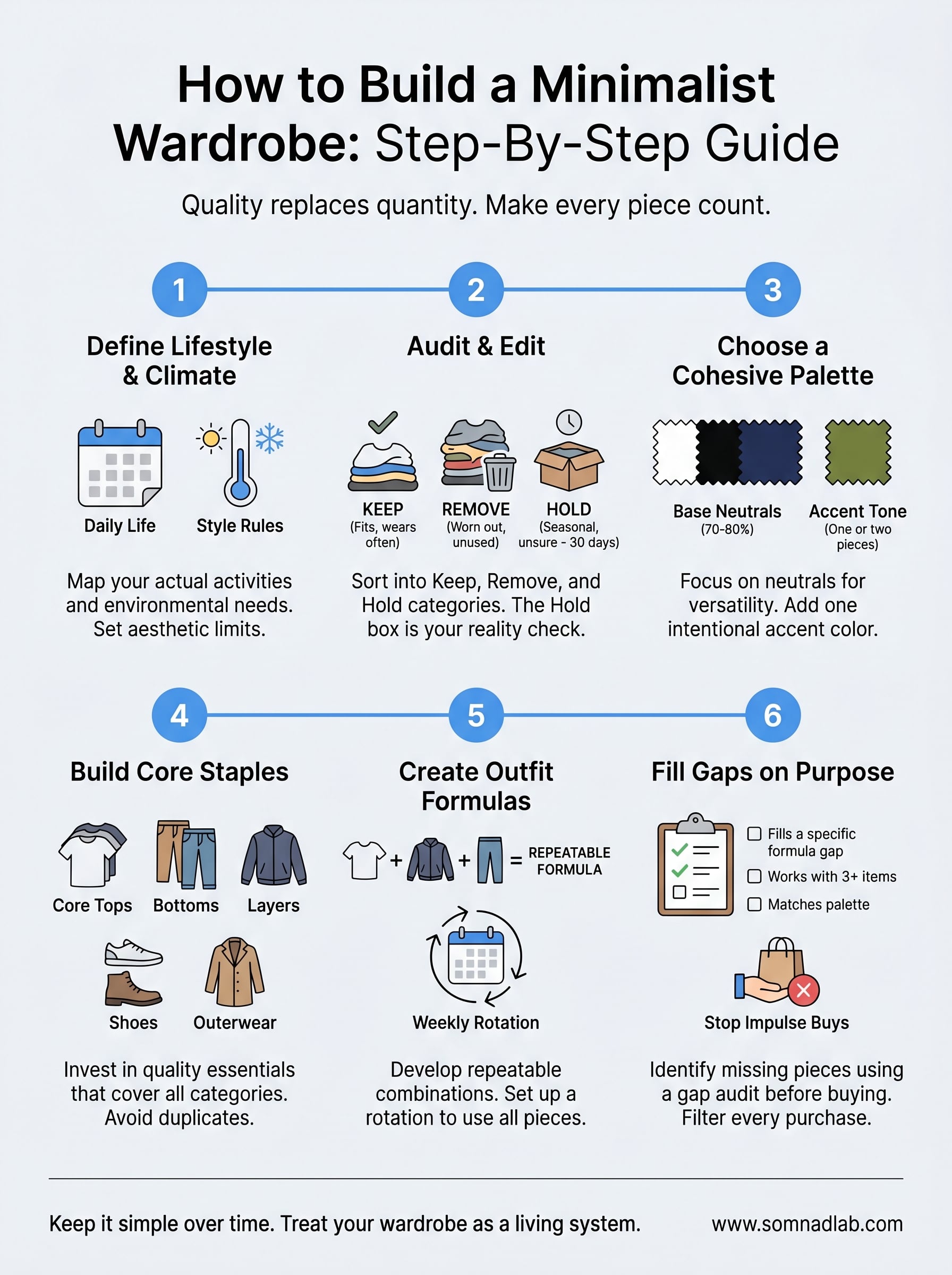
A minimalist wardrobe only stays useful if you treat it as a living system, not a finished project. Run a quick gap audit every three to four months, rotate out anything that has stopped earning its place, and resist the pull to add pieces outside your palette just because they look good in the moment. The six steps in this guide give you a complete, repeatable framework for how to build a minimalist wardrobe that holds its function across seasons and years, but the whole system works only if you keep applying it with the same consistency you used to build it.
When you need the foundation pieces to anchor that system, quality matters more than anything. SÖMNAD's premium everyday essentials are built to serve as exactly those anchors: heavyweight Supima cotton basics with clean fit and no excess branding, designed to hold their shape and stay in active rotation for years rather than seasons.