


Most guys own way more clothes than they actually wear. A closet full of impulse buys, forgotten sale items, and shirts that almost fit, yet somehow, nothing feels right when you're getting dressed. Learning how to build a men's capsule wardrobe fixes that problem by stripping your closet down to pieces that actually work together.
The concept is simple: own fewer items, but make every single one count. That means choosing versatile, well-made basics over trendy one-hit-wonders. It means each piece earns its spot. At SÖMNAD, this philosophy is baked into everything we make, premium essentials built to pair with anything and hold up through years of daily wear. A capsule wardrobe only works when the foundation pieces are worth relying on.
This guide walks you through the 3-3-3 rule, a practical framework that tells you exactly how many tops, bottoms, and layers you need to build a complete, functional wardrobe. No guesswork, no fluff. You'll get a clear item checklist, styling logic, and a step-by-step process to simplify your closet without sacrificing your style.
What the 3-3-3 rule is and why it works
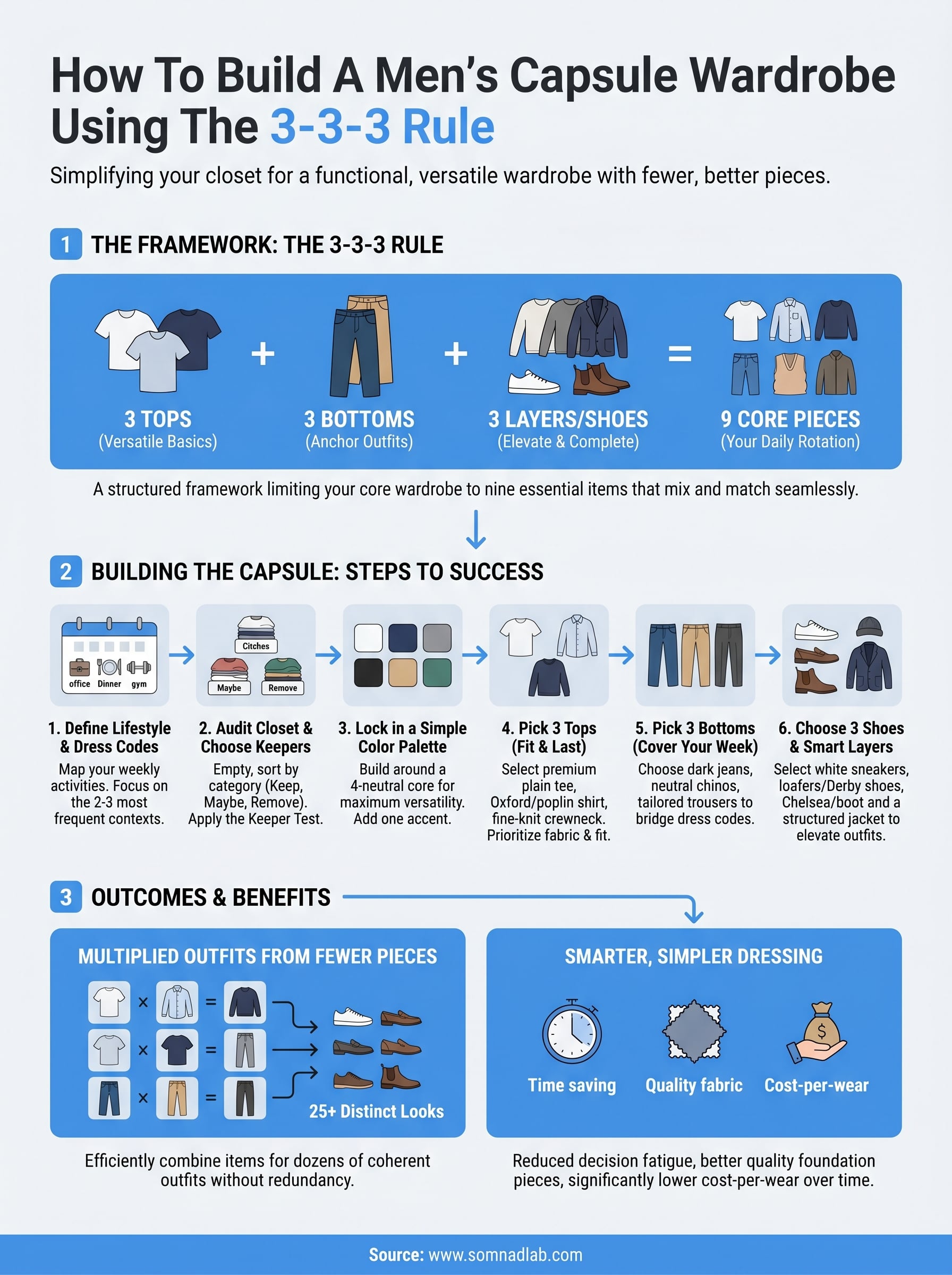
The 3-3-3 rule is a structured capsule wardrobe framework that limits your core daily rotation to 3 tops, 3 bottoms, and 3 layers or shoes. Those nine pieces cover the majority of your dressing decisions without overlap or redundancy. The rule borrows from the same minimalist logic used in product design and productivity thinking: a smaller set of better choices reduces decision fatigue and produces more consistent, deliberate results than a closet full of options you rarely touch.
The core numbers explained
Each category in the 3-3-3 system serves a specific function. Your three tops carry the most visible role in any outfit, so they need to work cleanly with every bottom you own. Your three bottoms anchor your looks and should span at least two different dress codes, casual and something more pulled-together. The third slot covers everything that completes and elevates the outfit: shoes, outerwear, or both depending on your climate and daily life.
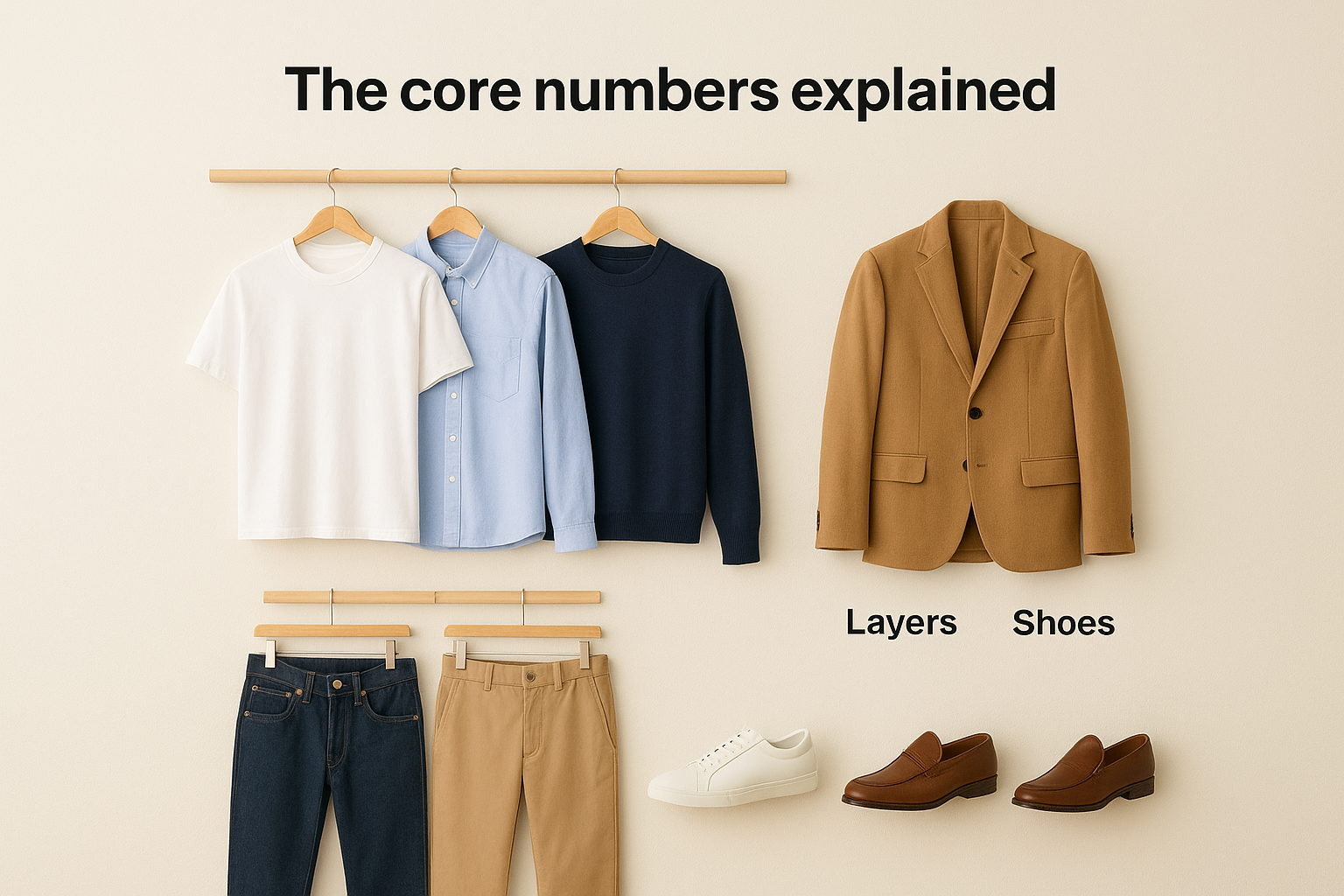
The goal isn't to limit your style. It's to force every single item to earn its place.
Here's a clear breakdown of how the three categories map to your wardrobe:
| Category | Primary role | Example items |
|---|---|---|
| Tops (x3) | Most-worn layer, maximum versatility | Premium tee, Oxford shirt, crewneck knit |
| Bottoms (x3) | Anchors the outfit, spans dress codes | Dark jeans, chinos, tailored trousers |
| Layers/Shoes (x3) | Completes and elevates each combination | White sneakers, loafers, structured jacket |
Why fewer pieces create more outfits
The counterintuitive reality about knowing how to build a men's capsule wardrobe is that cutting options actually increases your output. When every piece is chosen to work with every other piece, your outfit count multiplies quickly. Three tops paired with three bottoms gives you nine distinct combinations before you factor in footwear or layering at all. Bring in three shoe options and a jacket, and you're looking at dozens of coherent looks from nine total pieces.
Most overstuffed closets produce the opposite result. You might own 35 shirts but reach for the same five or six every week because the rest don't fit right, don't pair cleanly with anything, or belong to a version of yourself you no longer dress like. The 3-3-3 rule forces you to confront that pattern directly rather than add more items on top of it.
The quality trade-off that makes it work
The framework only holds up when the pieces themselves are genuinely worth relying on. Nine mediocre items wear out fast, look tired after a few washes, and need replacing constantly, which defeats the entire point. This is why fabric quality and construction matter more in a capsule wardrobe than in a conventional one. Each item gets worn at a much higher frequency, so the standard you apply when buying shifts. A well-constructed tee made from dense, durable cotton that holds its shape through two years of regular washing will outperform five cheaper alternatives that pill and stretch within months.
The practical implication here is straightforward: spend more per item, own fewer items, and your cost-per-wear drops significantly over time. That math applies consistently across every category in the 3-3-3 framework, from tops through to footwear.
Step 1. Define your lifestyle and dress codes
Before you pick a single item, you need to understand how you actually spend your time. Most capsule wardrobe mistakes happen at this exact stage because people build for who they want to be, not who they are day to day. Your lifestyle determines which dress codes matter most, and those dress codes determine which pieces earn a spot in your rotation. Skipping this step means you'll end up with a polished set of chinos and Oxford shirts you never actually reach for.
Map your actual week
Pull up your calendar for the past two weeks and look at where you went and what you wore. A remote worker who handles errands, gym sessions, and casual dinners has completely different wardrobe needs than someone commuting to an office five days a week. The goal is to identify the two or three recurring contexts that make up most of your time, then build your capsule around those situations rather than one-off occasions you encounter a few times a year.
If a dress code applies to fewer than 15% of your weekly activities, it belongs outside your core capsule rotation.
Use this template to map your dress codes before you touch your closet:
| Context | Days per week | Dress code required |
|---|---|---|
| Work (office or remote) | ___ | Casual / Smart casual / Business |
| Social (dinners, events) | ___ | Smart casual / Smart |
| Active (gym, errands, travel) | ___ | Casual |
| Other | ___ | ___ |
Match your dress codes to your item choices
Once you've mapped your week, the next step in understanding how to build a men's capsule wardrobe is translating those dress codes into specific clothing categories. A smart casual environment needs pieces that function during a work call and a Saturday dinner without requiring a full outfit change. A primarily casual lifestyle still benefits from pieces that look deliberate, where the cut and fabric do the work that a dress code normally handles.
Rank your three most common contexts by frequency and confirm that your 3-3-3 selections address each one. If smart casual covers six out of seven days, every top and bottom you pick should function in that register. If you split your time between casual and business casual, your bottoms need to bridge both codes, which is why well-fitted chinos and dark trousers belong in so many capsule wardrobes while cargo pants and joggers stay out.
Step 2. Audit your closet and choose keepers
You cannot build a lean, functional wardrobe on top of a cluttered one. Auditing your closet first gives you a clear picture of what you already own, what's worth keeping, and what's been sitting there without earning its spot. This step is where most guys realize they already have a few solid keepers, and where they see exactly how many pieces they've been holding onto out of habit rather than actual use. Getting honest about your current closet is the only way to move forward without repeating the same buying mistakes that created the problem in the first place.
Pull everything out at once
The audit only works if you take every single item out of your closet and drawers and place it somewhere you can see it all clearly. Leaving things hanging and judging them in place introduces bias. You'll underestimate how much you own and overestimate how often you actually reach for things. Lay everything flat on a bed or floor, separated by category: tops, bottoms, layers, and shoes. Seeing the full volume in front of you at once makes it far easier to make objective cuts.
Use this sorting method to organize what you pull out:
| Pile | Criteria |
|---|---|
| Keep | Fits well now, worn in the last 60 days, pairs with at least two other items |
| Maybe | Fits, but rarely worn or only works with one specific outfit |
| Remove | Doesn't fit, worn out, or hasn't been touched in over 90 days |
Apply the keeper test
Every item in your Keep pile still has to earn its place within the logic of how to build a men's capsule wardrobe. Run each keeper through three quick questions: Does it fit the way you'd want to be seen right now? Does it work with at least two other pieces you're keeping? Does it hold up well enough to wear at a higher frequency than you currently do?
If you can't pair an item with at least two other pieces in your closet, it has no place in a capsule wardrobe.
Your Maybe pile deserves a second, harder look. Most items sitting in that pile belong in the Remove group, even if they feel like they have potential. Potential doesn't count in a capsule system. If a piece hasn't worked its way into regular rotation already, placing it inside a tighter wardrobe won't change that. Donate or sell what's in good condition, and move forward only with what passed the keeper test cleanly.
Step 3. Lock in a simple color palette
Your color palette is the invisible structure that makes the 3-3-3 system function. When every piece you own sits within the same tonal range, any top pairs with any bottom without visual conflict, and the whole wardrobe clicks into place. Most people skip this step entirely and wonder later why their capsule still feels chaotic. Choosing a palette before you buy a single item is the most direct way to ensure future purchases integrate cleanly rather than creating new coordination problems on top of the old ones.
Build around a core of four neutrals
A four-neutral foundation gives you the widest possible range of combinations while keeping every pairing coherent. The goal is to select neutrals that layer well together, meaning lighter shades work comfortably on top of darker ones without clashing. Most functional capsule wardrobes pull from this set: white, navy, grey, and either black or camel depending on your skin tone and the climate you dress for most. These four neutrals cover every dress code in your core rotation and transition cleanly across seasons without requiring you to maintain separate summer and winter palettes.
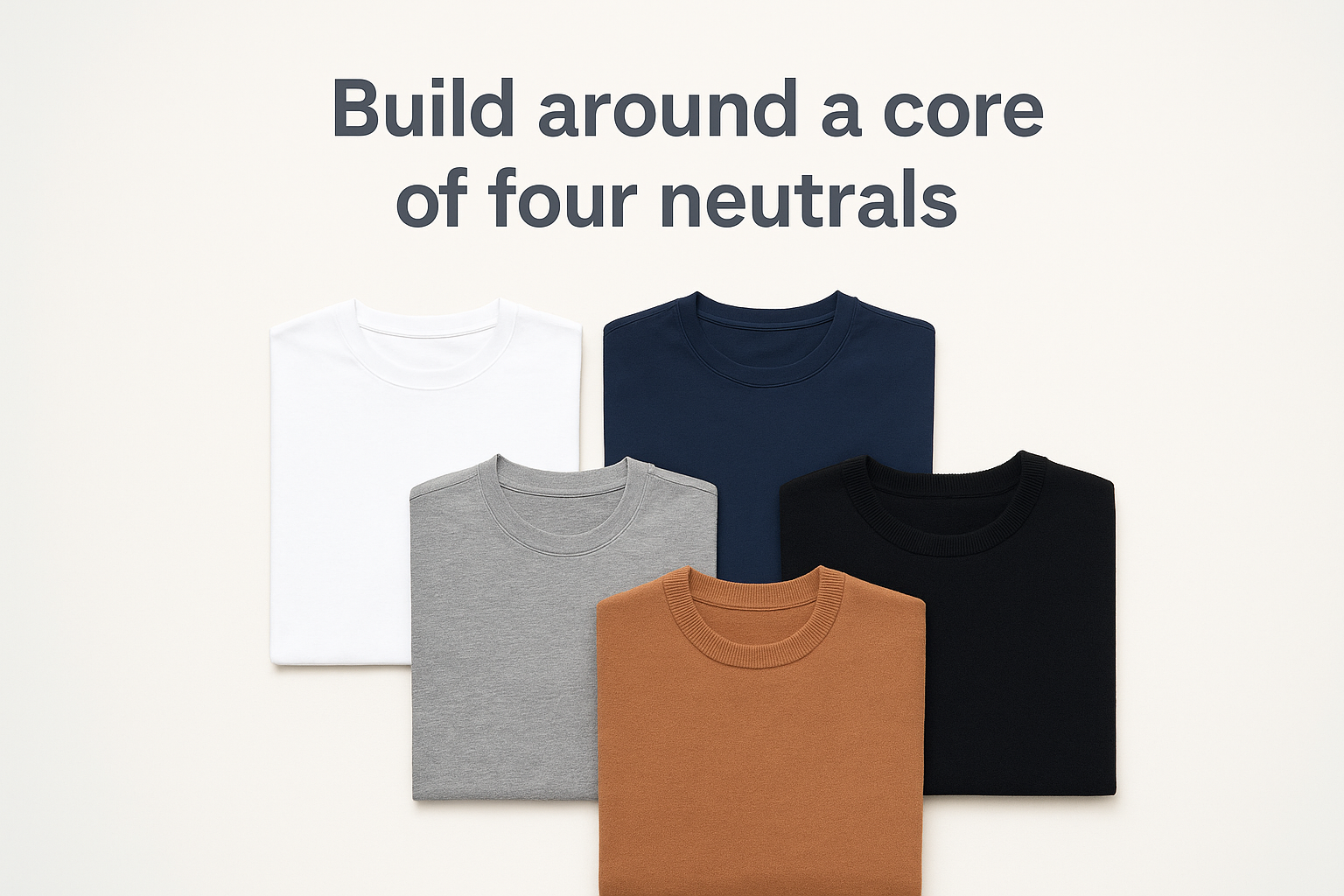
Choosing your palette before you shop is the single most effective way to guarantee every piece you own works with every other piece.
Use this reference to understand what each neutral contributes to the system:
| Neutral | Dress code range | Works well with |
|---|---|---|
| White | Casual to smart | All three other neutrals |
| Navy | Casual to business casual | White, grey, camel |
| Grey | Casual to smart casual | White, navy, black |
| Black or Camel | Casual to smart | White, grey |
Add one accent without fracturing the system
Once your four neutrals are locked in, one optional accent color gives your rotation variation without reintroducing the pairing problem you're trying to eliminate. The key word is one. An olive green, a washed burgundy, or a dusty blue can all function as an accent within a neutral palette as long as the piece is simple in cut and free of loud patterns or graphics. Prints and heavy textures restrict pairing options and age faster than solid pieces, which runs directly against the core logic of how to build a men's capsule wardrobe.
That accent should feel like a quiet variation on your existing palette, not a departure from it. Hold the piece next to your four neutral items. If it reads naturally in that group, it earns its slot in the rotation. If it pulls focus on its own, it belongs outside your capsule entirely.
Step 4. Pick 3 tops that fit and last
Your three tops are the most visible pieces in your entire rotation, so the selection criteria here are stricter than anywhere else. Every top you choose needs to work across at least two dress codes and pair cleanly with all three of your bottoms. That's nine outfit combinations before you factor in layers, and it only holds together if each top is cut well and made from fabric that survives frequent wear without losing shape.
The three tops that cover every situation
The most functional three-top combination for most men is a premium plain tee, an Oxford or poplin shirt, and a fine-knit crewneck or lightweight sweater. This trio spans the full range of daily dress codes: the tee handles casual, the shirt covers smart casual and business casual when tucked, and the knit sits between both registers depending on how you style it. All three work with every bottom in your rotation without any coordination effort once your color palette is locked in.
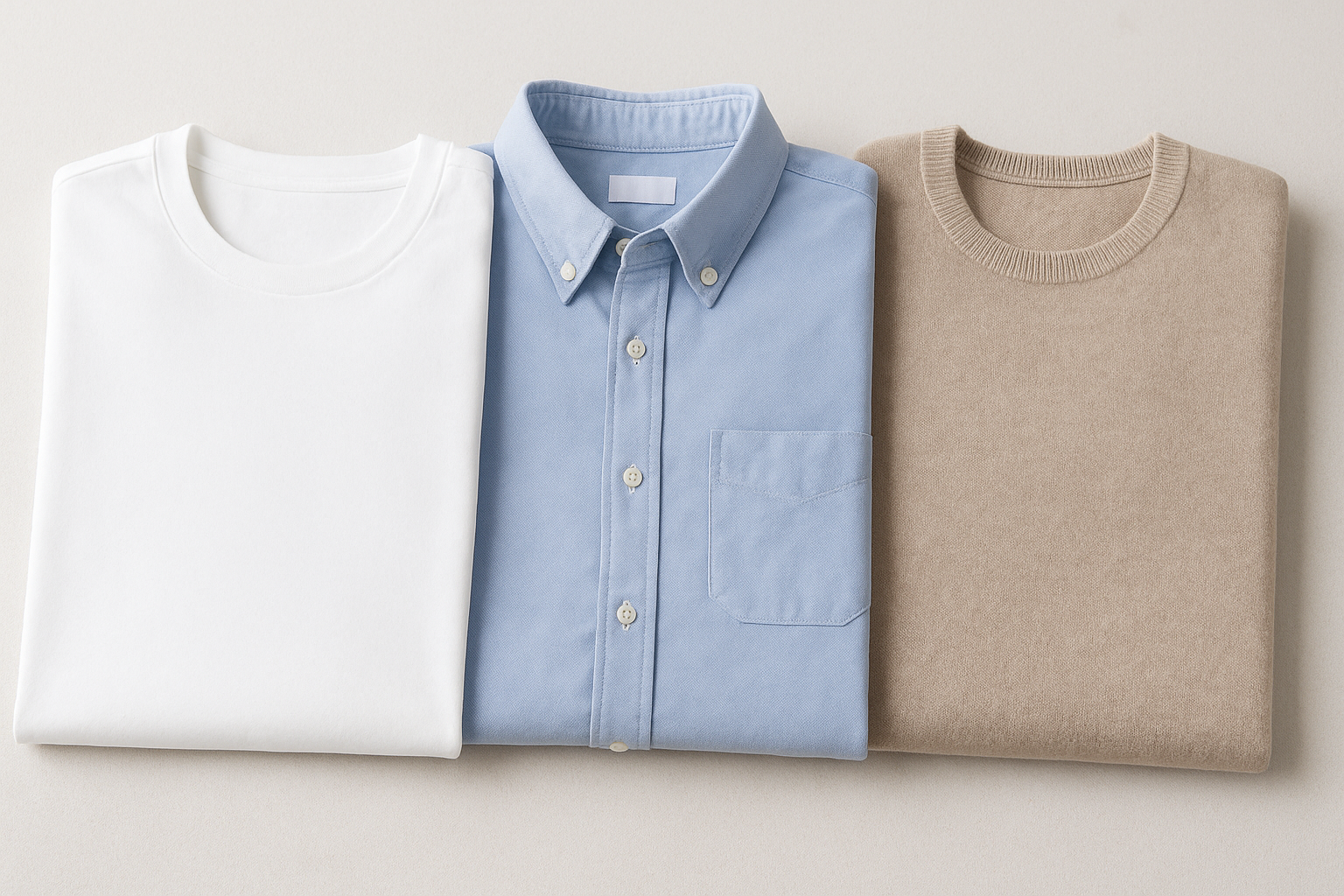
The plain tee is the hardest-working piece in the entire system. Getting the fabric and fit right here matters more than any other single decision.
Use this as your top-selection template before committing to each piece:
| Top | Primary dress code | Secondary dress code | Pairs with all 3 bottoms? |
|---|---|---|---|
| Plain tee | Casual | Smart casual | Yes |
| Oxford or poplin shirt | Smart casual | Business casual | Yes |
| Fine-knit crewneck | Smart casual | Casual | Yes |
What to look for in fit and fabric
Fit is the first thing to confirm before you consider any other quality marker. The shoulder seam should sit exactly at the edge of your shoulder joint, the chest should lie flat without pulling across the seams, and the hem should fall just below your waistband. A top that fails any one of those three fit points looks off regardless of price, which is a central principle in understanding how to build a men's capsule wardrobe correctly. A poor fit also limits pairing options by making the piece look intentionally casual even when you need it to read as pulled-together.
Fabric weight and construction determine how long each top stays in rotation before it starts looking tired. Heavier cotton in the 280g to 320g per square meter range resists pilling and shape loss far better than lighter jersey that softens fast but stretches and thins within months. Supima and Pima cotton are worth prioritizing over standard cotton because the longer fiber length produces a denser weave that holds its structure through repeated washing without thinning at the collar or distorting at the hem.
Step 5. Pick 3 bottoms that cover your week
Your three bottoms carry less visual exposure than your tops, but they anchor the dress code of every outfit you build. Get this selection wrong and even a well-chosen top looks mismatched against what you're wearing below. The goal is to cover your two or three core dress codes without redundancy, meaning each bottom should sit in a slightly different register so your nine base combinations actually span your full week rather than cluster in one territory.
The three bottoms that bridge every dress code
The combination that works for most men across the widest range of daily contexts is dark slim-straight jeans, well-fitted chinos in a neutral like stone or olive, and a pair of tailored trousers or smart-cut pants. Dark jeans handle casual and most smart casual situations cleanly. Chinos cover smart casual and bridge up into business casual without effort. Tailored trousers take care of anything that requires a more put-together look, and they still work with a plain tee when the cut is right. All three should fit from the waist without alteration, since a bottom that requires a belt to stay in place or bags at the knee will undercut every top you pair it with.
Your bottoms set the dress code ceiling for the entire outfit. A top can dress down a smart pair of trousers, but no top can dress up a pair of bottoms that reads as sloppy.
Use this template to confirm your three selections before committing to them as part of understanding how to build a men's capsule wardrobe correctly:
| Bottom | Dress code range | Color | Pairs with all 3 tops? |
|---|---|---|---|
| Dark slim-straight jeans | Casual to smart casual | Indigo or black | Yes |
| Neutral chinos | Smart casual to business casual | Stone, khaki, or olive | Yes |
| Tailored trousers | Smart casual to business | Charcoal, navy, or camel | Yes |
How to evaluate fit before you buy
Fit on bottoms breaks down into three measurable points: the waistband should sit flat without gaping at the back, the seat should allow movement without bunching or pulling across the fabric, and the leg should taper cleanly from hip to hem without excess fabric at the knee or ankle. Try sitting down in any bottom before you buy it. A pair that binds or rides up when seated will get avoided, which defeats the purpose of building a tight rotation.
Fabric weight and construction matter here for the same reason they matter in tops. Heavier cotton twill and structured weaves hold their shape through repeated wear far better than thin or stretchy blends that lose their line after a few washes.
Step 6. Choose 3 shoes and smart layers
Shoes and layers are where most capsule wardrobes stall. People either own too many shoes they never rotate or skip outerwear entirely until weather forces a decision. In this step, your three footwear choices define the upper dress code ceiling of every outfit, and your layering pieces determine how much real range your nine base combinations actually cover. Done right, this category takes your core nine pieces and multiplies them into a wardrobe that handles nearly every situation in your week without adding clutter.
The 3 shoes that cover every context
The most functional three-shoe combination follows the same logic as your tops and bottoms: each pair should sit at a different point on the dress code scale so that swapping footwear shifts the register of the entire outfit. Clean white leather sneakers handle casual and most smart casual situations without effort. A pair of loafers or leather Derby shoes bridges smart casual up to business casual and makes a plain tee look intentional rather than underdressed. A versatile boot, either a Chelsea or a clean lace-up, covers cooler weather and adds a third styling direction that neither sneakers nor loafers can replicate on their own.
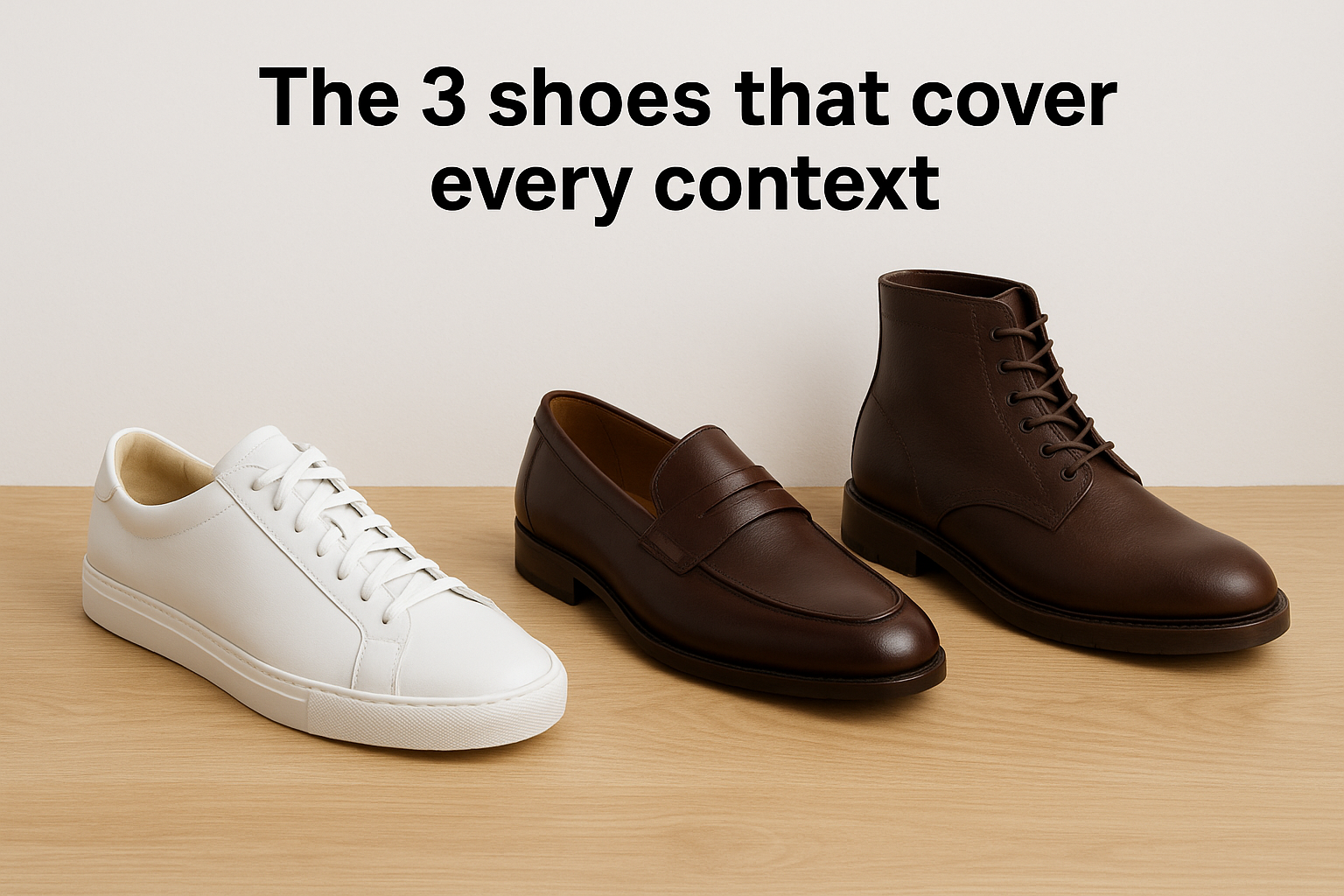
Your shoe choice changes the perceived dress code of the entire outfit more than any other single swap in your rotation.
Use this template to confirm your three footwear selections cover the full range of your daily contexts:
| Shoe | Dress code range | Pairs with |
|---|---|---|
| White leather sneakers | Casual to smart casual | Jeans, chinos, and trousers |
| Loafers or Derby shoes | Smart casual to business casual | Chinos and tailored trousers primarily |
| Chelsea or clean lace-up boot | Casual to smart casual | All three bottoms |
How to layer without overcomplicating the system
Layering within the 3-3-3 framework is not about adding pieces for the sake of variety. One structured layer, either a harrington jacket, a lightweight overshirt, or a well-cut chore coat, sits over any top in your rotation without disrupting the pairing logic you've already built. That single layer extends the temperature range of your existing tops and shifts casual combinations into smart casual territory, which is exactly what a tight capsule needs to cover a full week without gaps.
The fit rules on a jacket mirror the fit rules on your tops: the shoulder seam sits at the joint, the chest lies flat without pulling, and the sleeve length falls just above your wrist bone. A layer that fails any of those three points will stay on the hook rather than in regular use, which defeats the core principle behind knowing how to build a men's capsule wardrobe correctly.
Step 7. Build outfits and plan gaps to buy
At this point in the process of how to build a men's capsule wardrobe, you have your palette locked, your pieces selected, and your dress codes mapped. The final step is to combine everything into real, named outfit combinations and then compare that output against your weekly contexts to see where genuine gaps exist. Buying before you complete this step means you risk adding pieces that duplicate what you already have rather than filling actual holes in your rotation.
Map your nine base combinations
Lay out every top and bottom pairing as a written grid before you style a single outfit. Three tops across three bottoms produces nine distinct base combinations, and your goal here is to confirm that every one of those pairings actually works within the color palette and dress code logic you set in earlier steps. If two or three combinations produce a conflict, that is a signal that one of your pieces needs to be reconsidered before you move into footwear.
A combination that works on paper but looks wrong in practice means a piece failed the palette test, not that the system is broken.
Use this grid to map and verify each base outfit:
| Dark jeans | Neutral chinos | Tailored trousers | |
|---|---|---|---|
| Plain tee | Casual | Smart casual | Smart casual |
| Oxford or poplin shirt | Smart casual | Business casual | Business casual |
| Fine-knit crewneck | Casual | Smart casual | Smart casual |
Once you confirm all nine base combinations work, add your three footwear options to each pairing and note which shoe shifts each outfit up or down in dress code. That exercise alone gives you over twenty-five distinct looks from your nine core pieces.
Identify what's missing before you buy
Cross-reference your outfit grid against the lifestyle map you built in Step 1. Mark every weekly context that your current combinations cover cleanly, then flag any context where none of your outfits land at the right dress code. That gap is your actual shopping brief, not a general sense that you need something new.
Write down each gap as a specific item description rather than a category. "Stone chinos in a slim straight cut under 38 waist" is a useful brief; "better casual pants" is not. The more specific your brief, the less likely you are to buy something that creates a new coordination problem instead of solving the one you identified. Carry that list every time you shop, and only buy what appears on it.
Next steps
You now have a complete system for how to build a men's capsule wardrobe that actually holds up through daily use. The 3-3-3 rule gives you the structure, the audit clears the clutter, and the outfit grid turns nine pieces into a wardrobe that covers your full week without gaps or redundancy. The work you did in each step compounds, so resist the temptation to skip back and add more pieces before you've worn what you selected consistently for at least a month.
Your capsule only performs as well as the pieces you put into it. Foundation items like your plain tee take the most wear, so the fabric and construction need to match that demand. If you're ready to start with a top that holds its shape through two-plus years of regular washing, explore the premium everyday essentials at SÖMNAD and build your rotation on pieces worth relying on.