


Most guys own too many clothes and still feel like they have nothing to wear. The fix isn't buying more, it's owning fewer, better pieces that actually work together. A minimalist wardrobe for men starts with a ruthless edit and a short list of versatile essentials that earn their spot in your closet every single day.
The idea sounds simple, but execution trips people up. What stays? What goes? How many tees do you actually need? Without a clear framework, you end up donating half your closet and then panic-buying replacements that don't fit the plan. That's why a capsule checklist matters, it gives you a concrete blueprint instead of vague advice to "just simplify." The goal is a wardrobe where every piece pulls its weight, pairs easily, and holds up over time.
At SÖMNAD, we build everyday essentials around that exact principle: less, but better. Premium fabrics, clean fit, no logos, clothing designed to be the backbone of a pared-down wardrobe. This guide walks you through every category, item counts, and the criteria for choosing pieces that last beyond a single season. By the end, you'll have a complete capsule checklist you can start acting on today.
What a minimalist wardrobe is and isn't
A minimalist wardrobe is not about owning the fewest clothes possible. It's about owning exactly what you need and nothing more. Every piece in your closet should serve a clear purpose, fit well, and combine with at least three other items you already own. That's the functional definition, and it's more useful than any aesthetic one. Once you understand that, the editing process becomes a lot less stressful and a lot more systematic.
What minimalism actually means for your closet
The core principle is intentionality. You choose each item with a specific reason: this tee works under a blazer, this chino pairs with everything, this jacket handles both a casual Friday and a weekend errand run. Intentional buying replaces reflexive buying, and that shift changes how you shop, store, and get dressed in the morning. You stop accumulating things that almost work and start building a wardrobe where everything actually does.
A practical minimalist wardrobe for men typically lands between 30 and 50 total items, including tops, bottoms, outerwear, footwear, and basics. That number is not a hard rule, but it gives you a workable ceiling. Fewer items mean you spend less mental energy deciding what to wear, which is the real payoff. Every small choice you make in a day draws from the same cognitive resource pool, and a cluttered closet costs you more mental bandwidth than most people realize. A tighter wardrobe eliminates that friction entirely.
The goal is a closet you can navigate in under 60 seconds and still walk out looking put-together every time.
What it isn't: the misconceptions
Minimalism does not mean gray, boring, or monk-like. You can own a rich navy or a well-saturated olive and still be working within a minimal framework. The framework is about volume and versatility, not color suppression. If a shade works across multiple outfits and fits your lifestyle, it earns its spot regardless of how saturated it is.
It also does not mean buying cheap. In fact, a minimalist approach pushes you toward spending more per item because you're buying fewer of them. A single well-constructed tee made from premium Supima cotton, built to hold its shape through hundreds of washes, is worth more than five mediocre ones that stretch out after a season. You replace quality items far less often, which means the cost-per-wear math almost always favors the better piece by a significant margin.
Minimalism also is not a one-time project you complete and forget. Your wardrobe evolves as your lifestyle changes. A new job, a move to a different climate, a shift in how you spend your weekends: all of these are legitimate reasons to reassess what you own. Treating your closet as a living system rather than a solved problem keeps it functional long-term and prevents the slow creep of unnecessary items from undoing your work.
Here is a quick breakdown of what separates a minimalist wardrobe from a simply small one:
| Trait | Minimalist Wardrobe | Just a Small Wardrobe |
|---|---|---|
| Items chosen with intention | Yes | Not necessarily |
| Every piece pairs with others | Yes | Not necessarily |
| Quality prioritized over quantity | Yes | Not necessarily |
| Regular audits built in | Yes | Rarely |
| Clear, cohesive color palette | Yes | Not necessarily |
The distinction matters because a small wardrobe with no coherence still produces the same "nothing to wear" feeling you started with. A minimalist system solves that problem by design, not by accident, and that's the version worth building.
Set your lifestyle requirements and laundry rhythm
Before you touch a single item in your closet, you need to understand how you actually live. Most wardrobe advice skips this step and jumps straight to item counts, which is why most people end up with a capsule that looks good on paper but fails in daily use. Your lifestyle dictates what you need, and your laundry schedule dictates how many of each item you need. Get both wrong and you'll either run out of clean clothes or quietly start refilling your closet with backup pieces that weren't part of the plan.
Map your weekly activity breakdown
Start by writing down a realistic picture of a typical week. Not your best week or a vacation week, a normal, average week. Think through how many days you spend working in an office, working from home, running errands, going out casually, or dressing up for something formal. Each context pulls from a different clothing category, and the ratio of days you spend in each one tells you exactly where to concentrate your wardrobe investment.

Use this template as your starting point:
| Context | Days per week | Key clothing need |
|---|---|---|
| Office or client-facing | ___ | Chinos, button-down, clean shoes |
| Work from home | ___ | Quality tee, relaxed trouser |
| Casual errands or weekends | ___ | Tee, jeans, sneakers |
| Active or gym | ___ | Athletic shorts, performance top |
| Evening out or dressy | ___ | Sharp layer, clean dark trouser |
Fill this in honestly, not aspirationally. If you work from home four days a week and go to an office one day, your wardrobe should reflect that split. Building around who you wish you were produces a closet full of clothes you never reach for.
Match item counts to your laundry schedule
How often you do laundry matters just as much as what you own. If you wash clothes once a week, you need roughly seven to ten days worth of core items to get through a full cycle without repeating. Twice a week, you can cut that buffer nearly in half. A minimalist wardrobe for men only functions well when your item count aligns with your real laundry rhythm, not an idealized one.
Own enough to last your full wash cycle comfortably, then stop there.
Apply this formula: take the number of days between washes, add two for buffer, and that's your minimum count for high-frequency items like tees and underwear. For bottoms, you can usually stretch further since a well-constructed pair of chinos or jeans handles multiple wears between washes without losing its shape or looking worn.
Audit your closet fast and decide what stays
Pull everything out of your closet and lay it flat on your bed or floor. This step feels tedious, but seeing every item at once forces an honest accounting that you simply cannot do by flipping through hangers. Most people own a mix of aspirational pieces, worn-out standbys, and forgotten impulse buys, and separating them visually is the fastest way to see what you actually own versus what you think you own before any decisions get made.
The three-pile method
Divide everything into three piles: Keep, Remove, and Unsure. Keep is for items you wear regularly, fit well right now, and pair with at least two other pieces you already own. Remove is for anything damaged, ill-fitting, or untouched in the last six months. Unsure is for items you genuinely cannot decide on in under ten seconds, and that pile gets a deliberate second pass after the rest is sorted.
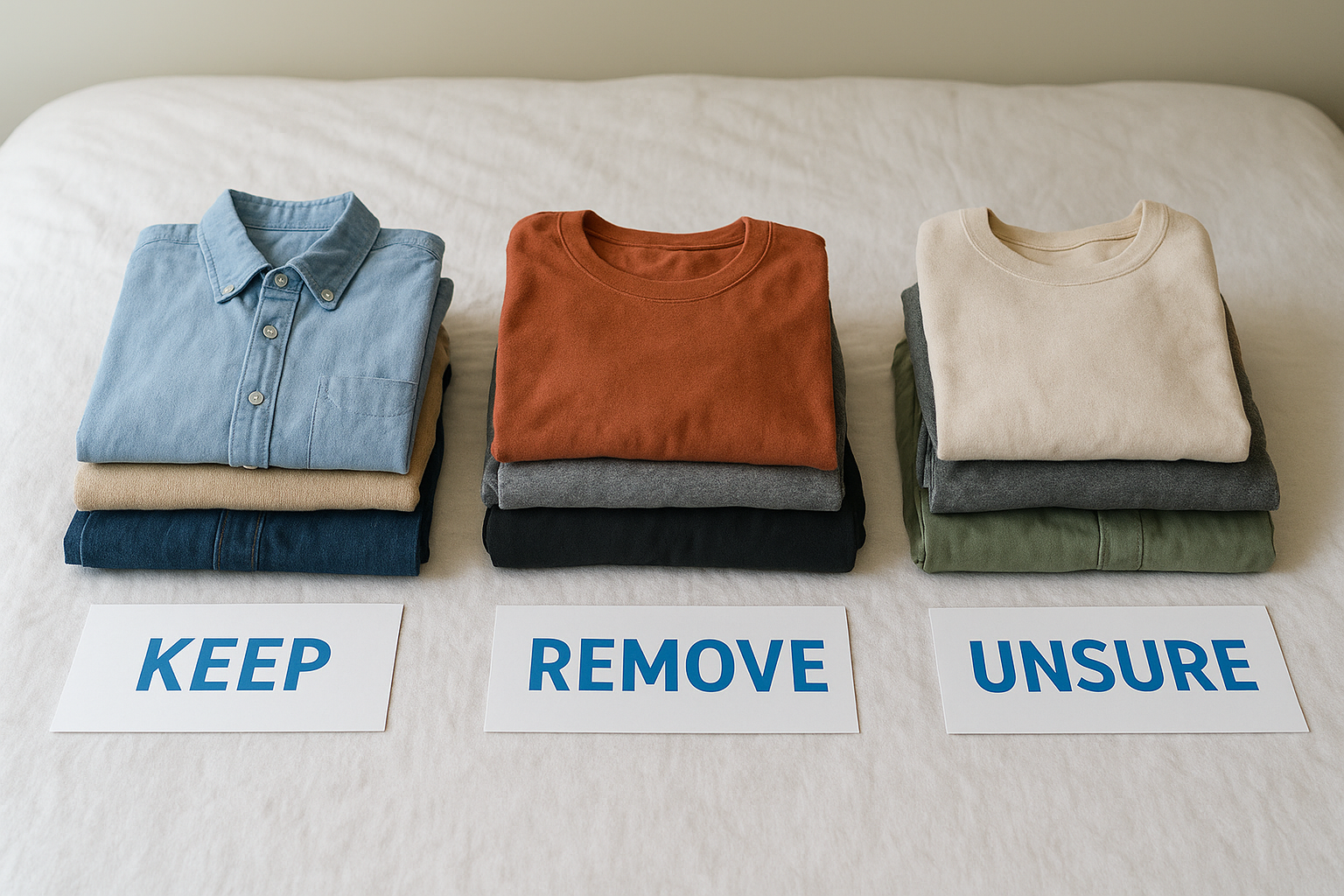
If you need more than ten seconds to justify keeping an item, that hesitation is already your answer.
Use this quick-reference guide as you sort each piece:
| Question | Yes | No |
|---|---|---|
| Does it fit well right now? | Keep candidate | Remove |
| Have you worn it in the last 6 months? | Keep candidate | Remove |
| Does it pair with 2+ items you already own? | Keep candidate | Unsure or Remove |
| Is it in good condition (no pilling, fading, or damage)? | Keep candidate | Remove |
| Would you buy it again today at full price? | Keep candidate | Remove |
Handle the unsure pile with one rule
Return to your unsure pile after clearing the obvious keeps and removes. Give each item one final ten-second review using the same five questions above, and this time commit without negotiating with yourself. Any item that still can't clear at least three of those five criteria moves to the remove pile. The rule removes sentimentality from the equation and keeps your decision-making fast and consistent.
For a minimalist wardrobe for men to function the way it's supposed to, you cannot carry uncertain pieces into the rebuild. Clothes that make the cut should earn their spot based on your actual lifestyle, not on what you paid for them or a vague sense that you might wear them eventually. Once your Keep pile is settled, you have a clear, honest picture of your starting point and can see exactly which categories still need work.
Build a tight color palette and silhouette
A tight color palette is what makes a minimalist wardrobe for men actually function as a system rather than a collection of individual items. When every piece you own shares a compatible tonal range, you can combine anything in your closet with confidence without thinking through whether it works. Color cohesion is the mechanical engine behind effortless getting dressed, and without it, even a perfectly edited closet still creates friction every morning.
The fewer colors you own, the more combinations you can build from the same number of pieces.
Choose your anchor colors
Anchor colors are the two or three neutrals that form the base of your wardrobe. These are the shades that appear most frequently across your tops, bottoms, and outerwear. Think navy, white, black, stone, olive, or mid-grey. Pick two anchors as your primary base and one accent shade that complements both without clashing.
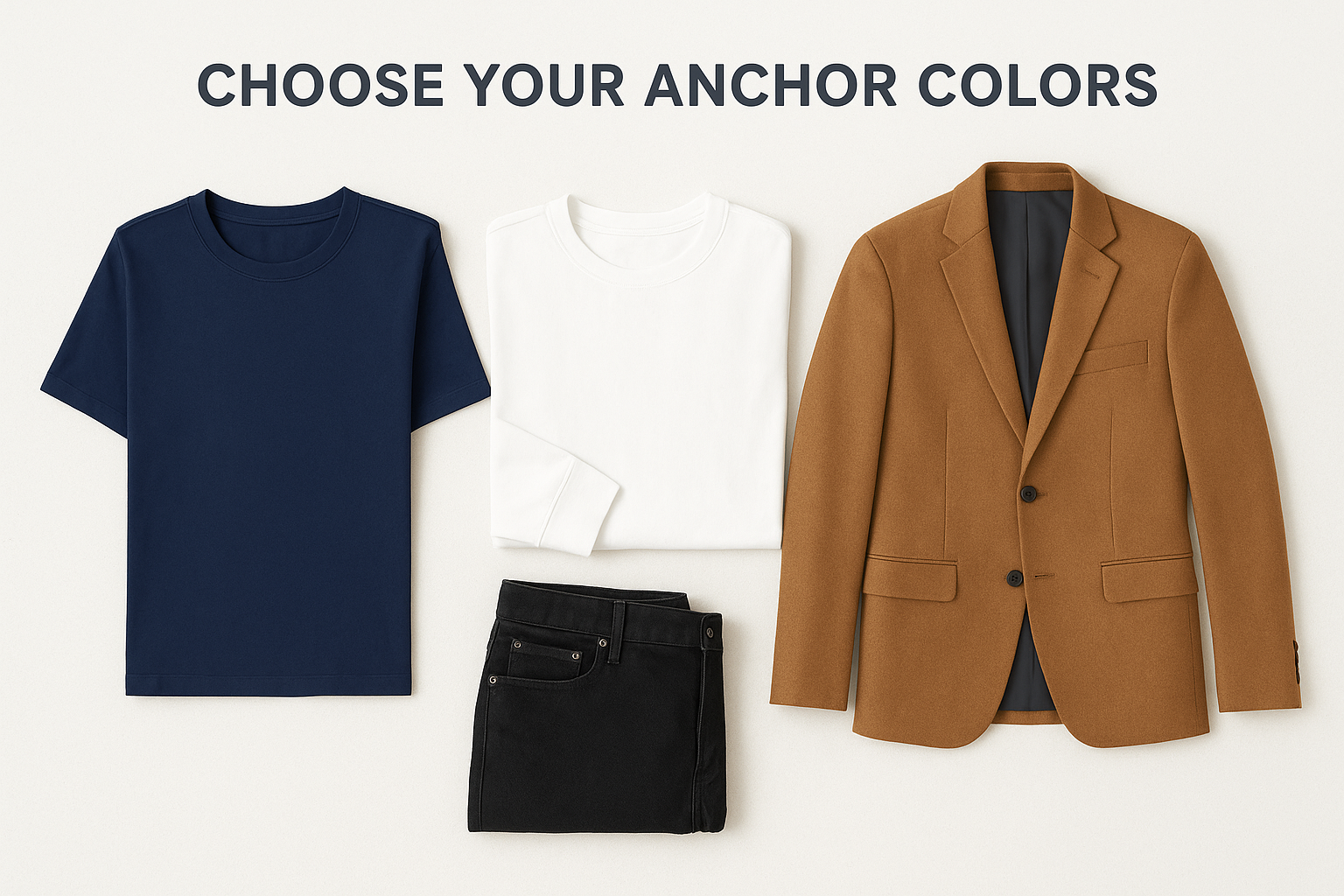
Here is a simple framework you can use to build your palette:
| Role | Examples | Items it covers |
|---|---|---|
| Primary anchor | Navy, Black, Stone | Tees, chinos, outerwear |
| Secondary anchor | White, Mid-grey, Olive | Tees, shirts, layering pieces |
| Accent | Burgundy, Tan, Slate blue | One or two statement pieces |
The accent color does not need to appear on more than one or two items. Its job is to add visual interest without breaking the system, so keep it grounded and close to the neutral family rather than pulling toward anything saturated or trend-dependent.
Lock in your silhouette
Silhouette consistency matters just as much as color palette. If your tees are relaxed and your trousers are slim and your jacket is boxy, nothing reads as intentional even if each item is high quality on its own. Decide early whether you prefer a relaxed, straight-cut approach or a slimmer, more tailored fit, then buy exclusively within that lane.
Relaxed fits are more forgiving across body changes and tend to look cleaner when items come from different brands because the proportions stay balanced. Slim fits look sharp but require tighter coordination between pieces. Pick one direction, define it clearly, and treat anything outside it as an automatic pass the next time you shop. This single rule eliminates more bad purchases than almost anything else in the process of building a minimal closet.
The minimalist capsule checklist by category
Here is where the planning from the previous steps pays off. You know your lifestyle, you have your color palette, and your closet is down to only what works. Now you need a concrete item count per category so you can see exactly what you have and what you still need. The numbers below are built for someone who does laundry once a week and lives a mixed casual-to-smart-casual life. Adjust the counts up or down based on the laundry rhythm you mapped earlier.
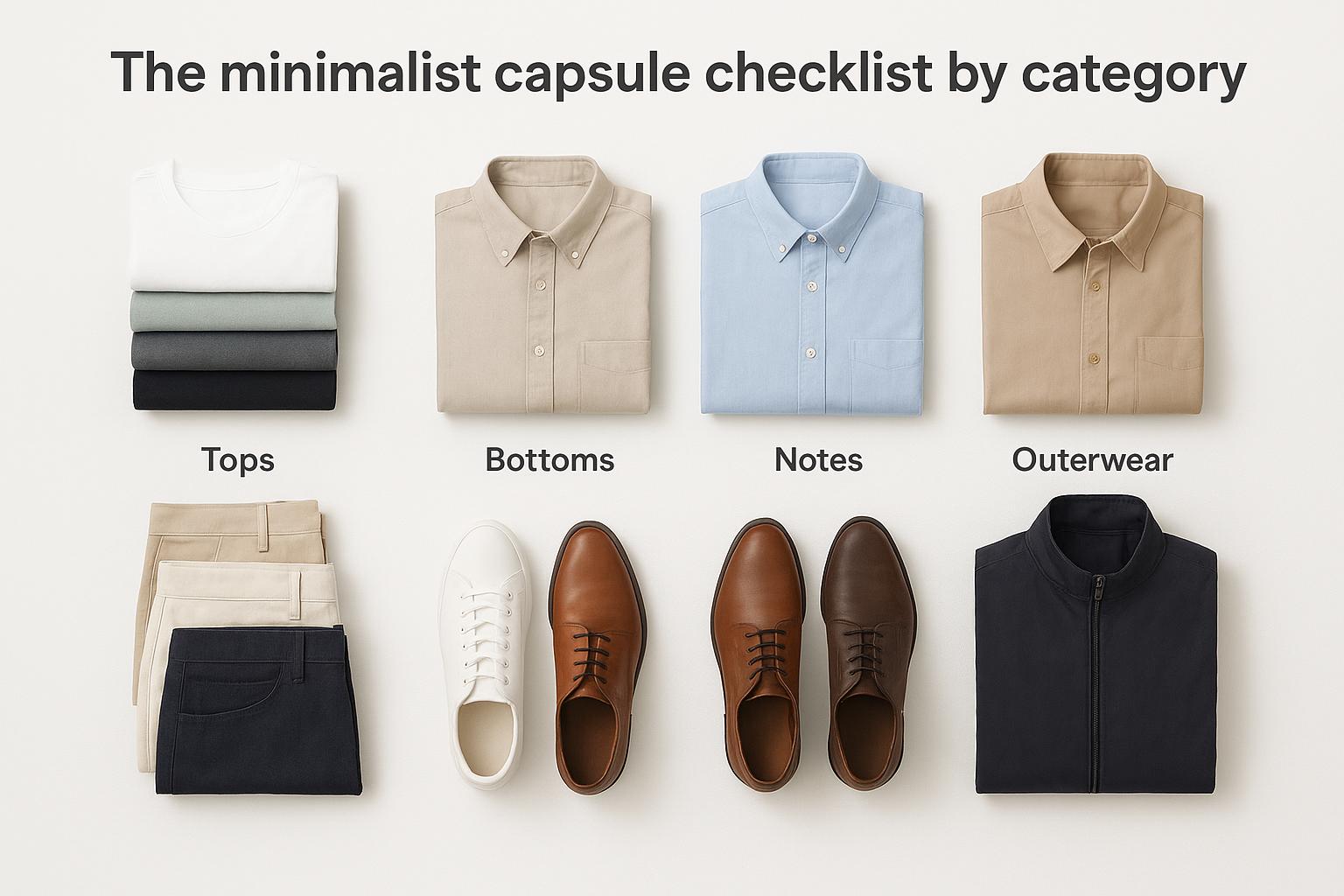
A capsule checklist only works if you treat the item counts as hard limits, not as a floor to build on top of.
Tops
Tops are the most-worn category in any wardrobe, which means they absorb the most daily use and require the highest quality. For a minimalist wardrobe for men, five to seven tees is the practical target: three in your primary anchor color, two in your secondary anchor, and one or two in your accent shade. Add two button-down shirts in neutral tones to cover slightly smarter occasions without duplicating what your tees already handle.
| Item | Count | Notes |
|---|---|---|
| Quality tees (heavyweight) | 5-7 | Split across your anchor colors |
| Button-down shirts | 2 | One white or light neutral, one earthy tone |
Bottoms
Bottoms hold up longer between washes than tops, so you need fewer of them. Three pairs of chinos or trousers in your palette covers most situations across the week. Two pairs of jeans round out the category: one dark or mid-wash for versatility, one more casual. Keep shorts to one pair at most unless your climate or lifestyle genuinely calls for more.
| Item | Count | Notes |
|---|---|---|
| Chinos or trousers | 3 | Anchor colors only |
| Jeans | 2 | One dark wash, one mid-wash |
| Shorts | 1 | Only if your lifestyle requires it |
Footwear and outerwear
Three pairs of shoes cover nearly every situation a casual-to-smart-casual lifestyle presents: a clean neutral sneaker for everyday use, a leather or leather-look shoe for smarter days, and a versatile boot that bridges both registers. For outerwear, two jackets is the firm ceiling: one lightweight layer for transitional weather and one heavier option for cold months. More than that and you start rebuilding the bloat you just cleared out.
| Item | Count | Notes |
|---|---|---|
| Sneakers | 1 | Clean, minimal, neutral colorway |
| Dress or leather shoe | 1 | Brown or black, unbranded |
| Boot | 1 | Smart-casual capable |
| Lightweight jacket | 1 | Spring and fall transitions |
| Heavy outerwear | 1 | Winter or cold climates |
Add one sharp layer for dressier moments
A minimalist wardrobe for men handles everyday life well, but you need at least one piece that raises the register when the situation calls for it. One sharp layer, chosen correctly, handles every dressier moment you'll realistically encounter without pushing your total item count over the line. The key is picking something that works over your existing tees and with your existing trousers, so it multiplies your outfit options rather than creating a category that sits isolated in your closet waiting for a rare occasion.
One well-chosen sharp layer does more work than three mediocre ones that only fit one narrow occasion.
Pick the right piece for your lifestyle
Not every man needs a blazer, and not every man needs a structured overshirt. Before you buy anything, look back at the lifestyle breakdown you mapped earlier. If you have more than two dressy moments per month, a tailored blazer in a neutral like navy, charcoal, or camel is the right call. It sits over a quality tee, pairs with dark chinos or trousers, and moves from a dinner out to a client meeting without needing to change anything underneath.
If your life skews more casual and dressy moments are rare, a premium overshirt or structured bomber in a clean neutral gives you a smarter look without committing to full suiting territory. Choose one that reads as intentional rather than casual, with clean seams, a structured shoulder, and no logos. That single distinction separates a sharp piece from just another jacket.
Make it earn its spot with versatility
Your sharp layer should combine with at least four items already in your capsule before you commit to buying it. Run the test manually: lay it against your tees, your chinos, your dark jeans, and your dress shoes. If it works across all four pairings, it justifies its place. If it only looks right with one specific outfit, it does not belong in a minimal closet.
Here is a quick pairing check to run before you buy:
| Sharp layer | Works with | Avoid pairing with |
|---|---|---|
| Navy blazer | White tee, dark chinos, leather shoe | Relaxed joggers, chunky sneakers |
| Structured overshirt | Neutral tee, slim jeans, clean boot | Printed tees, heavily distressed denim |
| Camel overcoat | Almost any anchor-color base | Bright accent tees or bold bottoms |
Versatility across multiple base outfits is the only metric that matters when choosing a sharp layer for a minimal wardrobe. If it passes the pairing test, buy it once and buy it well.
Create outfits and a repeatable daily uniform
A tight capsule only pays off if you can pull outfits from it without stopping to think. The goal is to build a small set of proven combinations you can rotate through the week without inventing something new every morning. This is where the color palette and silhouette work you did earlier becomes concrete: because everything shares a tonal range and a consistent fit, combining pieces becomes mechanical rather than creative, and that speed is the whole point.
Build your core outfit formulas
Outfit formulas are simple three-part combinations you establish in advance: top, bottom, shoe. Write out five to seven formulas using only the items already in your capsule, and you have your weekly rotation mapped without any guesswork on tired mornings. Each formula should pull from a different register, casual through smart-casual, so you can shift between contexts by swapping one piece rather than rethinking the whole look.
Once you have five solid formulas, you never need to start from scratch again.
Use this template to write yours out:
| Formula | Top | Bottom | Shoe |
|---|---|---|---|
| Casual everyday | White tee | Mid-wash jeans | Neutral sneaker |
| Work from home | Stone tee | Slim chino | Clean sneaker |
| Smart casual | White tee + navy blazer | Dark chino | Leather shoe |
| Weekend errand | Navy tee | Dark jeans | Clean boot |
| Dressier evening | White button-down | Dark trouser | Leather shoe |
Fill in your own items using exactly what your capsule contains. Stick to pieces from your Keep pile and avoid adding anything new until a formula genuinely cannot be satisfied by what you already own.
Design your daily uniform
A daily uniform takes the formula idea one step further: you pick one combination that works for your highest-frequency context and treat it as your default. Mark Zuckerberg and Barack Obama have both publicly described using a daily uniform to reduce decision fatigue, and the reasoning is straightforward. Every decision you eliminate before noon gives you more focus for the things that actually matter during the rest of your day.
For a minimalist wardrobe for men, the daily uniform typically combines your best-quality tee in your primary anchor color with your most versatile trouser or chino and a clean, neutral shoe. That single combination covers most of your week, and you only deviate from it when a specific context genuinely demands it. Set it, wear it, and let the saved mental energy go somewhere more useful.
Buy less, buy better, and avoid common traps
The hardest part of maintaining a minimalist wardrobe for men is not the initial edit. It's the behavior that follows. Most people clear their closet, feel the relief, and then slowly refill it over the next six months through low-stakes purchases that individually seem harmless but collectively undo everything they built. Buying less and buying better is a discipline, and it requires you to recognize the patterns that pull you off course before they do damage.
Know the traps before you hit them
The most common trap is the sale purchase. You find a decent item at 60% off, you buy it because the price feels like a win, and then it sits in your closet unworn because it doesn't fit your palette or fill a real gap. A cheap price on the wrong item still costs you money, closet space, and decision-making friction. The second trap is buying for a future version of yourself: the blazer for the job you're interviewing for, the linen shirt for the trip you haven't booked. Your wardrobe should serve your life today, not a projected version of it six months from now.
If an item doesn't solve a specific gap in your current capsule, it doesn't belong in your cart.
Here are the most common purchase traps and how to sidestep each one:
| Trap | What it looks like | How to avoid it |
|---|---|---|
| Sale impulse | Buying because the price is low, not because you need it | Ask if you'd buy it at full price first |
| Aspirational buying | Buying for occasions you rarely have | Match purchases to your actual lifestyle map |
| Duplicate creep | Buying a slight variation of something you already own | Check your checklist before you buy anything |
| Trend grab | Buying something because it looks current, not versatile | Test it against your palette and silhouette rules |
Spend more per item and fewer times overall
Quality and cost-per-wear are directly linked, and the math only works in your favor when you commit to it fully. A tee that costs three times more but lasts five times longer is not an indulgence, it's the economically rational choice. Look for heavyweight natural fibers like Supima cotton in your basics, full-grain leather in your shoes, and dense, well-constructed fabric in your outerwear. Those are the categories where quality shows up most clearly in longevity.
Before every purchase, run one final check: does this item fill a genuine gap in your capsule, does it match your palette, and does it fit your silhouette standard? Three yes answers means you buy it. Anything less means you put it back and move on.
Wrap-up
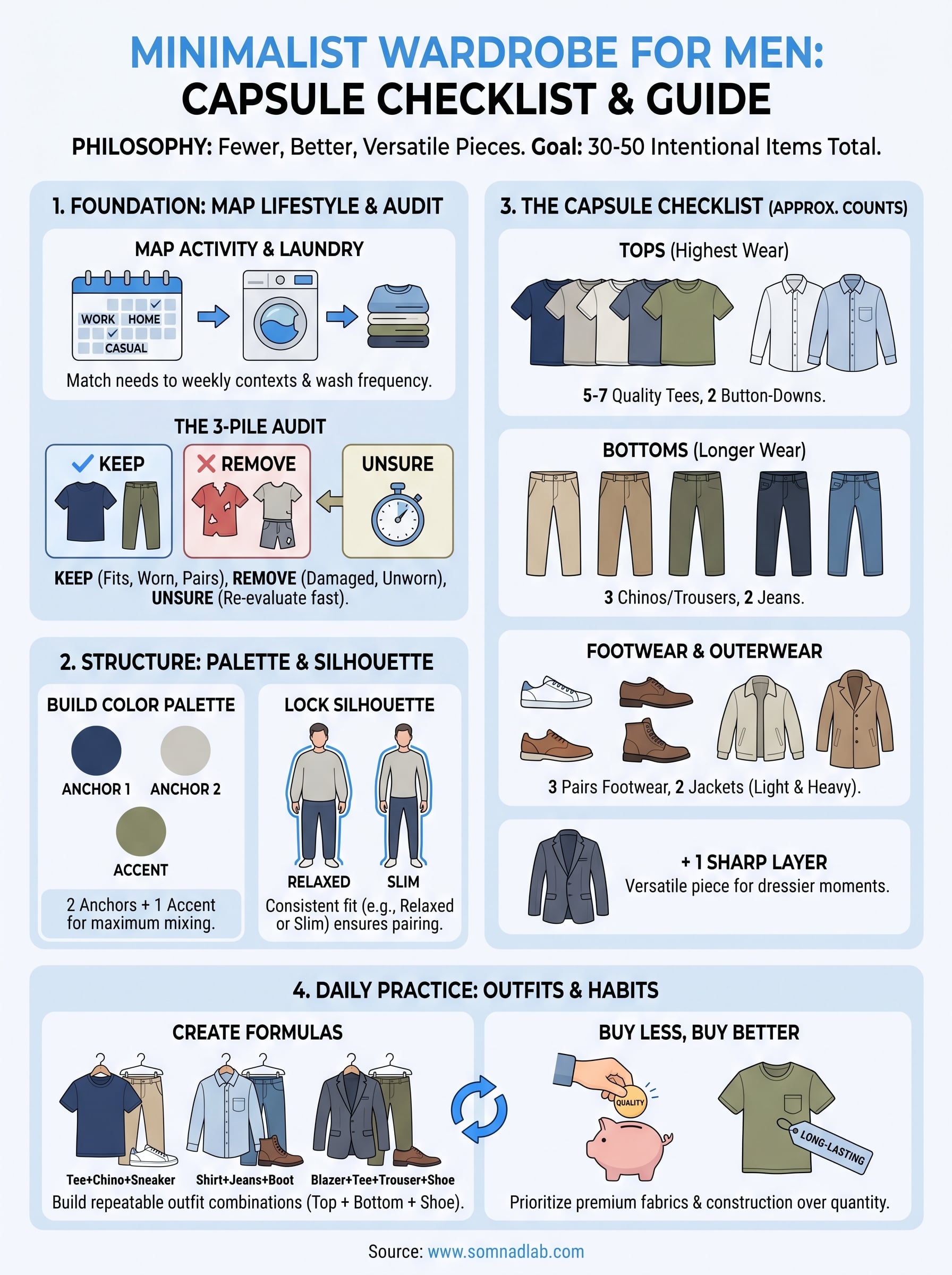
Building a minimalist wardrobe for men comes down to four moves: understand your lifestyle, audit what you own, lock in a color palette and silhouette, and buy better pieces far less often. The checklist in this guide gives you a concrete starting point, but the real shift is behavioral. Stop filling gaps with cheap placeholders and start treating every purchase as a permanent addition to a working system.
Your closet should make mornings faster and decision-making simpler, not harder. Every item you keep or buy should earn its place by fitting your palette, matching your silhouette standard, and pairing with at least three other pieces you already own. Hold that standard consistently and your wardrobe stays sharp without constant maintenance.
If you want basics built to anchor a capsule, explore the premium everyday essentials at SÖMNAD. Quality fabric and a clean fit are the foundation every minimal wardrobe needs.