


You keep buying clothes, and your closet keeps feeling messy. Nothing matches, half the pieces have logos you never wanted, and getting dressed takes longer than it should. That frustration is exactly why so many people start searching for what is minimalist clothing in the first place. It's not a trend or a strict uniform. It's a way of dressing built on fewer, better pieces that actually work together, chosen for fabric and fit rather than branding or hype.
At its core, minimalist clothing means simple silhouettes, a tight color palette, and materials that hold up over years, not months. Building a minimalist wardrobe isn't about owning ten items and calling it done. It's about knowing which basics deserve your money and which ones you can skip entirely.
This article breaks down what minimalist clothing actually means, the rules that make a wardrobe feel cohesive instead of random, and which essential pieces and brands are worth your investment. If you're tired of closets full of clothes you don't reach for, this is where you start.
Why minimalist clothing matters for your everyday wardrobe
Most closets aren't full because people love clothes. They're full because nobody ever stops to ask why they bought each item. A minimalist wardrobe fixes that by forcing every purchase to answer a simple question: will I actually wear this, over and over, for years? That single habit changes how you shop, how you dress, and how much money disappears into your closet every season.
The hidden cost of an overstuffed closet
Overbuying doesn't just cost money, it costs time and mental energy you don't get back. Studies on consumer behavior consistently link cluttered environments to higher stress and slower decision-making, and a closet stuffed with mismatched basics is a daily version of that problem. You stand in front of twenty shirts and still can't find one that fits right or looks put together. Fewer, better pieces solve this because everything in the closet already works, so there's nothing to sort through.
A closet with less in it is a closet you actually trust.
Decision fatigue and the ten-second outfit
Getting dressed shouldn't be a project. When your basics share a color palette and fit consistently, outfits assemble themselves without thought. This matters more than people admit, because willpower and decision-making capacity are finite resources you'd rather spend elsewhere. A minimalist closet removes one more decision from your morning, which sounds small until you count how many decisions you're already making before 9 a.m.
Here's what tends to happen once a wardrobe shrinks to genuine essentials:
- Outfits take under a minute to put together
- Laundry loads shrink because you rotate the same reliable pieces
- Shopping slows down since you're replacing, not accumulating
- Packing for trips gets simpler because everything mixes with everything
The real math on cost per wear
Price tags lie if you only look at the sticker. A $150 tee made from heavyweight cotton that lasts five years and gets worn twice a week beats a $25 tee that pills after ten washes. Cost per wear is the number that actually matters, and it consistently favors well-made basics over cheap, frequent replacements.
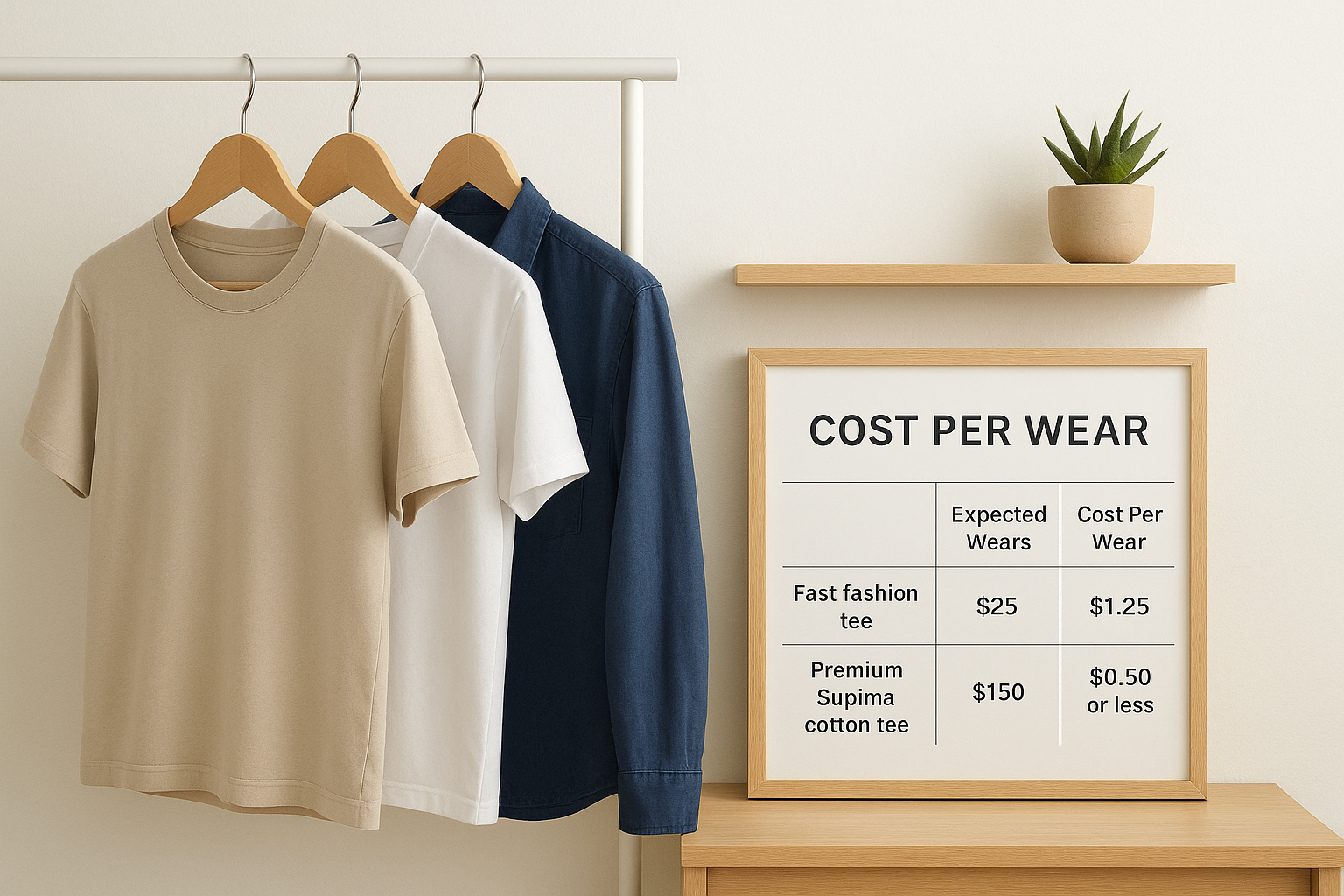
| Item | Price | Expected Wears | Cost Per Wear |
|---|---|---|---|
| Fast fashion tee | $25 | 20 | $1.25 |
| Premium Supima cotton tee | $150 | 300+ | $0.50 or less |
Quality fabric doesn't just feel better against your skin, it survives the wash cycle abuse that kills cheaper cotton within a season.
Sustainability without the marketing spin
Textile waste is a real, measurable problem, not a talking point. The Environmental Protection Agency reports that Americans generate over 11 million tons of textile waste annually, much of it from clothing that's barely worn before it's discarded. Choosing durable basics over disposable ones is one of the few wardrobe decisions that actually reduces that number, without requiring you to buy anything labeled "eco-friendly" or pay extra for a marketing story.
Understanding why minimalist clothing matters sets up the next question naturally: how do you actually build one of these wardrobes without overcorrecting into a different kind of clutter?
How to build a minimalist wardrobe step by step
Switching to a minimalist wardrobe isn't a weekend project. It's a slow replacement process where you remove what doesn't work and add pieces that do, one purchase at a time. Rushing it by donating everything and restocking in a single shopping trip usually backfires, because you end up buying under pressure instead of buying with intention. The goal is a closet that reflects real habits, not an aesthetic you saw online.
Step 1: Audit what you actually wear
Start by pulling everything out of your closet and sorting it into three piles: worn regularly, worn occasionally, and untouched for six months or more. That last pile tells you more about your real style than any Pinterest board ever will. Track what you reach for during a normal week, because your actual habits reveal the silhouettes and colors you gravitate toward without thinking.
Step 2: Lock in a color palette
Pick three to five colors that all pair with each other, usually anchored by neutrals like black, white, navy, or gray. A tight color palette means every shirt matches every pair of pants, so getting dressed stops being a puzzle. Write the palette down and check new purchases against it before buying, not after.
Step 3: Replace, don't accumulate
Once you know your gaps, replace worn-out basics one category at a time instead of buying everything at once.
- Start with the piece you wear most often, usually a tee or a base layer
- Buy the best version you can afford, since it will absorb the most wear
- Retire the old version only after the new one proves itself over a few washes
- Move to the next category once the first feels solid
A minimalist wardrobe grows one deliberate purchase at a time, never all at once.
Step 4: Set a pause before every purchase
Give yourself 24 hours before buying anything that isn't a direct replacement for something worn out. This single rule filters out impulse buys that don't match your palette or your real wearing habits. Fabric weight, fit, and origin matter more here than trend or price, so use the pause to check details like whether the cotton is Supima, the seams are reinforced, and the fit holds up to your existing pieces before you commit.
Key style rules for dressing minimalist
Dressing minimalist isn't about wearing plain clothes and calling it a day. It's a set of specific choices that make every piece work together, so the wardrobe reads as intentional instead of random. Minimalist clothing follows a short list of rules, and once you internalize them, shopping and dressing both get faster.
Fit comes before fashion
A piece that fits well always looks more expensive than one that doesn't, regardless of price tag. Look for a clean silhouette: shoulders that sit right, sleeves that hit at the right length, and a hem that doesn't bunch or gap. Skip anything oversized for the sake of a trend unless it's a deliberate, structured oversize rather than sloppy excess.
Fit is the single detail that separates minimalist from just plain.
Stick to a tight, repeatable palette
Your closet should function like a color wheel with three or four stops, not twenty. Anchor everything in neutrals, black, white, navy, gray, and let one accent color rotate in. This limited palette means you can grab any top and any bottom without thinking twice.
- Choose two neutrals as your base
- Add one warm and one cool accent, no more
- Test new purchases against the palette before buying
- Retire colors that never got worn after a full season
Layer with intention, not bulk
Layering is where minimalist dressing earns its versatility, but only if each layer serves a purpose. A base tee, a mid layer like a light sweater, and an outer layer like a jacket should each solve a different problem: warmth, structure, or weather. Avoid stacking pieces just to look put together, since unnecessary layers add bulk without adding function.
Let construction speak instead of logos
Minimalist style leans on quality signals that don't need a brand name to prove themselves. Reinforced seams, a fabric weight that holds its shape, and stitching that doesn't fray after a few washes tell you more about a garment than any tag. Visible branding works against the whole point, since the goal is clothing that looks considered because of how it's made, not because of what it says on the front.
Minimalist wardrobe essentials to invest in first
Not every basic deserves the same budget. Some pieces carry the whole wardrobe on their back, while others just fill gaps. Prioritizing spend on the items you touch daily is the fastest way to feel the benefits of minimalist clothing without overhauling everything at once.
Start with the tee that does the heavy lifting
Your everyday tee gets worn more than anything else you own, so it deserves the biggest chunk of your budget. Look for heavyweight cotton, ideally something like 300g Supima, since it holds its shape wash after wash instead of stretching out by month three. A relaxed fit that still sits clean on the shoulders beats anything boxy or overly tight.
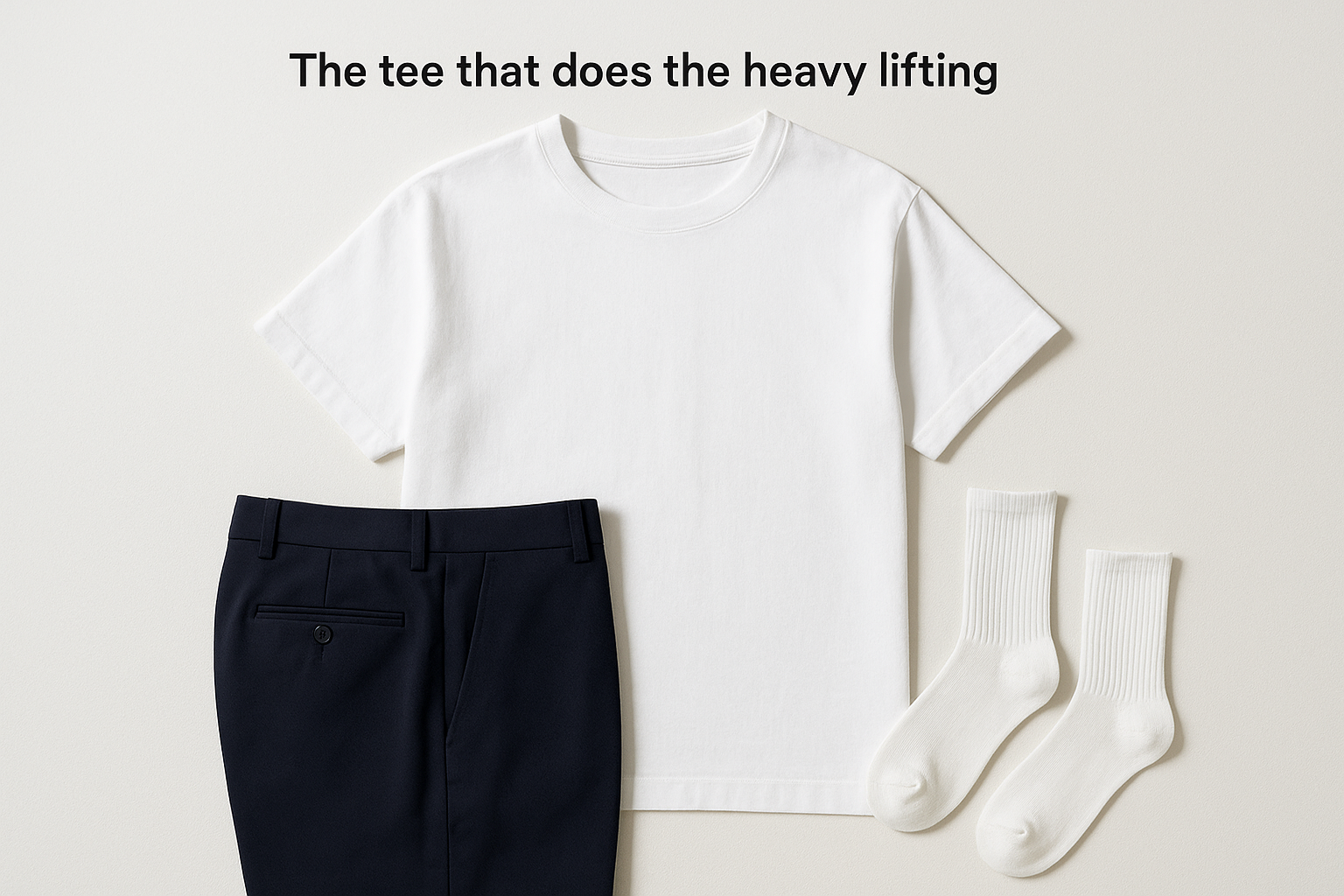
Buy the tee first, because everything else in the wardrobe gets judged against it.
Add bottoms that match without effort
Once your top layer is locked in, move to bottoms that pair with it automatically. Straight or slightly tapered trousers in a neutral shade do more work than five pairs of trend-driven jeans. Clean-fitting pants in black, gray, or navy will match every tee and layer you already own.
Layer with one solid mid piece
A single, well-made sweater or overshirt in a neutral tone fills the gap between a tee and outerwear. Pick fabric weight over flash: a mid layer that's too thin won't earn its spot in the rotation, no matter how good it looks on a hanger.
Round it out with outerwear and basics that finish the look
Once the core is solid, fill in outerwear and the small essentials that finish outfits. Here's the order that tends to work best for building this out:
| Priority | Item | Why it comes first |
|---|---|---|
| 1 | Heavyweight tee | Worn most, sets the fit standard |
| 2 | Neutral trousers | Pairs with every top |
| 3 | Mid-layer sweater | Bridges seasons and layers |
| 4 | Structured jacket | Anchors outerwear |
| 5 | Neutral socks and underwear | Invisible but essential |
Spend where wear is heaviest, then work outward. A minimalist wardrobe built in this order rarely leaves you with pieces that sit unworn.
Common minimalist wardrobe mistakes to avoid
Even with the right intentions, it's easy to build a closet that looks minimalist but doesn't actually function that way. Most of these mistakes come from treating minimalism as an aesthetic instead of a system, and that's where minimalist clothing goals quietly fall apart. Knowing the traps ahead of time saves you from buying your way into the same clutter you were trying to escape.
Confusing plain with minimal
A blank t-shirt isn't automatically a minimalist one. If the fabric pills after five washes or the fit sags by week two, plain doesn't save it. Construction quality is what separates minimalist from just boring, so judge every piece by fabric weight and stitching, not by how little print it has on it.
Plain clothing without quality construction is just clutter with fewer colors.
Buying a capsule wardrobe checklist instead of your own habits
Copying someone else's exact 20-piece list rarely works, because their climate, job, and body aren't yours. A finance worker in Chicago and a freelancer in Austin need completely different wardrobe essentials, even if both call themselves minimalist. Build from your own audit, not a template you found online.
Chasing an all-black wardrobe for its own sake
Black reads as minimalist, but an entire closet of it without variation in texture or fit just looks flat. Texture and fit carry more visual weight than color choice alone, so don't assume monochrome automatically equals put-together.
Skipping fabric research to save money
Cheap basics feel like the smart minimalist move until they wear out in a season and you're back at the store. This defeats the entire cost per wear logic that makes minimalism worth it in the first place. A few extra dollars spent on heavyweight cotton upfront almost always beats replacing a thin tee three times a year.
Overcorrecting into a new kind of scarcity
Some people swing too far and end up with too few clothes to get through a week without laundry. That's not minimalism, that's just inconvenience wearing a nicer label. Aim for enough repeatable pieces to cover 7 to 10 days comfortably, not a number picked to impress anyone. A functional minimalist wardrobe still needs to survive real life, not just look good in a photo.
Dressing with less, living with more
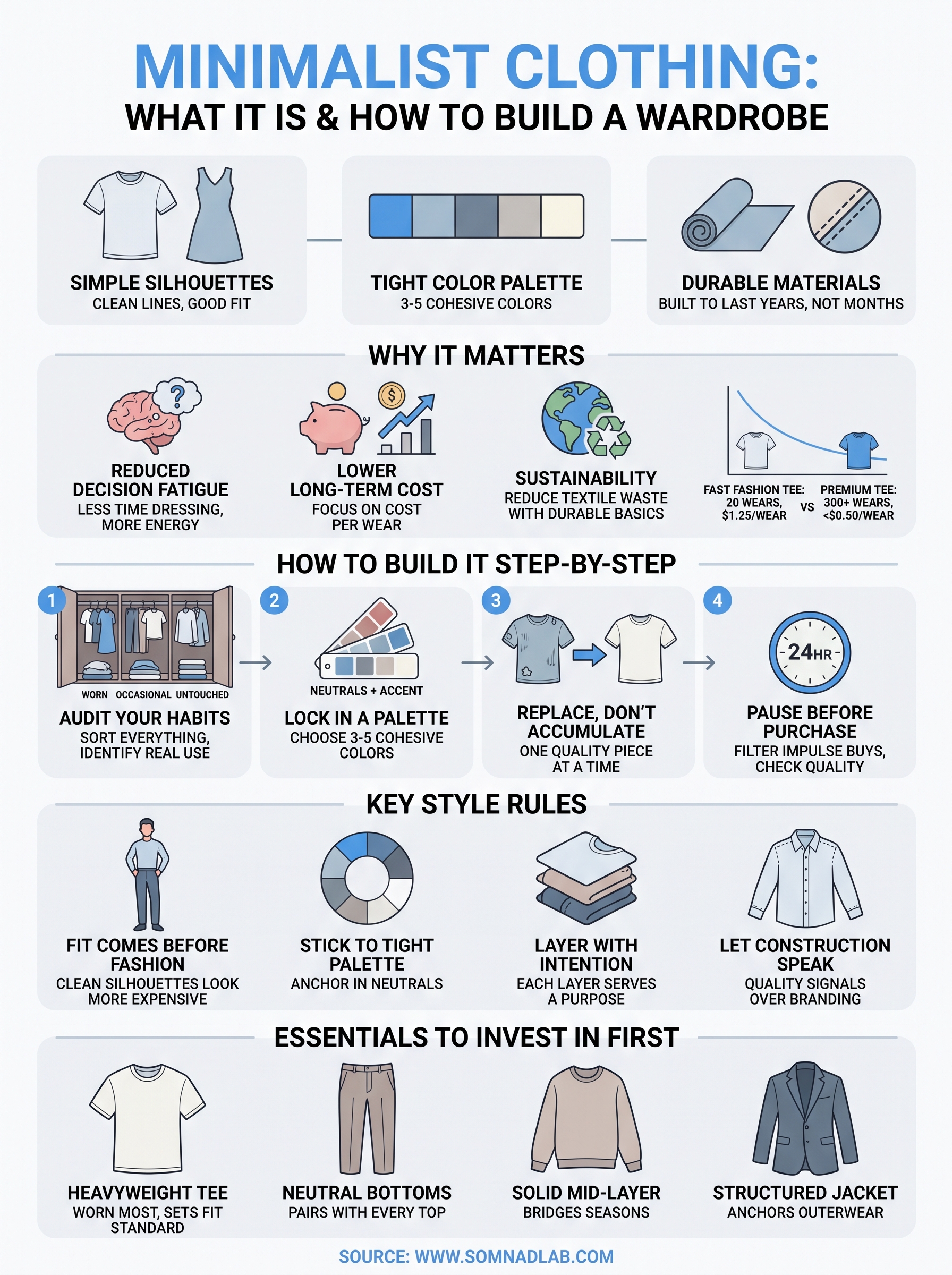
Minimalist clothing isn't about owning as little as possible. It's about owning the right things, so every piece earns its spot in the rotation. Once you understand what is minimalist clothing at its core, fabric, fit, and restraint over branding, the rest of the process is just patience and a willingness to buy less but buy right.
Start small. Audit your closet, lock in your palette, and replace one worn-out basic at a time with something built to last. The goal isn't a closet that photographs well, it's one that works every single morning without a second thought.
If you're ready to put that first heavyweight tee into rotation, one built from real 300g Supima cotton instead of the thin stuff that pills by week three, shop the relaxed tee at SÖMNAD and see what less, but better, actually feels like.