


Most guys don't have a wardrobe problem, they have a clutter problem. Drawers stuffed with impulse buys, sale-rack pickups that never quite fit right, and a rotating pile of shirts that lost their shape after three washes. Figuring out how to build a men's wardrobe from scratch isn't really about buying more. It's about buying with intention.
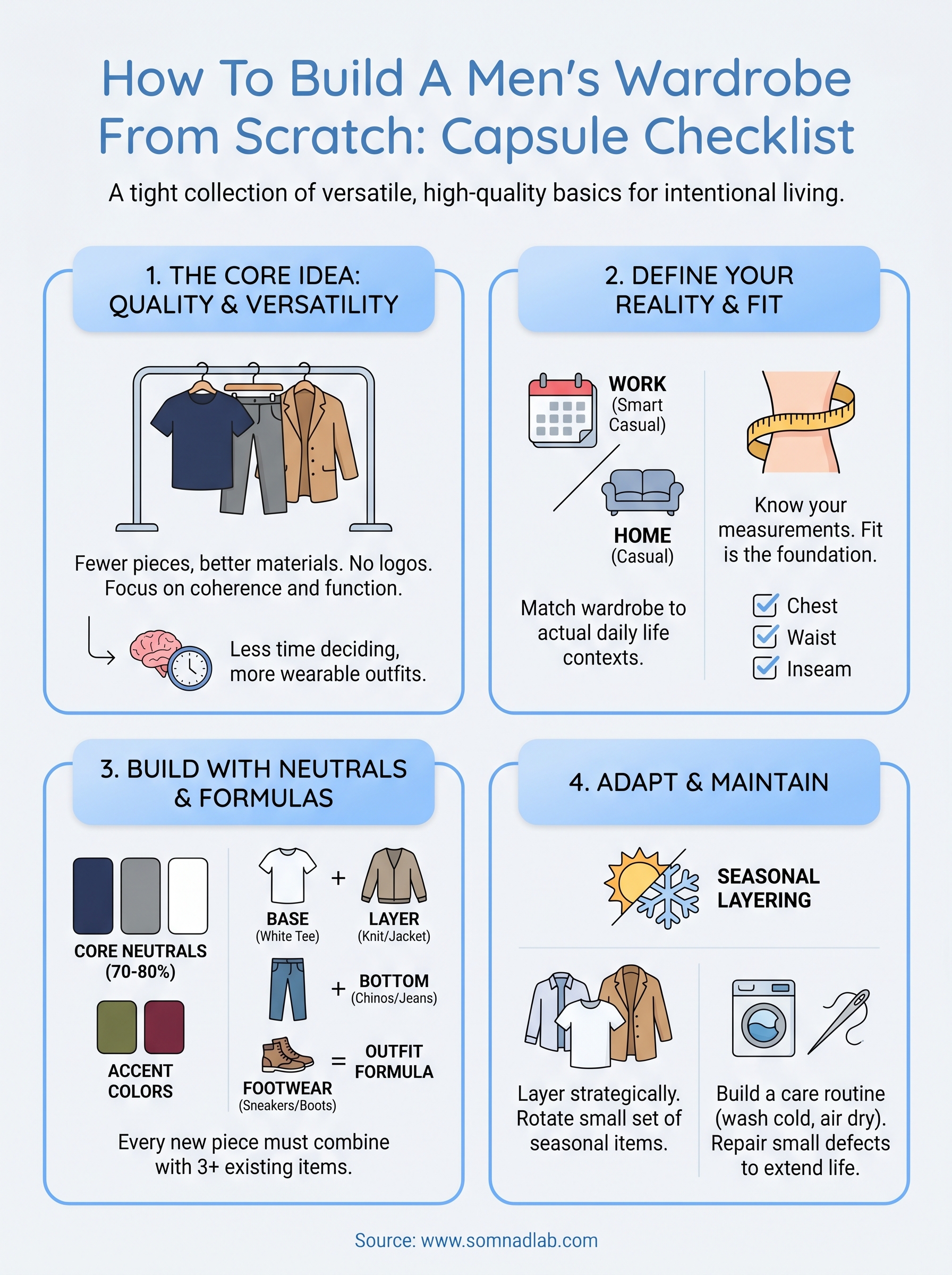
A capsule wardrobe strips things down to the pieces that actually earn their place in your rotation. We're talking about a tight collection of versatile, high-quality basics that mix and match without thinking, the kind of items you reach for every single day. That philosophy sits at the core of what we do at SÖMNAD: fewer pieces, better materials, no logos or gimmicks standing in for real craftsmanship.
This guide walks you through the full process, piece by piece. You'll get a practical checklist of foundational items, from tees and outerwear to trousers and footwear, along with the reasoning behind each pick so you're not just copying a list but actually understanding what makes a wardrobe work. Whether you're starting completely fresh or gutting a closet that stopped serving you, this framework gives you a clear path from empty hangers to a wardrobe you won't second-guess.
What a capsule wardrobe is and why it works
A capsule wardrobe is a small, curated collection of clothing where every item fits well, matches with the others, and holds up over time. The term was coined by London boutique owner Sheila Hicks in the 1970s and later brought to wider attention through Donna Karan's "Seven Easy Pieces" collection in 1985. The concept is straightforward: own less, use more. Instead of filling a closet with pieces you rotate through once a year, you build a tight foundation of items you actually reach for every week.
The core idea behind a capsule wardrobe
The capsule model works on one principle: every item earns its place by being versatile enough to combine with multiple other pieces you already own. A well-chosen pair of chinos, for example, pairs with a basic tee, a button-down, and a knit layer without looking forced. When you think about how to build a men's wardrobe this way, the goal isn't volume. It's coherence. Each piece connects to the others, which means you spend less time staring at a full closet feeling like you have nothing to wear.
Most capsule wardrobes for men land between 30 and 40 total items, including clothing, shoes, and outerwear. The exact number matters less than the logic behind each pick. If you can't explain in one sentence why something belongs, it probably doesn't.
A capsule wardrobe isn't a restriction. It's a framework that gives you a clear answer every morning.
Why most wardrobes fail without this structure
Without a system, most closets become a collection of one-off purchases and impulse buys that don't connect. You buy a shirt because it's on sale, a jacket because it looked good on a mannequin, and a pair of trousers that technically fits but doesn't work with anything else you own. Over time, the closet fills up while the actual number of wearable outfits stays small.
The problem isn't spending too little or too much. It's the absence of clear selection criteria. When you don't know what role a piece is supposed to fill, you end up with duplicates in some categories and gaps in others. You might own four hoodies and zero versatile trousers. A capsule approach fixes this by forcing you to think in terms of function and coverage before you buy anything.
How the capsule approach changes the way you shop
Thinking in capsule terms shifts your relationship with shopping from reactive to deliberate and intentional. Instead of browsing and grabbing whatever catches your eye, you start from a list of specific gaps. You know you need one versatile jacket. You know your white tee is starting to lose its shape. You buy with a defined purpose rather than a vague sense that you need more.
This shift also tends to push your spending toward quality over quantity. When you know you're going to wear something 150 times instead of 15, the calculation changes completely. A tee made from heavyweight Supima cotton that holds its shape through repeated washing makes far more sense than three cheaper ones that don't. Better construction pays for itself when you stop replacing things every season.
Step 1. Define your lifestyle and dress code
Before you buy a single item, you need to understand where you actually go and what you actually do. This step is where most wardrobe builds go sideways. People copy a capsule list from a blog without stopping to ask whether those pieces match their real daily life. A freelance designer working from home has completely different needs from a financial analyst commuting five days a week.
Map out how you actually spend your time
Start with a simple audit. Think about a typical two-week period and write down the contexts you dress for. Here's a useful template to work from:
| Context | Days per week | Required formality |
|---|---|---|
| Work or office | e.g., 4 days | Smart casual / business |
| Remote or home | e.g., 2 days | Casual |
| Social outings | e.g., 3 evenings | Casual to smart casual |
| Exercise | e.g., 5 mornings | Athletic |
| Errands / travel | Daily | Casual |
Fill this in honestly. Your wardrobe should reflect how you spend most of your time, not the lifestyle you'd like to have. If you work from home four days a week, you don't need seven dress shirts. You probably need two and a strong lineup of quality casual basics.
Build for the life you actually live, not the one that looks good on a mood board.
Match your pieces to your dress code reality
Once you see your breakdown on paper, you can assign rough percentages to each category. If 60% of your days are casual, casual pieces should make up roughly 60% of your capsule. This prevents the common mistake of building a wardrobe that's completely lopsided toward one end of the formality spectrum.
Understanding how to build a men's wardrobe that works long-term means factoring in dress code expectations at your specific workplace or social environment. "Smart casual" means different things in a Brooklyn creative agency versus a law firm in Dallas. Take 10 minutes to define what it actually means where you operate. From there, every item you choose has a clear role to play, and you stop buying things that technically fit the category but don't fit your actual context.
Step 2. Choose a core color palette that mixes easily
Color is the invisible system behind every outfit you pull together without thinking. When all your pieces share a common palette, you can grab almost anything from your closet and know it will work together. This is one of the most overlooked steps when figuring out how to build a men's wardrobe, and skipping it is exactly why people end up with items that sit unworn because nothing else pairs with them.
Start with neutrals as your foundation
Your neutral base is the backbone of the entire capsule. Neutral colors - white, black, navy, grey, and tan - mix with each other and with almost anything else you add later. The goal is to make roughly 70 to 80 percent of your capsule neutral, so that outfit-building happens automatically rather than requiring deliberate effort every morning.
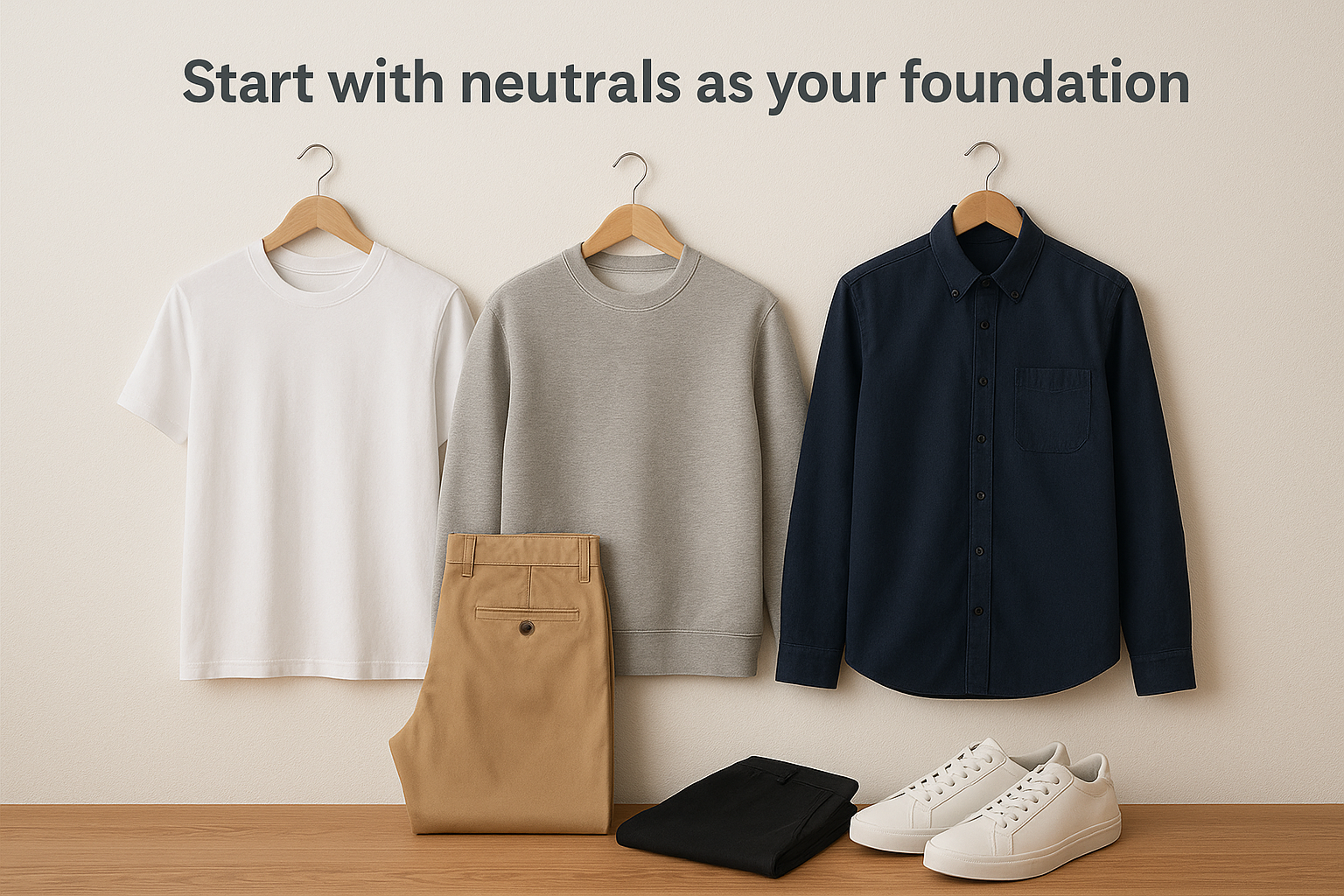
Here's a practical breakdown of the core neutrals and what they work best for:
| Neutral | Best used for | Works with |
|---|---|---|
| White | T-shirts, shirts, sneakers | Everything |
| Navy | Trousers, outerwear, knitwear | Grey, white, tan, olive |
| Grey | Sweatshirts, trousers, tees | Navy, white, black |
| Black | Trousers, shoes, outerwear | White, grey, navy |
| Tan / Camel | Chinos, coats, boots | Navy, white, grey |
Most capsule wardrobes work best anchored in navy, grey, and white because those three neutrals create natural contrast without requiring any coordination effort. Start by building your foundational pieces around two or three of these before introducing anything else.
Add one or two accent colors strategically
Once your neutral base is in place, you can bring in one or two accent colors that reflect your personal preference without breaking compatibility. Olive green, burgundy, and earthy browns all integrate cleanly into a neutral-based wardrobe. The key constraint is that your accents should still combine with multiple neutral pieces you already own, not just one specific item.
Pick accent colors that appear in nature. They tend to harmonize with neutrals far more reliably than bright or saturated tones.
Avoid introducing more than two accent colors at this stage. Every new hue you add requires more mental work when building outfits, which defeats the purpose of a capsule system designed around simplicity and consistency.
Step 3. Use the capsule checklist to cover every day
A checklist turns the abstract idea of a capsule wardrobe into something you can act on immediately. Without a reference list, you'll either overbuy in one category or completely miss another. The checklist below covers every major clothing category a man needs for daily life, from the most casual situations to occasions that require a sharper look. Work through it category by category rather than buying everything at once.
The core capsule checklist
The items below represent the functional foundation of a men's capsule wardrobe. Each piece fills a specific daily role, and every item should connect to at least three others in your collection. Use this as your master buying guide, checking off pieces you already own and flagging the specific gaps you need to fill.
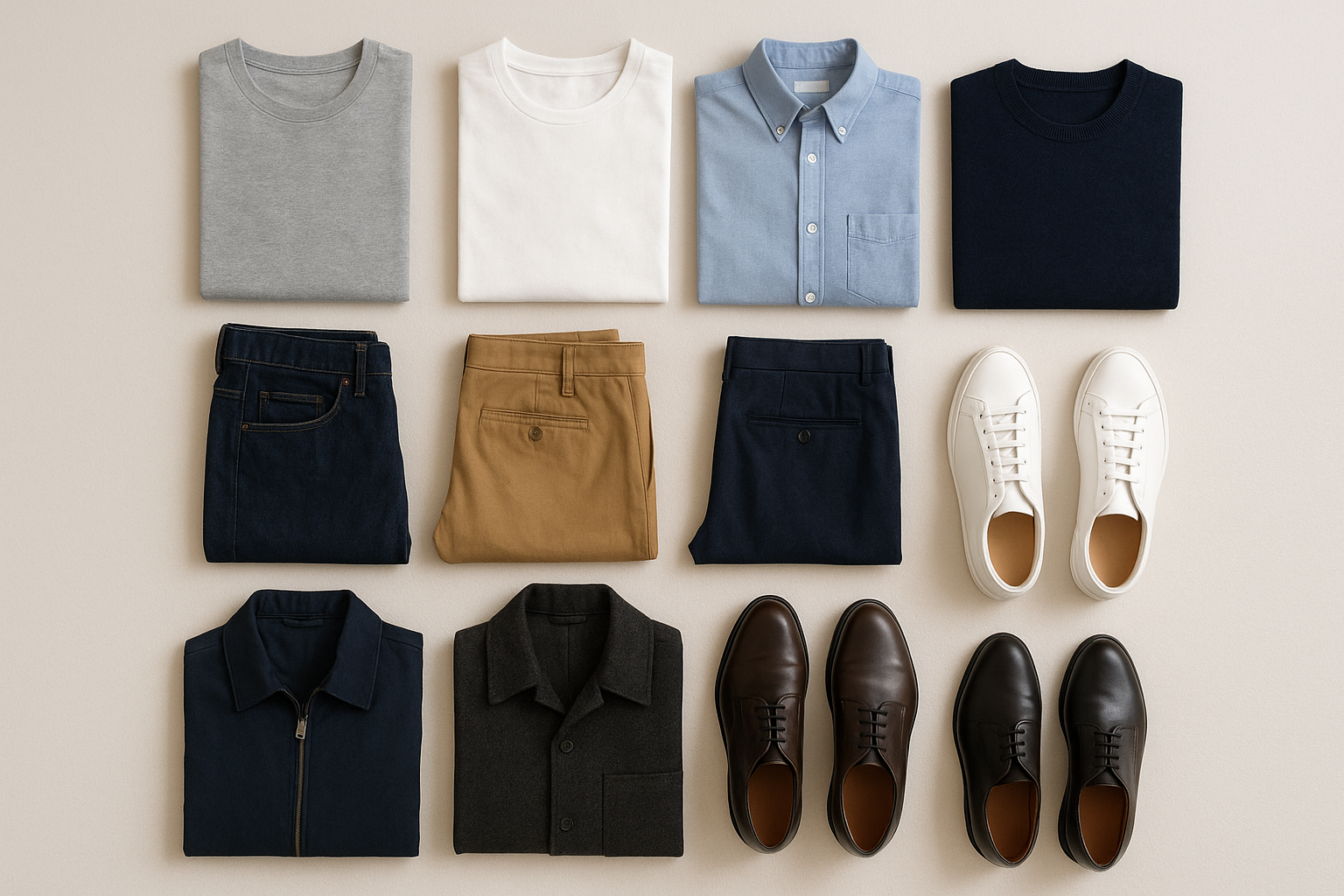
| Category | Item | Quantity |
|---|---|---|
| Tops | White T-shirt (heavyweight, fitted) | 3 |
| Tops | Grey or navy T-shirt | 2 |
| Tops | Oxford button-down shirt | 2 |
| Tops | Crewneck sweatshirt | 1 |
| Tops | Merino wool knit or sweater | 1 |
| Bottoms | Dark-wash slim or straight jeans | 1 |
| Bottoms | Chinos (tan or navy) | 2 |
| Bottoms | Tailored or smart trousers | 1 |
| Outerwear | Lightweight jacket (harrington or bomber) | 1 |
| Outerwear | Mid-layer (overshirt or wool coat) | 1 |
| Footwear | White leather sneakers | 1 pair |
| Footwear | Chelsea boots or Derby shoes | 1 pair |
| Footwear | Clean casual sneaker (backup) | 1 pair |
A good capsule doesn't try to cover every situation. It covers the situations you actually face, reliably and without excess.
How to prioritize what you buy first
Knowing how to build a men's wardrobe in a practical order matters as much as knowing what to buy. Start with your highest-frequency items, the pieces you'll wear most often. For most men, that means quality T-shirts and well-fitting trousers before anything else. Once your daily basics are locked in, move to outerwear and footwear, which tend to carry more cost per item but cover multiple contexts at once.
Don't buy the full checklist in a single session. Build in stages, starting with the three or four items that solve your most immediate gaps, then adding the rest over the following weeks as you identify what's missing from actual daily use. Your wardrobe will be more intentional and more useful for the patience.
Step 4. Nail fit first so everything looks better
Fit is the single variable that separates a wardrobe that looks sharp from one that looks like a pile of clean laundry. No material quality or color coordination compensates for a shirt that billows at the torso or trousers that bunch at the crotch. When you're working out how to build a men's wardrobe, fit isn't a finishing touch you address later. It's the foundation every other decision rests on.
Know your measurements before you shop
Most men guess at their sizing, which explains why so many purchases end up wearable but never quite right. Taking your actual measurements takes about five minutes and eliminates the guesswork that leads to returns, alterations, and items that sit unworn. Write these down and keep them accessible when you shop, particularly online where you can't try anything on first.
Here are the core measurements to track before buying anything:
| Measurement | How to take it | Why it matters |
|---|---|---|
| Chest | Tape around fullest part, arms relaxed | Shirts and jacket sizing |
| Waist | Tape around natural waist, not belt line | Trousers and chinos |
| Hip | Fullest point around the seat | Fit through trousers |
| Inseam | Crotch to ankle, standing straight | Trouser length |
| Shoulder width | Seam to seam across the back | Jackets and shirts |
| Neck | Around base of neck, add 0.5 inch | Dress shirt collars |
Size labels vary significantly between brands, so your measurements matter far more than the number on a tag.
Recognize the signs of poor fit
A few clear indicators tell you immediately whether a piece fits or simply fits over your body. On a T-shirt, the shoulder seam should sit exactly at the edge of your shoulder, not drooping onto your arm or pulling inward toward your neck. The hem should fall at or just below your hip bone when untucked.
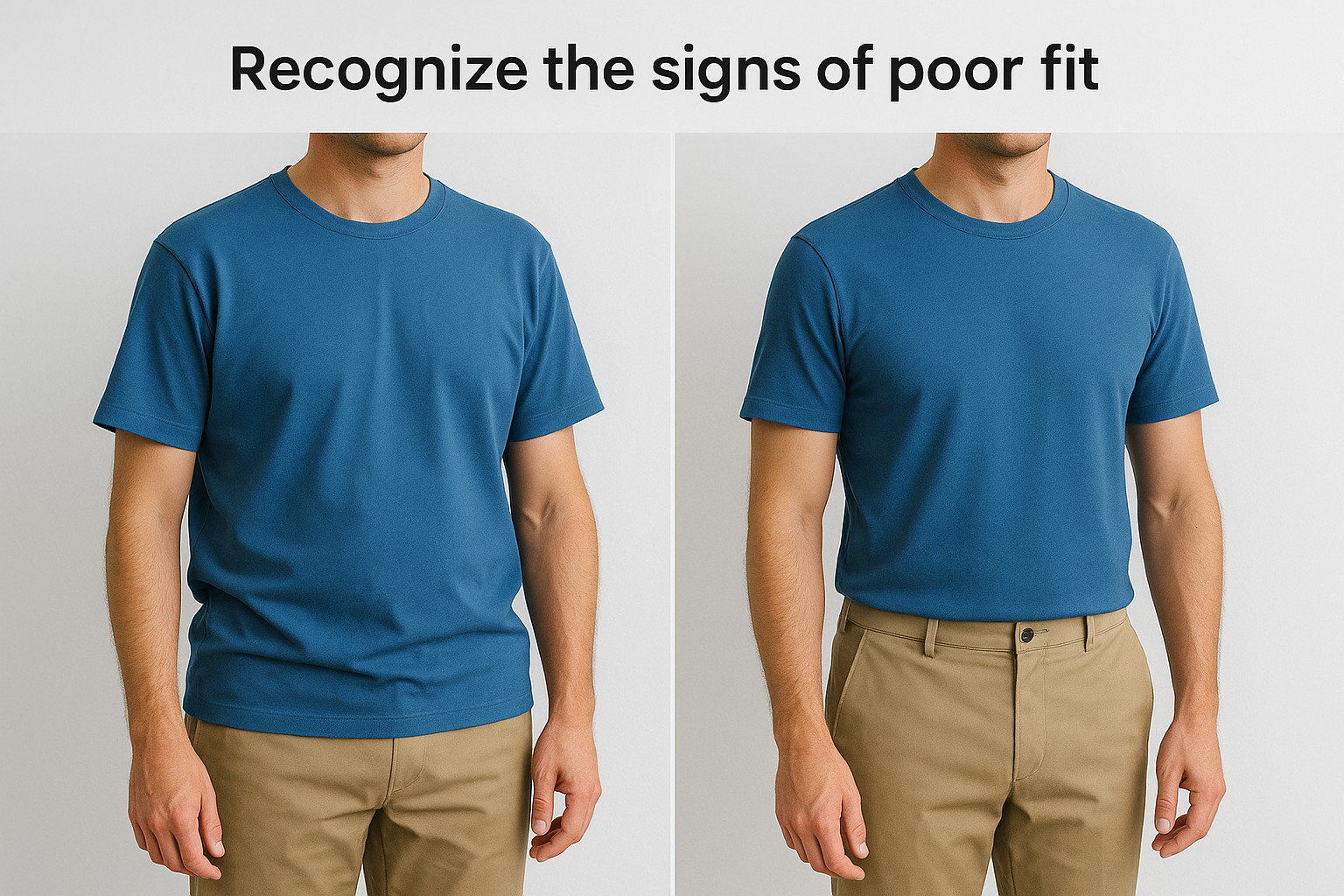
Fit problems that require more than minor tailoring mean the piece is the wrong size, not the wrong style.
On trousers, the fabric should drape cleanly from hip to knee without excess bunching at the thigh or pulling tight across the seat. A clean, unbroken line from waist to hem signals the right fit. Tension across any point signals the wrong size entirely, and no amount of wearing in will fix that.
Step 5. Shop in the right order and avoid mistakes
The sequence in which you shop matters more than most men realize. Buying outerwear before your basics are locked in almost guarantees you'll end up with a jacket that pairs with two items instead of eight. When you understand how to build a men's wardrobe as a system with layers, the order of purchases becomes obvious: ground floor first, everything else after.
Buy foundations before accent pieces
Your highest-frequency items should come first, every time. Basics like T-shirts, chinos, and a versatile pair of trousers form the connective tissue of your entire capsule. Outerwear and footwear are more expensive per item and more visible, so buying them before your basics are settled means you're designing around the wrong anchor points.
Follow this buying sequence to keep your spending aligned with actual need:
- Core tops first: white T-shirts, one grey or navy tee, one Oxford shirt
- Trousers and bottoms second: chinos, dark jeans, one pair of smart trousers
- Footwear third: white sneakers and one leather shoe or boot
- Outerwear last: lightweight jacket, then a heavier mid-layer once the rest is in place
Buy each layer only after the layer beneath it is solid. That constraint keeps your purchases connected instead of random.
The mistakes that derail most wardrobe builds
Even with a solid checklist, a few predictable mistakes push people off course. Recognizing these before you shop saves both money and the frustration of a closet that looks full but doesn't function.
Avoid the following when shopping your capsule:
- Buying items on sale that don't fill a gap: a discount isn't a reason to buy something you didn't already need
- Prioritizing visual appeal over fit: a well-made piece in the wrong size is a wasted purchase
- Shopping multiple categories in one session: decision fatigue leads to compromises you'll regret
- Skipping brand size charts: sizing varies enough between labels that your usual number is often unreliable
- Replacing items before they're actually worn out: hold off until a piece genuinely needs replacing, not just because a newer version exists
Treating each purchase as a gap-fill rather than an opportunity keeps your capsule tight and your spending intentional from the start.
Step 6. Build outfits fast with simple formulas
A capsule wardrobe only saves you time if you know how to pull it together quickly. This is where outfit formulas come in. Rather than deciding from scratch each morning, you work from a small set of proven combinations that always land well. Understanding how to build a men's wardrobe isn't just about what you own; it's about knowing how to deploy it without effort.
Three formulas that work every time
Three reliable outfit structures cover roughly 90 percent of the daily situations you'll face. Each formula is built around a base, a layer, and a bottom, with footwear as the final variable that shifts the tone up or down.
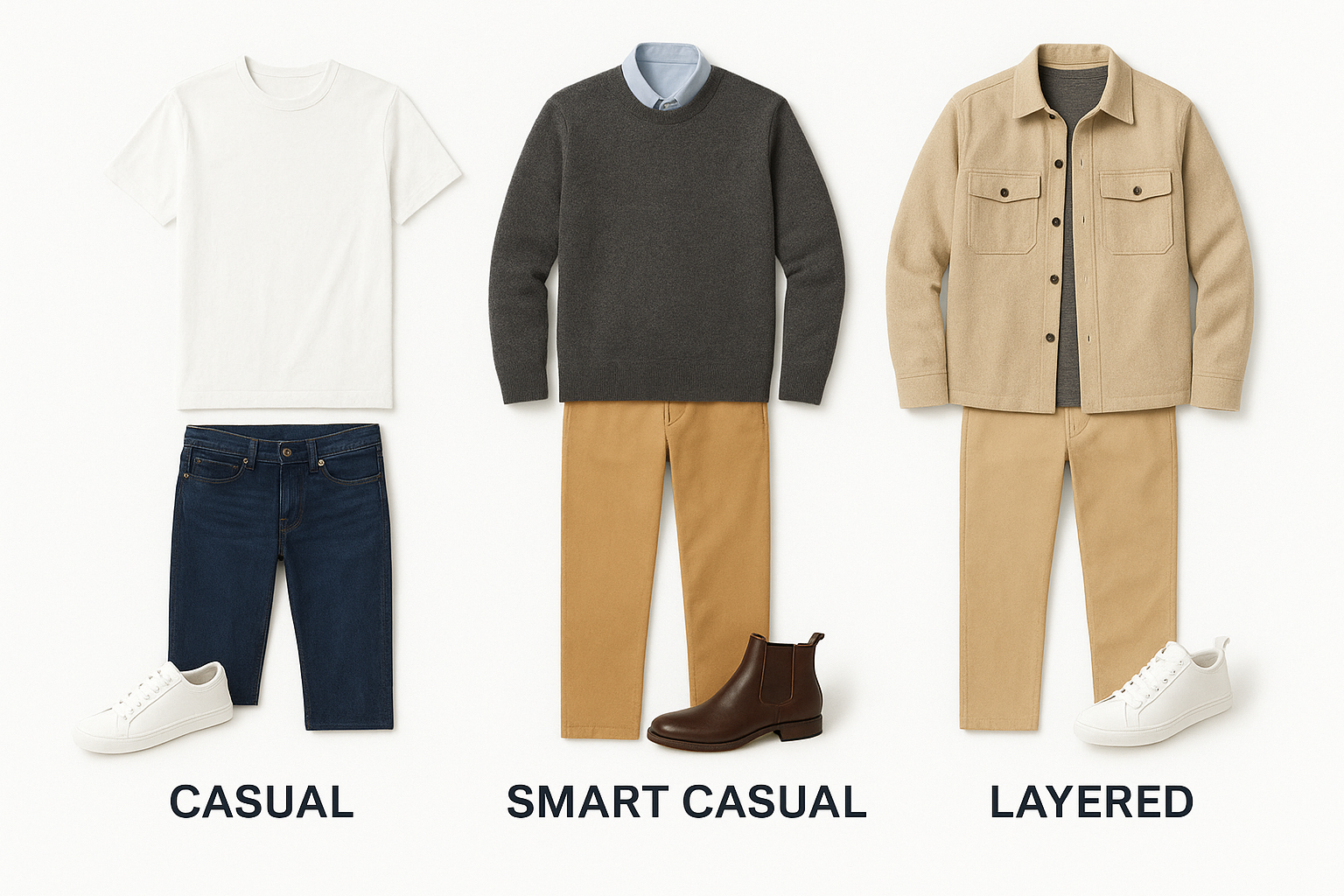
| Formula | Top | Layer | Bottom | Footwear |
|---|---|---|---|---|
| Casual | White tee | None | Dark jeans | White sneakers |
| Smart casual | Oxford shirt | Merino knit | Chinos | Chelsea boots |
| Layered | Tee | Overshirt or jacket | Chinos | Clean sneaker or boot |
Each of these formulas works with the neutral palette you established earlier, which is why color coordination is a step you handle in advance rather than solve on the spot. Swap one element per formula and you immediately have a second outfit without rebuilding from scratch.
A formula isn't a uniform. It's a starting point you adjust without losing the logic behind it.
How to get more combinations from fewer pieces
The multiplication principle behind a capsule wardrobe is straightforward: every new piece you add should combine with at least three items you already own, not just one. A navy chino that works with your white tee, your merino knit, and your Oxford shirt adds three outfits to your rotation without adding any clutter.
Run through the combination test before buying anything new. Take the piece you're considering and count how many existing items it pairs with cleanly. If the number sits below three, you either don't need that piece yet or your capsule has a gap elsewhere that needs filling first.
Tracking your combinations doesn't require anything complicated. A quick note listing your current pieces and their pairings takes ten minutes and saves you from buying items that sit isolated rather than integrated into the rest of what you own.
Step 7. Adapt the capsule for weather and seasons
A capsule wardrobe isn't a static object you build once and never touch. Weather and temperature shifts require adjustments, but the goal is to make those adjustments in a way that doesn't bloat your closet or break the coherence you've already built. Understanding how to build a men's wardrobe that holds up across all four seasons means thinking in terms of layers and small rotations, not complete seasonal overhauls.
Layer strategically instead of rebuilding
The most efficient way to handle seasonal change is through layering, not replacement. Your core neutral pieces stay in rotation year-round, and you adjust the layers around them as temperature dictates. A white tee and chinos function in July with nothing over them and in November under a heavyweight knit and a structured outer layer.
Use this seasonal layering framework as a reference point:
| Season | Core pieces stay | Add | Remove |
|---|---|---|---|
| Spring | Tees, chinos, Oxford shirt | Lightweight jacket, loafers | Heavy coat, wool knit |
| Summer | Tees, chinos, sneakers | None needed | All outer layers |
| Fall | Tees, chinos, Oxford shirt | Overshirt, Chelsea boots, knit | Lightweight jacket |
| Winter | Chinos, Oxford shirt, knit | Wool coat, heavyweight tee as base | Sneakers (swap for boots) |
The items that shift with seasons are always the outermost layers, which means your foundation never changes. That stability is what keeps outfit formulas intact through the year without requiring you to re-learn your wardrobe every three months.
Rotate a small set of seasonal additions
Rather than storing an entirely separate wardrobe for each season, keep a rotation of four to six seasonal items that you swap in and out of active use. A single wool coat, one heavyweight knit, and a pair of leather boots cover everything you need from October through March in most US climates.
Treat seasonal pieces as temporary additions to your permanent foundation, not replacements for it.
When a seasonal item goes out of rotation, store it clean and folded. Washing before storage prevents fabric degradation from skin oils and light exposure, which is the main reason seasonal pieces come back looking worn out after months in a drawer. A small, intentional rotation kept in good condition extends the life of every piece significantly.
Step 8. Maintain, repair, and replace with a system
Knowing how to build a men's wardrobe is only half the work. The other half is keeping it functional over time. A capsule fails when pieces degrade faster than expected, when small repairs get ignored until an item is unwearable, or when replacements happen too late and leave gaps in your daily rotation. A basic maintenance system prevents all three problems before they start.
Build a simple care routine
How you wash and store your clothes determines how long they hold their shape and color. Most fabric damage happens in the laundry, not through wear. Washing on high heat, overloading the machine, and machine-drying items that should air-dry shortens the useful life of a garment significantly.
Follow these care rules as defaults across your capsule:
- Wash tees and cotton basics inside out on a cool or warm cycle to protect color and fiber integrity
- Air-dry merino wool and knits flat to prevent stretching under their own weight
- Hang trousers and button-downs immediately after washing to reduce creasing before it sets
- Wash denim no more than once every four to five wears to preserve the fabric and structure
- Store seasonal items clean, never with food stains or body oils left in the fabric
The single biggest cause of premature wardrobe replacement is washing items more aggressively than the material requires.
Know when to repair versus replace
Small defects become irreversible if you leave them long enough. A loose button reattached in two minutes prevents a shirt from becoming unwearable. A seam that starts to open along the hem of a tee can be hand-stitched back in under five minutes with a needle and matching thread.
Use this quick decision framework to decide between repair and replacement:
| Issue | Action |
|---|---|
| Loose or missing button | Repair, takes under 5 minutes |
| Small seam separation | Repair with hand stitch |
| Pilling on knit surface | Remove with a fabric shaver |
| Thinning fabric at collar or cuffs | Replace |
| Permanent stain or structural damage | Replace |
Replacing items on a schedule rather than a need wastes money and breaks the intentional logic behind a capsule. Check your core pieces twice a year, around spring and fall, and replace only what has genuinely reached the end of its functional life.
A simple way to keep it going
Once you understand how to build a men's wardrobe that actually works, keeping it functional is straightforward. Run a quick audit twice a year, checking each piece against two questions: does it still fit well, and does it still connect to at least three other items you own? If the answer to either question is no, you have a clear decision in front of you.
Your system holds up best when the foundation is built from pieces that last. Quality basics that hold their shape and structure reduce how often you need to replace anything, which keeps your capsule tight and your spending low over time. That's the logic behind starting with well-made essentials rather than cheaper items you'll cycle through every season. If you're looking for a clear starting point, SÖMNAD's everyday essentials are built around exactly that standard: superior materials, clean fit, and no unnecessary markup standing in for real craftsmanship.