


You've seen the label. You've noticed the price difference. Now you're asking: is Supima cotton worth it, or is it just another premium markup on a basic material? It's a fair question, especially when a regular cotton t-shirt costs a fraction of the price and looks nearly identical on the hanger.
Here's what most people miss: the difference between Supima and standard cotton isn't obvious at first glance. It shows up after the fifth wash, after the tenth, after six months of steady wear. It's in the fibers, literally. Supima cotton uses extra-long staple fibers that are stronger, softer, and more resistant to pilling than what you'll find in conventional cotton. That's not marketing language. It's measurable.
At SÖMNAD, we build our essentials from 300g Supima cotton because we've tested the alternatives and none of them hold up the same way. Our entire approach, quality fabric, clean fit, no logos, depends on the material doing the talking. So we have a direct stake in this question, and we'd rather give you the full honest breakdown than a sales pitch.
This article covers what makes Supima cotton different from regular and Pima cotton, where it actually outperforms, where the price gap is justified, and where it might not be, so you can decide for yourself.
Why Supima cotton costs more
The price gap between Supima and standard cotton isn't arbitrary. Several specific factors drive the cost up at every stage of production, from the seed in the ground to the finished garment on the shelf. Understanding these factors matters when you're deciding whether Supima cotton is worth it for what you're buying.
The fiber itself is fundamentally different
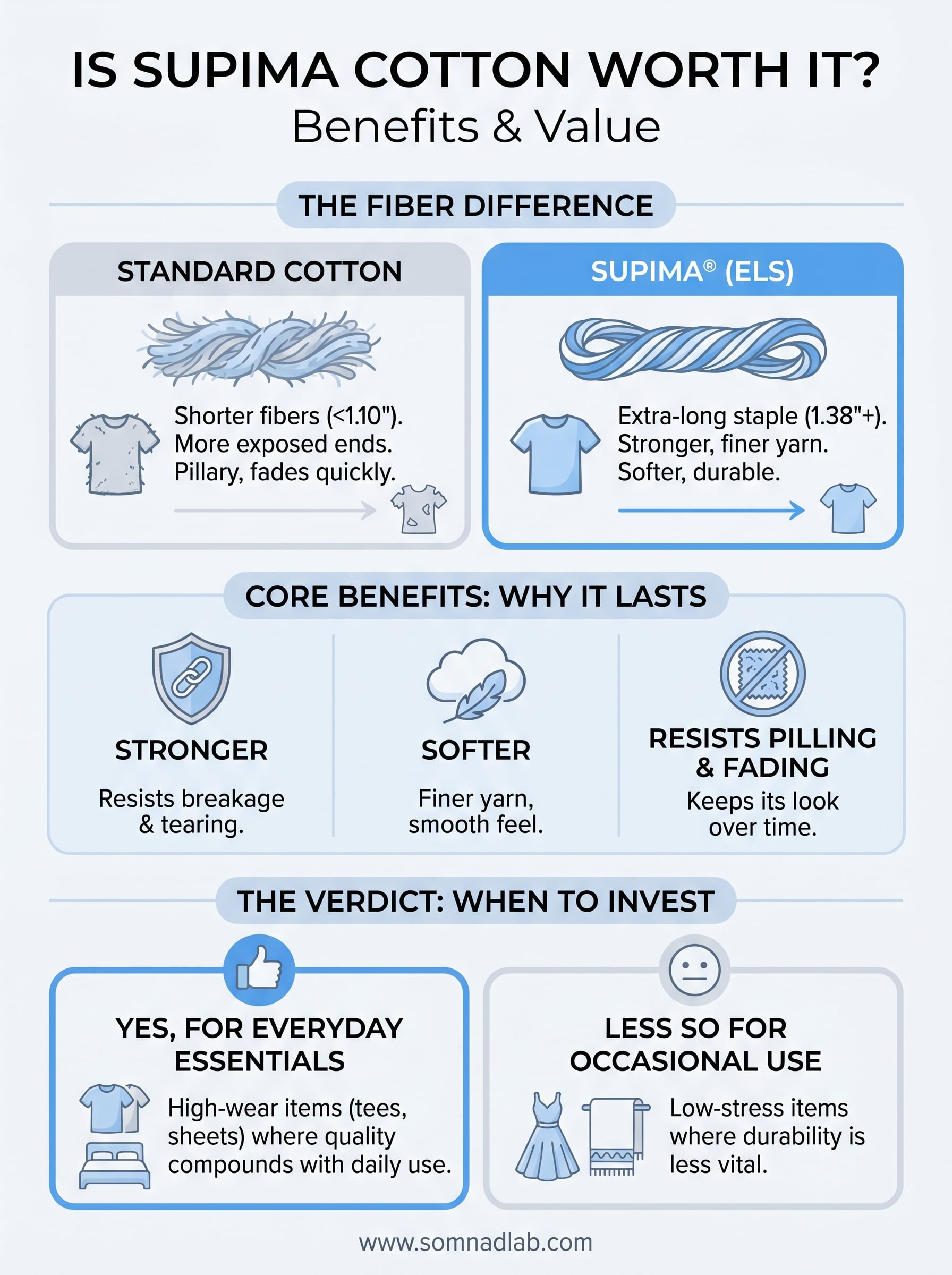
Supima cotton is made from extra-long staple (ELS) fibers, which measure at least 1.38 inches in length. Regular cotton fibers typically measure between 0.75 and 1.10 inches. That difference sounds small, but longer fibers create a stronger, finer yarn because they wrap around each other more times per inch. The result is a thread with fewer exposed fiber ends, which directly reduces pilling, breakage, and surface fuzz after washing.
Fiber length is the single biggest predictor of cotton quality. Longer fibers produce finer, stronger yarn, and Supima's ELS classification is what separates it from the rest.
Only about 1% of all cotton grown worldwide qualifies as extra-long staple. Of that, Supima specifically refers to ELS cotton grown in the United States, primarily in California, Arizona, New Mexico, and Texas. That narrow geographic and quality window keeps supply deliberately tight, which pushes prices up before a single thread is spun.
Controlled supply and certification
Supima is a trademarked certification, not just a cotton variety. The Supima Association of America oversees the licensing, which means manufacturers must meet documented standards before they can use the name on a label. This adds an accountability layer at every point in the supply chain, but it also adds real cost.
Farmers growing Supima cotton tend to work smaller plots in arid climates with specific irrigation requirements. The crop yields less cotton per acre than commodity cotton grown at scale. Combined with stricter quality grading at harvest, this means less of what's picked even qualifies for the Supima designation, which tightens supply further and raises the per-unit price across the board.
Processing and yarn construction
Once harvested, Supima cotton requires more careful processing to preserve what makes it valuable. Aggressive industrial combing can break longer fibers or reduce their usable length. Mills that work with ELS cotton invest in equipment calibrated specifically for it, and they run smaller, more controlled production batches rather than high-volume commodity runs.
Spinning ELS fibers into yarn is also more technically demanding. Because the fibers are finer, the resulting yarn needs tighter tolerances throughout production. Brands that source Supima correctly, meaning they trace it through licensed mills and verify the chain of custody, pay a documented premium at every stage: fiber, yarn, fabric, and finishing.
What you're actually paying for
When you look at the final price of a Supima cotton garment, you're not paying for a logo or a brand story. You're paying for a measurably denser, stronger fabric that resists the degradation that makes cheaper t-shirts look worn out within a few months. The cost-per-wear calculation often flips entirely when you account for how long Supima cotton holds its shape, softness, and color compared to standard cotton.
A basic tee made from commodity fiber might cost less upfront, but it frequently pills, fades, and loses structure within a year of regular washing. A well-constructed Supima garment, cared for properly, can hold up for several years without losing what made it feel good on day one. That changes the math significantly over time.
Supima vs regular, Pima, and Egyptian cotton
Knowing how Supima stacks up against its alternatives helps you make a smarter buying decision. The cotton market uses a lot of terms that sound similar, and brands sometimes use them loosely. Understanding the real differences tells you whether the premium you're paying for Supima is justified compared to what else is available.
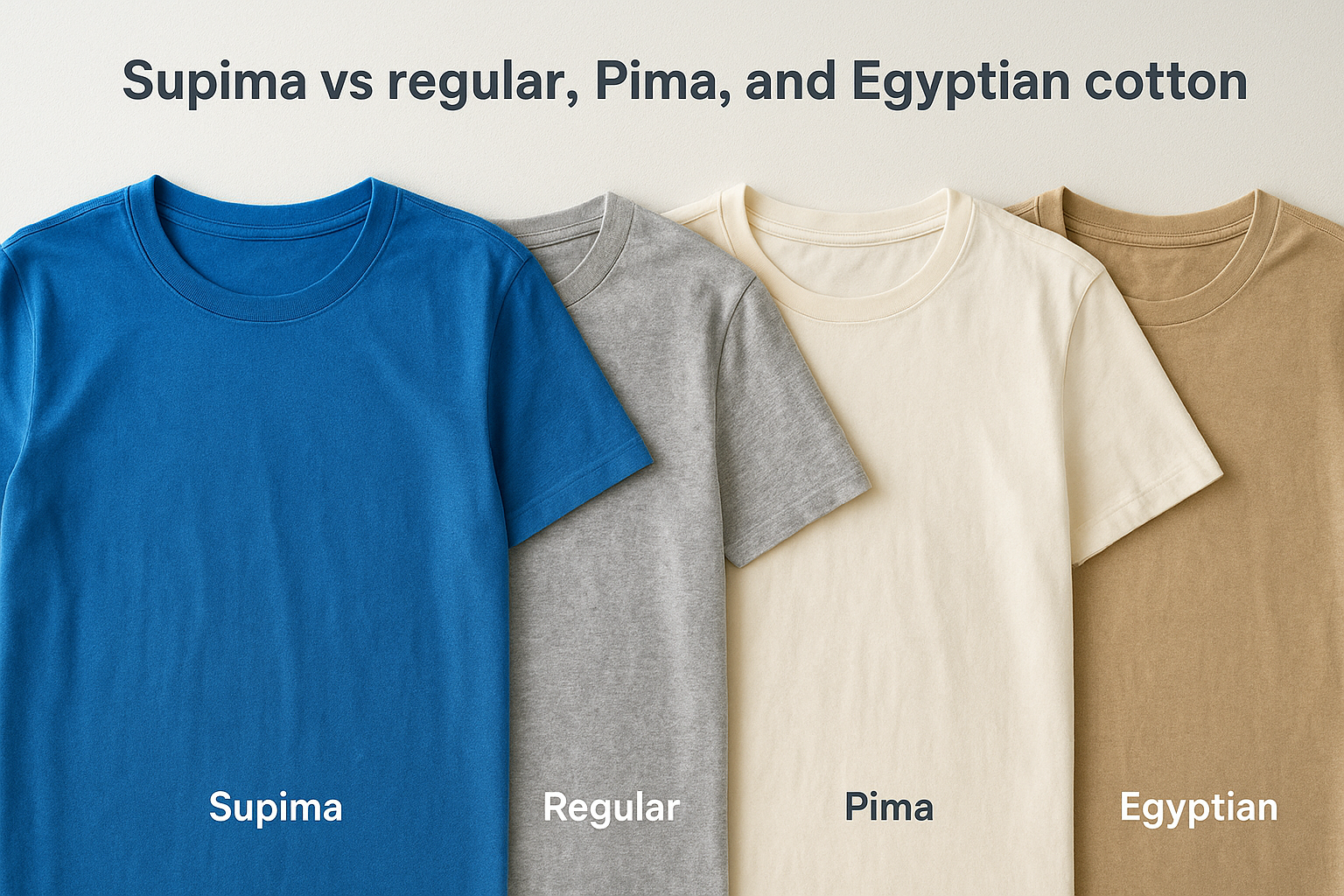
Supima vs regular cotton
Regular commodity cotton uses short to medium staple fibers, typically under 1.10 inches in length. These shorter fibers produce a coarser yarn with more exposed fiber ends, which is why standard cotton t-shirts tend to pill, fade, and lose their shape after repeated washing. The performance gap is measurable: where a regular cotton tee might look noticeably worn after six months of steady use, a comparable Supima garment holds its surface texture and color considerably longer.
If you're deciding whether Supima cotton is worth it over regular cotton, the answer depends on how often you'll wear and wash the item. For everyday essentials you reach for constantly, the fiber quality difference shows up quickly and keeps compounding over time.
Supima vs Pima cotton
Pima cotton is also an extra-long staple variety, which means it shares Supima's fundamental fiber advantage over commodity cotton. The key distinction is origin and oversight: Pima cotton can be grown anywhere, including Peru and Australia, and it doesn't carry the same certification and supply chain accountability that the Supima trademark requires. Quality varies widely under the Pima label because no central licensing body verifies each batch.
Supima is essentially Pima cotton with a verified chain of custody. Without that certification, you're trusting the brand's word on quality rather than a traceable standard.
Supima vs Egyptian cotton
Egyptian cotton has a strong historical reputation, but that reputation has been significantly diluted in recent years. Research and industry investigations have found widespread mislabeling, with products sold as Egyptian cotton containing little to none of the actual fiber. Even when genuine, Egyptian cotton quality varies considerably depending on growing region and harvest conditions.
Supima's US-grown, certified structure gives it a clear traceability advantage that most Egyptian cotton products currently lack. You can verify a Supima product's authenticity through its licensing chain in a way that isn't reliably possible with Egyptian cotton claims on the market today, which makes Supima the lower-risk choice when quality consistency matters.
When Supima cotton is worth it for you
Whether Supima cotton is worth it depends heavily on how you actually use the item. The premium makes clear sense in some situations and less sense in others. Before you commit to the higher price, it helps to think honestly about wear frequency, washing habits, and how long you expect the item to stay in rotation.
Everyday essentials you reach for constantly
If you're buying a foundational wardrobe piece you'll wear multiple times a week, Supima cotton pays for itself over time. T-shirts, crewnecks, and base layers are the best candidates because they go through the most wash cycles. Every wash cycle is another opportunity for cheaper cotton to pill, fade, or go thin at the collar, and Supima's longer fibers resist that breakdown in a way commodity cotton simply doesn't.
The higher upfront cost matters far less when you spread it across two or three years of consistent wear rather than replacing a cheaper shirt every few months.
The same logic applies to bedding you sleep on every night. Sheets and pillowcases made from Supima cotton experience heavy friction and frequent washing, exactly the conditions where longer fibers and better color retention make a noticeable difference over a year or two of use. For items like that, the investment holds up.
When the premium is harder to justify
Not every purchase warrants the Supima price point. If you're buying something you'll wear occasionally, like a seasonal layer or a piece you rotate infrequently, the durability advantage takes much longer to show up in a meaningful way. A garment that gets washed ten times a year won't demonstrate the same gap between Supima and standard cotton as one that gets washed three times a week.
Guest towels, decorative throw blankets, and similar items fall into a similar category. Light-use items simply don't stress the fabric in ways that require ELS fiber performance. Spending more on those doesn't give you a proportional return compared to spending it on the clothes you wear daily.
The clearest signal for whether Supima is worth your money is straightforward: if the item is part of your everyday routine, the quality compounds in your favor. If it sits in a drawer for most of the year, the calculus shifts. Match the material to the use case, and the premium stops feeling like a luxury and starts looking like the more practical choice.
How to shop for genuine Supima cotton
When you're deciding is Supima cotton worth it, the answer partly depends on whether you're actually buying what the label claims. Misleading cotton labeling is widespread, and paying a premium for fabric that isn't certified Supima defeats the entire purpose. Knowing exactly what to look for protects your investment before you check out.
Look for the Supima trademark directly
The most reliable signal is the official Supima trademark on the label or product page. The Supima Association of America licenses the name to brands that meet its standards and can trace their fiber through certified mills. If a brand uses the Supima name legitimately, they hold a documented license to do so, which means the claim is verifiable rather than just aspirational.
You can cross-check whether a brand holds a valid Supima license through the Supima Association's official website at supima.com, which maintains a public list of licensed partners.
When shopping online, look for the trademark listed in the product's materials breakdown or fiber description, not just buried in a headline. Brands that genuinely source Supima cotton tend to be specific about fiber origin, weight, and construction because those details reinforce the value. Vague language like "premium cotton" or "luxury soft cotton" without specifics is a warning sign that the claim may not hold up under scrutiny.
Spot the red flags in cotton labeling
Several common label tactics signal that a product may not deliver what it implies. Phrases like "Pima-style," "Egyptian-inspired," or "luxury cotton blend" have no regulatory definition and carry no certification requirement. Any brand can print them on a tag without verifiable backing. Blend percentages also matter: a shirt described as containing Supima cotton but listed as a cotton-polyester blend significantly dilutes the fiber quality you're paying for.
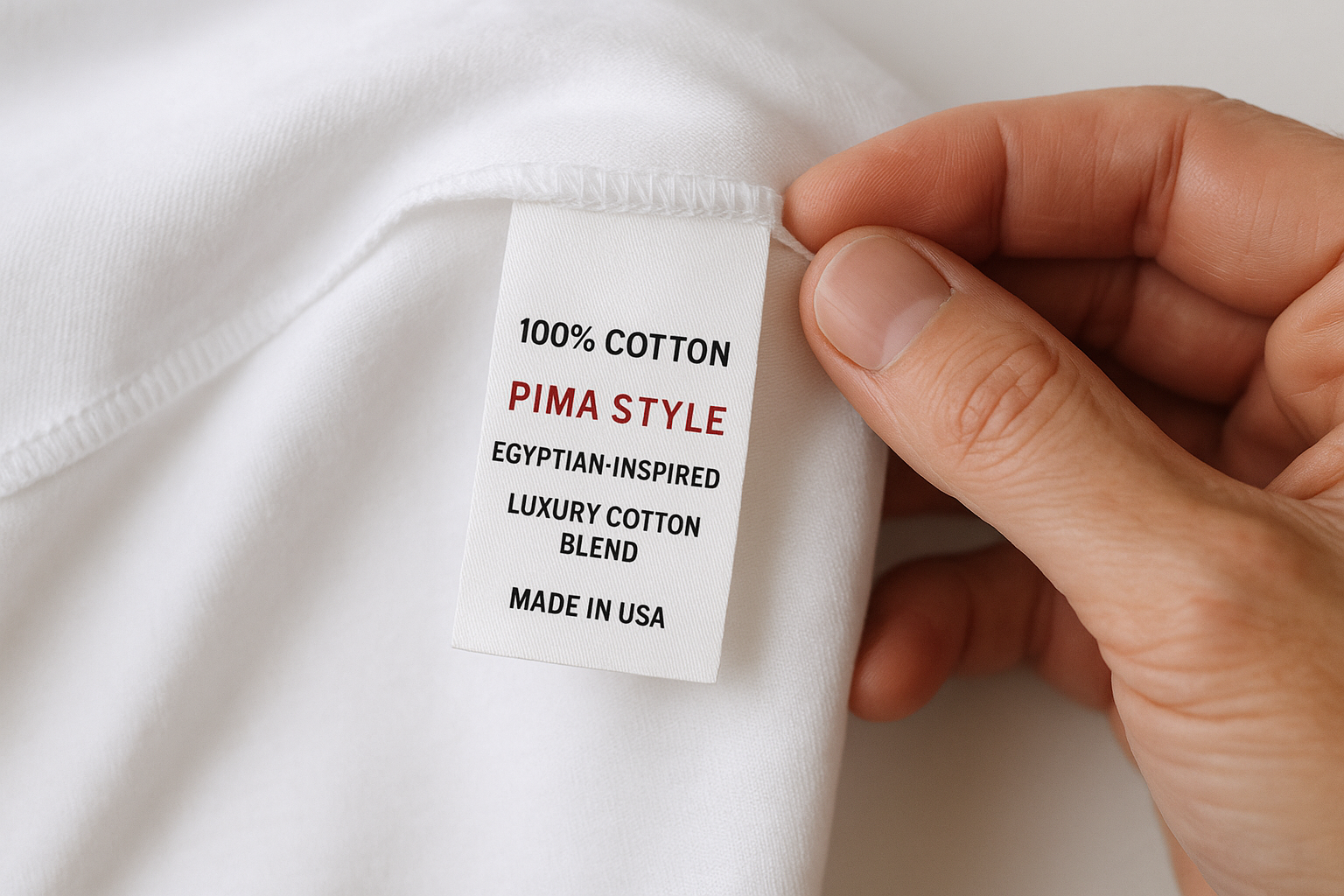
Checking the fabric weight when it's listed gives you another useful data point. Lightweight cotton, typically under 180g, is rarely genuine Supima regardless of label claims, because the cost structure of certified ELS fiber makes ultra-thin applications uncommon in quality apparel. A heavier weight in the 280g to 320g range is far more consistent with what you'd expect from a brand investing seriously in fiber and construction. Taking thirty seconds to check these details gives you a much clearer picture of what you're actually buying.
How to care for Supima cotton so it lasts
Buying genuine Supima cotton is only half the equation. How you wash, dry, and store it determines how long it actually performs. The good news is that caring for Supima cotton doesn't require any special products or complicated routines. A few consistent habits protect the fiber structure and keep the fabric feeling close to how it felt when you first wore it.
Wash it the right way
The biggest threat to any cotton fabric is excessive heat and aggressive agitation, both of which break down fiber length over time. For Supima cotton, turn garments inside out before washing to reduce surface friction during the cycle. Cold water on a gentle cycle does the job without forcing the fibers to work against each other the way hot water and high-spin settings do.
Harsh detergents with optical brighteners or bleach agents are the fastest way to degrade color retention in Supima cotton, even when the label says they're safe for cotton.
Stick with a mild, fragrance-free detergent and avoid fabric softeners. Softeners leave a coating on the fibers that reduces breathability and actually makes the fabric feel less soft over time, the opposite of what you're paying for.
Dry it correctly
Air drying is the single most effective thing you can do to extend the life of a Supima cotton garment. Lay the item flat on a clean surface or hang it on a wide hanger away from direct sunlight. Direct sun bleaches the fabric and degrades fiber structure faster than most people expect.
If you use a dryer, keep it on the lowest heat setting and remove the garment while it's still slightly damp. Overdrying is what causes shrinkage and the stiff, coarse feel that makes cotton garments lose their appeal. Pulling a piece out a few minutes early and letting it finish drying on a flat surface gives you the convenience of the dryer without the heat damage.
Store and maintain it properly
Folding Supima cotton rather than hanging it prevents the fabric from stretching at the shoulders over time, particularly for t-shirts and lightweight crewnecks. Store items in a cool, dry space away from humidity, which can introduce mildew odor into natural fibers even when garments appear clean.
Pilling is minimal with genuine Supima cotton, but if any develops at friction points like underarms, a fabric shaver removes it cleanly without damaging the surrounding material. Staying on top of small maintenance like this keeps the garment looking sharp through years of regular wear, which is exactly the return you're looking for when you're asking whether is Supima cotton worth it.
Final take
So, is Supima cotton worth it? For everyday items you wear and wash constantly, the answer is yes. The certified fiber and longer staple length translate into clothing that holds its softness, shape, and color far longer than commodity alternatives. You pay more upfront, but the gap closes quickly when you stop replacing worn-out basics every few months.
The calculation shifts for items you rarely use. For low-frequency pieces, the durability advantage doesn't compound fast enough to justify the price difference over regular cotton. Match the material to how often you actually reach for it, and the decision becomes straightforward rather than complicated.
If you want a direct example of what a well-built Supima essential looks and feels like in practice, explore SÖMNAD's 300g Supima cotton tees. No logos, no excess, just fabric that earns its price through material and construction you can feel from the first wear.