


Most cotton is, frankly, mediocre. It pills, it shrinks, it loses shape after a handful of washes. So when someone mentions Supima cotton, the natural question is: what is Supima cotton, and why does it warrant its own name? The short answer is that it's a specific type of American-grown cotton with extra-long staple fibers, and that single distinction changes everything about how fabric feels, performs, and holds up over time.
At SÖMNAD, we build our essentials around 300g Supima cotton because we've tested the alternatives and nothing else comes close. It's the reason our relaxed tee keeps its structure wash after wash instead of becoming a shapeless rag. But we're not here to just sell you on our choice, we want you to understand the material itself so you can make sharper decisions about what goes in your closet.
This article breaks down Supima cotton from the ground up: where it comes from, what makes its fibers different, how it actually feels against skin, and how it stacks up against regular cotton, Pima, and Egyptian cotton. We'll also cover why it costs more and whether that premium is justified. By the end, you'll know exactly what you're paying for, and what you're settling for when you don't.
Why Supima cotton matters for everyday wear
Most people don't think about fiber length when they buy a t-shirt. That's understandable, but it's also why most people end up replacing shirts every year. Supima cotton's extra-long staple fibers are the single most important factor in how a garment performs over time, and understanding what is Supima cotton helps explain why it consistently outperforms the generic cotton sitting in most fast-fashion racks.
Fiber length determines fabric quality
Longer fibers create finer, stronger yarn because spinners can twist them into tighter, more continuous threads with fewer exposed ends. Fewer exposed ends means fewer places for pilling to start, and tighter yarn means the fabric holds its structure under tension. When you pull a generic cotton tee out of the dryer for the twentieth time and notice it's gone loose and rough, that's short-staple fiber breakdown happening in real time. Supima's fibers measure 1.38 inches or longer, which puts them in a different category entirely.
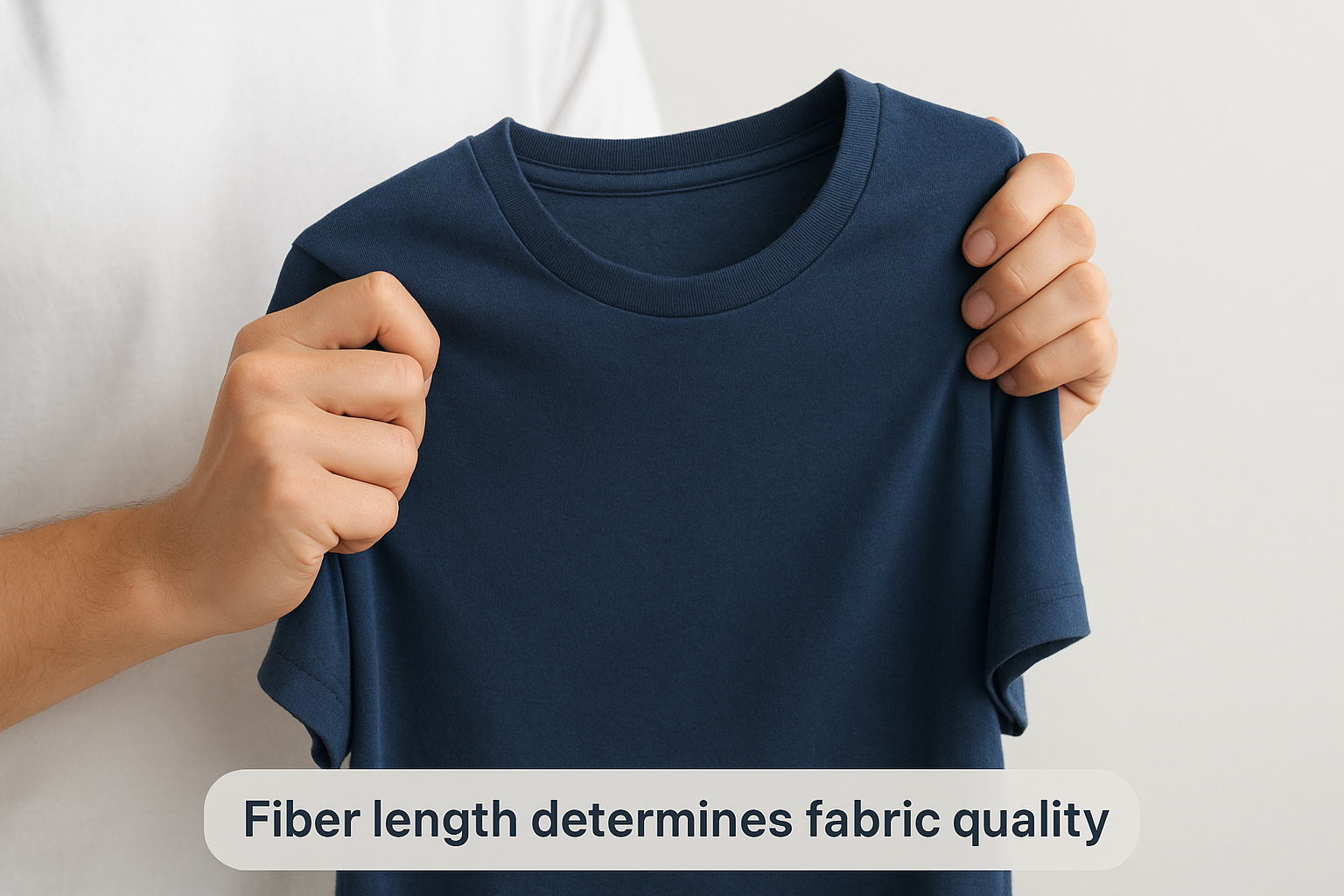
Fiber length is not a marketing metric. It's the mechanical reason why one fabric lasts three years and another lasts three months.
It resists the things that ruin most shirts
Pilling, fading, and shape distortion are the three common ways a shirt fails before it should. Supima cotton resists all three better than standard cotton because the fiber structure stays intact through repeated wash cycles. The tight yarn construction means fibers don't migrate to the surface and clump into pills. The natural fiber strength helps color molecules bond more deeply, which translates to colors that stay true longer instead of washing out to a washed-gray version of what you bought.
Shape retention matters too. A shirt that fits well on day one needs to fit well on day one hundred. Short-fiber cotton stretches and doesn't fully recover, so necklines bag and shoulder seams drift. Supima's tensile strength keeps those areas anchored through the stress of regular wear and washing.
Why this translates to real value
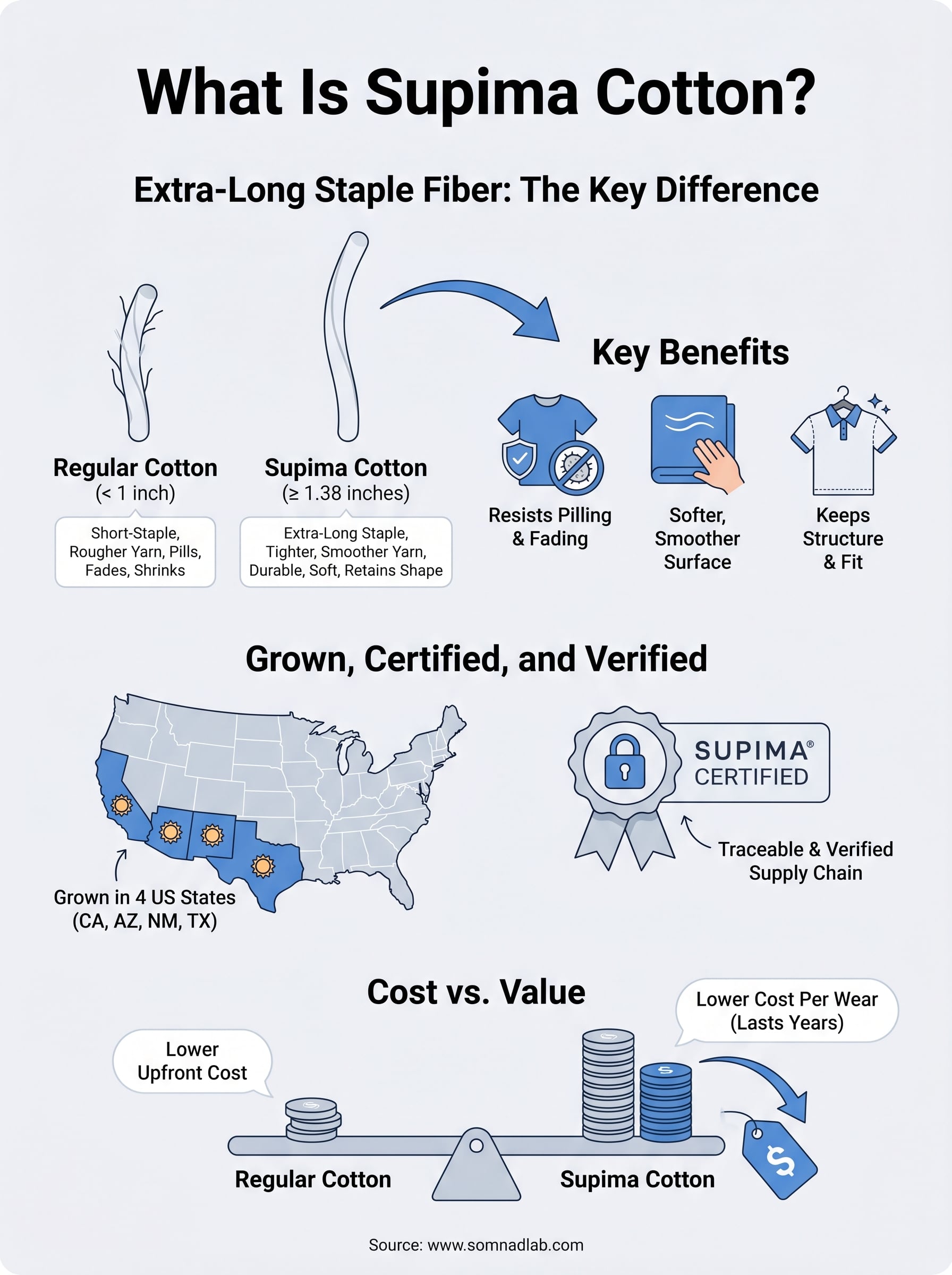
Buying a Supima cotton shirt costs more upfront. That's a fact. But cost per wear drops significantly when a garment holds up for three to five years instead of one. You're not paying extra for a label or a logo, you're paying for the physical properties of a longer, stronger fiber that performs better under the conditions you actually put clothing through.
Your wardrobe benefits most from premium materials in high-frequency items: the tee you wear twice a week, the layer you reach for without thinking. Those are exactly the pieces where Supima cotton justifies every dollar.
How Supima cotton is made and certified
Understanding what is Supima cotton requires looking at where it actually comes from. Supima stands for Superior Pima, and it refers specifically to American Pima cotton grown in the United States under controlled conditions. The Supima Association of America oversees the entire supply chain, from the farms where the cotton is grown to the finished garments that carry the Supima trademark.
Where and how it grows
Supima cotton grows exclusively in four U.S. states: California, Arizona, New Mexico, and Texas. These regions offer the hot days and cool nights that allow extra-long staple fibers to develop fully. Farmers who grow Supima cotton work under strict agricultural guidelines, and only about 1% of all cotton grown worldwide qualifies as Supima. That scarcity reflects genuine growing conditions, not marketing spin.
Registered farmers plant Supima seeds on licensed acreage and follow specific harvesting protocols designed to preserve fiber integrity from the moment the bolls open.
The certification process
Certification is what separates real Supima cotton from imitations. The Supima Association licenses brands and manufacturers to use the Supima trademark, and that license comes with traceability requirements at every production step. When you see the Supima logo on a product, it means the fiber has been tracked from the farm through spinning, knitting or weaving, and final construction.
Without certification, any brand can call a fabric "Pima-style" or use vague quality language with no accountability behind it.
Third-party verification keeps the chain honest. You can check whether a brand holds a licensed Supima partnership through the official Supima website, which maintains a current list of authorized manufacturers and retailers. That trademark is your only reliable signal that the fiber inside the garment is the real thing.
How Supima cotton feels and performs
When people ask what is Supima cotton, they usually want to know one thing above everything else: how does it actually feel? The answer is noticeably softer than standard cotton, with a smoothness that comes from tightly spun long fibers rather than from any chemical softening treatment. You're not getting a temporary finish that washes out after a few cycles. The softness is structural, built into how the yarn is constructed at the fiber level.
The texture against skin
Supima cotton sits light and smooth against your skin without feeling thin or flimsy. The high fiber density creates a fabric with natural drape and weight that holds its shape around your shoulders and torso instead of clinging or pulling. For a 300g fabric, you get a substantial feel that doesn't trap heat, which makes it comfortable across seasons.
That weight also means the fabric moves with you rather than riding up or bunching. You'll notice it most in how the fabric settles after you put it on, it finds its position and stays there through a full day of wear without constant adjusting.
The softness you feel on day one with Supima cotton is the same softness you feel on wash one hundred, which is not something most fabrics can deliver.
How it holds up through washing
This is where Supima separates itself most clearly from cheaper alternatives. Standard cotton breaks down at the fiber level with repeated agitation in a washing machine, and you see the results as pilling, fading, and stretching. Supima's long fibers stay tightly bound within the yarn structure, which means the fabric surface stays smooth and colors stay consistent wash after wash.
You'll also notice that necklines and seam lines hold their shape rather than distorting or curling at the edges, something that happens quickly with short-staple fabric under regular washing stress.
Supima vs Pima vs Egyptian vs regular cotton
The cotton market runs on loose labeling, and brands use quality-sounding terms without any obligation to back them up. Knowing what is Supima cotton becomes more useful when you understand how it stacks up against the alternatives you'll find on tags and product pages.
Supima vs Pima and Egyptian cotton
Pima is the broader fiber category; Supima is the certified, American-grown subset. All Supima cotton is Pima cotton, but not all Pima cotton is Supima. Generic Pima can be grown anywhere, blended with shorter fibers, and sold without verification. The Supima trademark requires traceability at every production stage, which generic Pima labels cannot provide.
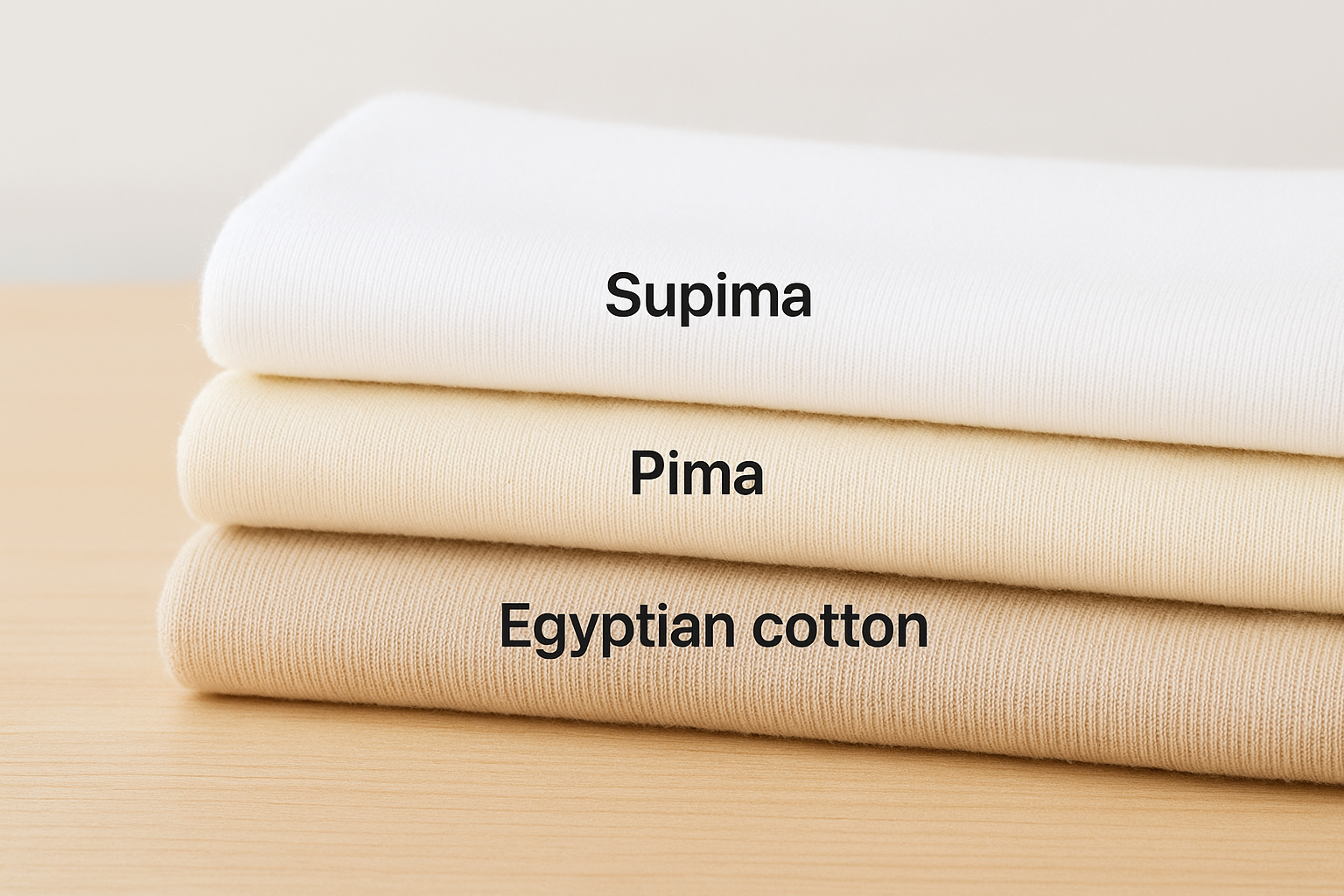
If a label says "Pima" without the Supima trademark, you have no way to confirm what's actually inside the fabric.
Egyptian cotton carries a strong reputation, but independent testing has found that a high percentage of products labeled Egyptian cotton contain little or no authentic Egyptian fiber. Both Supima and genuine Egyptian cotton use extra-long staple fibers, but Supima's certification is more consistently enforced, making it the more reliable choice when you can't verify sourcing directly.
Supima vs regular cotton
Standard cotton uses short-staple fibers that measure under one inch. Shorter fibers produce rougher yarn with more exposed ends, which is exactly where pilling starts and where color fades first under repeated washing.
Supima's fibers measure 1.38 inches or longer, which creates tighter yarn, a smoother surface, and a garment that holds its shape through hundreds of wash cycles. You won't see this difference on a store shelf, but you'll feel it clearly after a few months of regular wear.
How to shop for real Supima cotton
Knowing what is Supima cotton is only useful if you can identify it reliably at the point of purchase. The label alone doesn't protect you because terms like "premium cotton," "Pima-quality," and "luxury fabric" carry no legal definition and no verification requirement. Brands use them freely, which means your only reliable anchor is the Supima trademark and the sourcing transparency behind a brand's product claims.
Look for the trademark first
The Supima Association maintains a public list of licensed brands and manufacturers on their official website. Checking that list before you buy takes less than a minute and tells you immediately whether a brand has the traceability agreement in place. If a product claims Supima cotton but the brand doesn't appear on that list, treat the claim as unverified. The trademark exists precisely because the supply chain needs independent verification, not just brand promises.
Ask about fabric weight and construction
Weight and construction details signal how seriously a brand takes its materials. A Supima cotton garment worth the price will typically list fabric weight in grams per square meter, state fiber content clearly as 100% Supima cotton, and include information about the knit or weave structure. Vague product descriptions like "soft cotton blend" or "premium feel" without specifics are a sign that the brand either doesn't know what's in their fabric or doesn't want you to look closely.
A brand confident in its materials will tell you exactly what those materials are, down to the fiber and the weight.
Return policies and product pages can also reveal a lot. Brands that stand behind their materials typically offer clear return windows and respond to specific questions about sourcing. If a brand's customer service can't tell you whether their cotton is certified Supima, that silence is your answer.
Final take
Understanding what is Supima cotton comes down to one core fact: fiber length determines fabric performance, and Supima's extra-long staple fibers sit at the top of that scale. You get a softer feel, stronger yarn, better color retention, and a garment that holds its shape through years of regular wear. That's not a marketing claim, it's the physical result of a longer fiber spun into tighter yarn with fewer exposed ends to pill, fade, or fray.
Your clothing budget works hardest when you put premium materials into high-frequency pieces, the shirts and essentials you reach for constantly. Those are exactly the items where Supima cotton earns its price over time. If you want to see what that looks like in a garment built around 300g Supima cotton with no logos and no excess, explore the SÖMNAD relaxed tee and judge the material for yourself.