


Most closets are full of clothes and short on outfits. If you've ever stared at a packed rack and thought "I have nothing to wear," you're not alone, and you're not the problem. The problem is clutter disguised as options. That's exactly why minimalist wardrobe essentials women actually rely on look nothing like a massive haul. They look like a tight edit of pieces that work together without effort.
The goal isn't to own less for the sake of less. It's to own better, pieces that layer, transition between seasons, and still look sharp after dozens of washes. Frameworks like the 3-3-3 rule and the 5-4-3-2-1 method give you a practical starting point, but they only work when the individual items are worth building around. A capsule wardrobe built on flimsy basics falls apart in weeks, literally and figuratively.
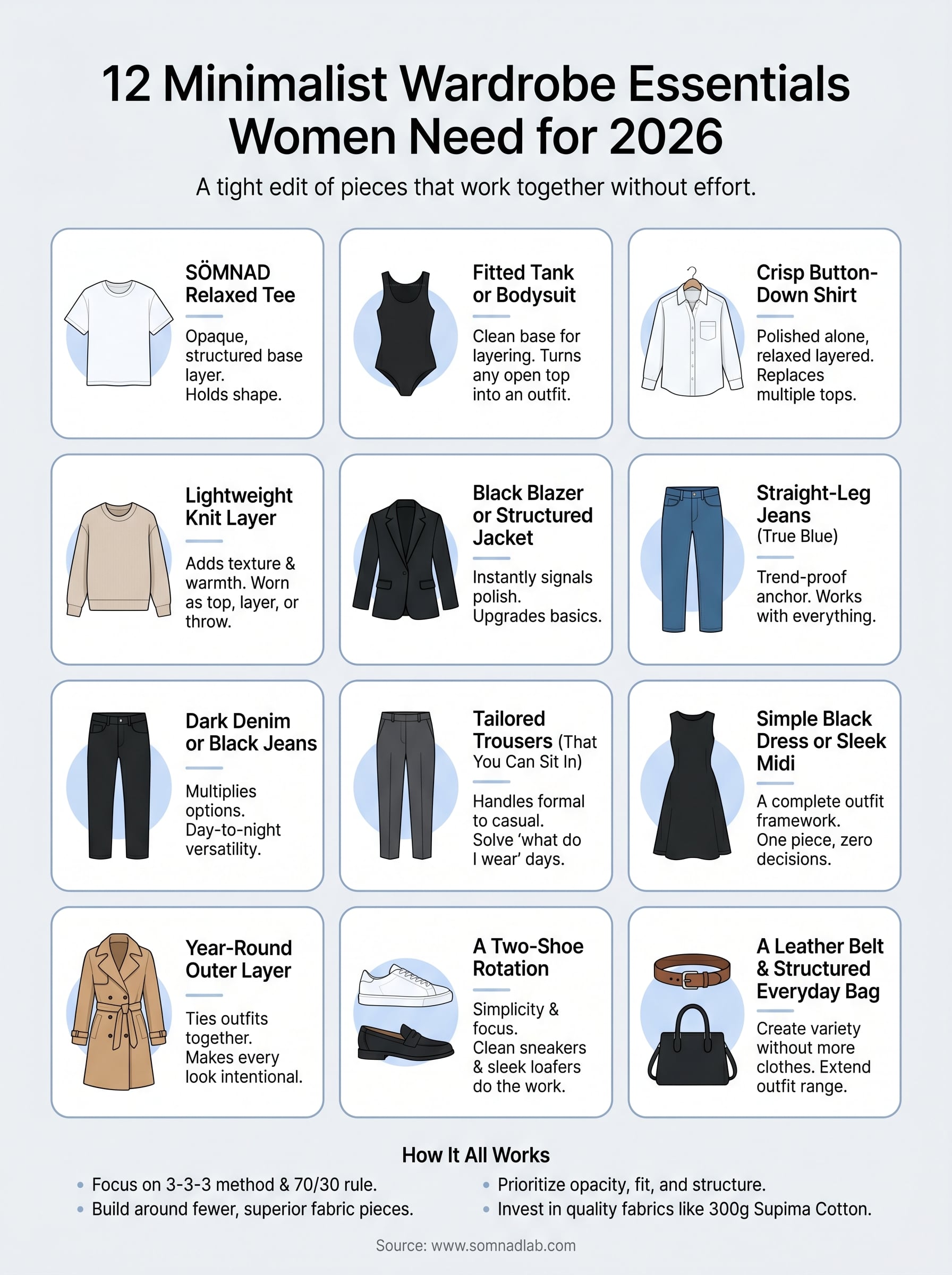
At SÖMNAD, we design premium everyday essentials with exactly this kind of wardrobe in mind, fewer pieces, superior fabric, zero logos. Below, we break down the 12 items that form the backbone of a functional minimalist wardrobe for 2026, along with the rules and strategies that help you put it all together with confidence.
1. SÖMNAD Relaxed Tee
The SÖMNAD relaxed tee is built from 300g Supima cotton, which puts it in a different category from anything you'd find at a fast fashion retailer. Most basic tees clock in around 150-180g and lose their shape after a dozen washes. This one doesn't. It holds its structure, stays opaque, and drapes in a way that works across contexts without looking like you're overthinking it.
Why this tee anchors a minimalist wardrobe
A high-quality tee is the piece that minimalist wardrobe essentials women actually rely on most. It works under blazers, over trousers, tucked into denim, and worn alone on warmer days. The relaxed fit gives you coverage without bulk, which means it layers cleanly rather than adding visual noise to your outfit. For a capsule wardrobe, this is the piece you reach for first.
A tee you actually trust removes decision fatigue from getting dressed. You stop second-guessing the base of your outfit and focus on the one or two pieces you add on top.
What to look for in fabric weight, drape, and seams
Fabric weight matters more than most people realize. Anything under 200g tends to pill, cling, or go sheer after washing. The 300g Supima cotton in the SÖMNAD tee sits at a weight that gives the shirt real presence on your body while still breathing comfortably. Look for flat-locked or reinforced shoulder seams, which signal structural quality and prevent warping over repeated wear.
Drape is how the fabric falls when you move. Your tee should skim the body without pulling at the hips or bunching at the waist. Clean, settled drape means you can wear it untucked and still look intentional, not like you grabbed something off the floor.
How to style it for work, weekends, and travel
For work, tuck the tee into tailored trousers and layer a blazer over the top. Your outfit reads polished without feeling stiff. On weekends, pair it with straight-leg jeans and clean sneakers for a look that needs nothing else. For travel, it packs flat, resists creasing, and moves from a long flight to a dinner without looking worn.
How it fits capsule rules like 70 30 and 3 3 3
The 70/30 rule suggests that 70% of your wardrobe should be neutral basics, with 30% reserved for statement pieces. The SÖMNAD tee fits directly into that 70%. Under the 3-3-3 method, where you select 3 tops, 3 bottoms, and 3 accessories for a defined period, a reliable tee earns one of those top slots without debate.
2. A Fitted Tank or Bodysuit
A fitted tank or bodysuit sits at the foundation of most outfits you'll build in a minimalist wardrobe. It adds a clean base layer without demanding extra closet space or planning. Unlike a tee, it disappears under sheer tops, blazers, and open shirts while still functioning as a standalone piece on warm days.
Why a base layer does more work than you think
Most people underestimate how much a reliable base layer contributes to outfit versatility. As part of the minimalist wardrobe essentials women depend on daily, a tank or bodysuit gives you the option to add or remove layers without rebuilding your entire look from scratch.
One good fitted tank or bodysuit turns every open shirt, blazer, and knit layer you own into a complete outfit.
What to look for in opacity, straps, and neckline
Opacity is non-negotiable. A base layer that goes sheer under bright light defeats the purpose. Look for a medium-weight fabric, at least 160g, that holds its color and coverage through multiple washes. For straps, adjustable options give you flexibility across bra styles. A scoop or square neckline covers the most styling situations without limiting your layering choices.
How to layer it without adding bulk
Fitted tanks layer cleanly when the fabric is thin but opaque. Wear it under a structured button-down left open at the collar, or tuck it into high-waisted trousers with a knit draped over your shoulders. The goal is depth in an outfit, not extra thickness that disrupts a clean silhouette.
How to build a small tank lineup without duplicates
Start with two tanks: one black, one white or ivory. Those two handle the majority of your base layer needs. A bodysuit in a neutral tone serves as a practical third option if you want something that stays tucked throughout the day without readjusting.
3. A Crisp Button-Down Shirt
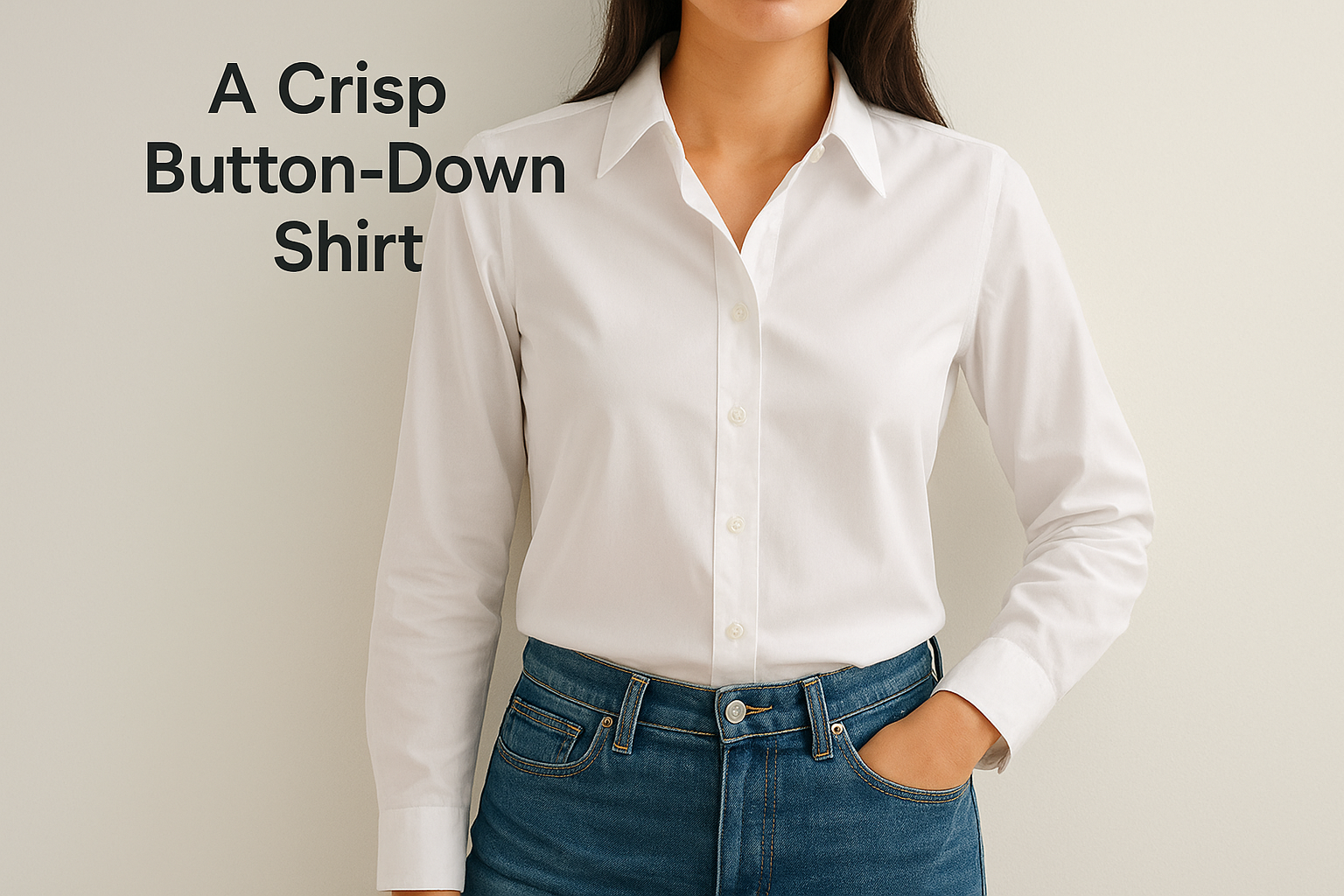
A crisp button-down shirt earns its place in a minimalist wardrobe because it adapts to more contexts than almost any other single piece. Worn alone, it reads polished. Layered open, it reads relaxed. That range is exactly what minimalist wardrobe essentials women need from every item in a tightly edited closet.
Why this piece replaces multiple tops
A well-fitted button-down replaces the sheer blouse, the office top, and the casual layer you'd otherwise need separately. It handles dressy occasions when you tuck it in with trousers, and it handles relaxed weekend mornings when you throw it open over a tank.
One button-down that fits well across the shoulders does the job of three tops that don't quite work.
What to look for in fit across the chest and shoulders
Shoulder seams should sit exactly at the edge of your shoulder, not drooping toward your arm. A drooping seam signals the shirt is too large everywhere else, and no amount of tucking fixes that. Look for a chest fit that allows comfortable movement without pulling at the buttons when you cross your arms.
Fabric choice also matters here. A light weave like poplin or Oxford cloth gives you a smooth surface that stays pressed longer between washes, which reduces the upkeep on a piece you'll reach for constantly.
How to wear it tucked, untucked, and open as a layer
Tucked into tailored trousers, the button-down reads work-ready without needing a blazer. Untucked over straight-leg jeans, it stays casual but intentional. Open over a fitted tank, it acts as a lightweight structural layer that adds depth to an outfit without adding warmth.
- Tucked in: pair with trousers and loafers
- Untucked: pair with straight-leg denim and sneakers
- Open as a layer: wear over a fitted tank or bodysuit
How to choose white, stripe, or chambray for versatility
White is the most versatile starting point because it pairs with every neutral and most colors in a capsule wardrobe. A fine stripe adds visual interest without committing to a bold print. Chambray reads like denim but wears lighter, making it a strong secondary option for warmer months or casual settings.
4. A Lightweight Knit Layer
A lightweight knit layer is the piece that quietly pulls a whole outfit together. It adds texture and warmth without the structure of a jacket, which makes it one of the most flexible minimalist wardrobe essentials women can own. You reach for it when an outfit needs something more but you don't want to add visual weight.
Why a knit makes outfits feel finished
A knit layer signals intention. When you add one over a tank or button-down, your outfit shifts from basic to considered without any extra effort. It works the same way a well-placed accessory does, except it also keeps you warm.
What to look for in fiber, pilling resistance, and care
Choose a knit made from natural or high-quality blended fibers like Merino wool, cotton, or a cotton-linen blend. These pill less than acrylic alternatives and respond better to washing. Look for a tight knit construction, which resists snagging and holds its shape through repeated wear. Check the care label before you buy. A machine-washable knit will get far more use than one that requires dry cleaning every time.
How to wear it as a top, a layer, and a shoulder throw
Tucked into high-waisted trousers, a fitted knit reads like a polished top. Worn open over a tee, it adds a relaxed layer. Draped over your shoulders with a structured bag, it gives your outfit a finished, intentional look without adding bulk.
A knit you can style three different ways earns more closet space than three single-use pieces.
How to pick between crewneck, cardigan, and fine gauge
A crewneck knit is the most versatile silhouette because it works as a standalone top or a clean mid-layer. A cardigan gives you the option to open or close it depending on temperature. Fine gauge knits layer under blazers without adding visible thickness, which makes them especially useful if your outfits typically involve multiple structured pieces.
5. A Black Blazer or Structured Jacket
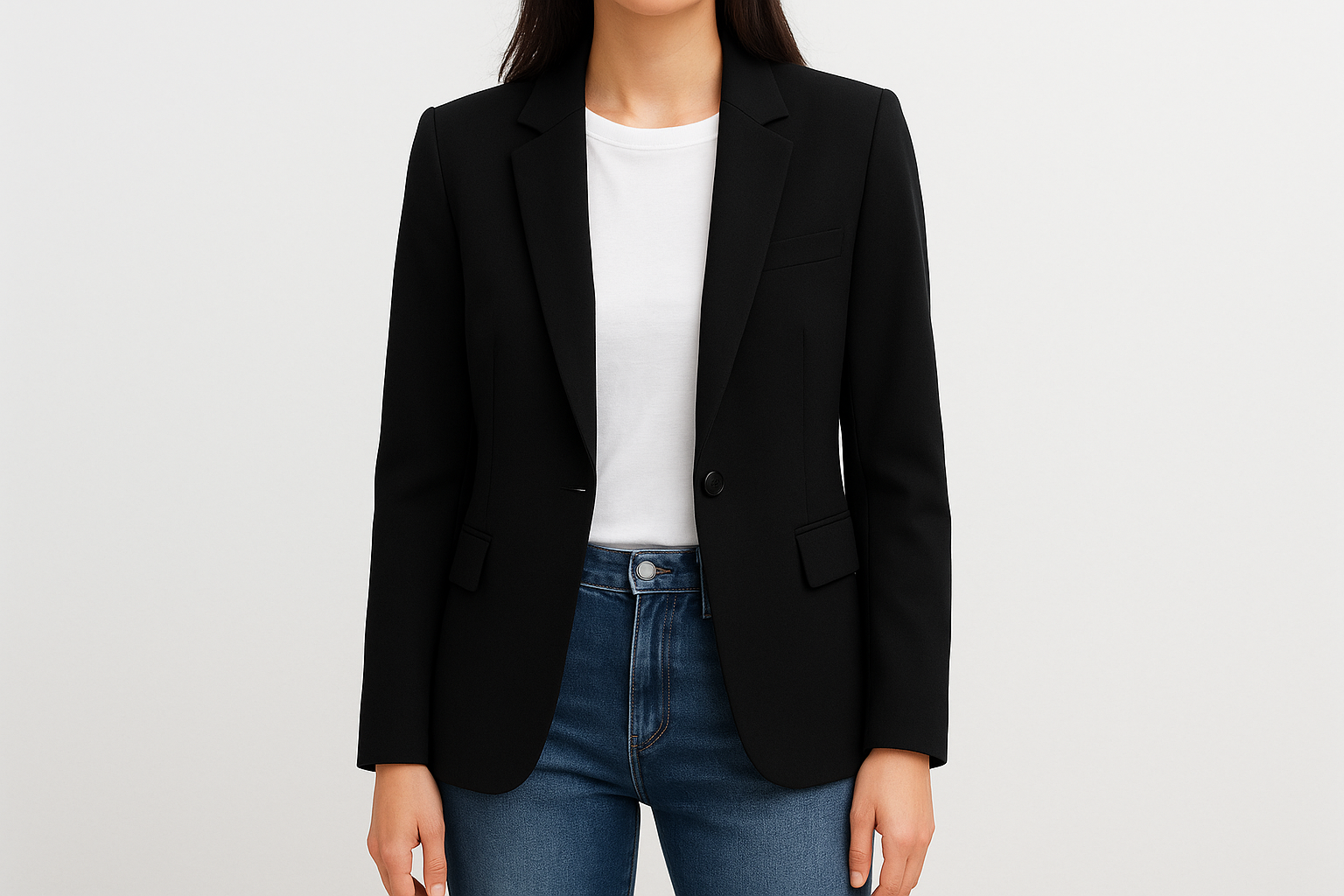
A black blazer or structured jacket is the piece that instantly signals polish without needing anything else to change. You can wear the same tee and jeans underneath, add the blazer, and your outfit shifts registers completely.
Why structure instantly upgrades basics
Structure does the heavy lifting in an outfit when everything else is simple. A well-fitted blazer takes a tee-and-trousers combination from casual to considered in one move. For minimalist wardrobe essentials women rely on, this is one of the few pieces that upgrades every other item in your wardrobe rather than competing with them.
The right blazer makes your basics look like they were always part of a plan.
What to look for in shoulder fit, length, and lining
Shoulder fit is the single most important detail in a blazer because it cannot be easily altered. The seam should sit exactly at the edge of your shoulder, no lower. Look for a length that hits at the high hip, which flatters most proportions and works over both dresses and trousers. A partial or full lining reduces bunching under the arms and helps the blazer hold its shape through regular wear.
How to style it with denim, trousers, and dresses
Over straight-leg jeans and a fitted tank, the blazer creates a clean daytime look. Paired with tailored trousers, it reads office-ready without any extra effort. Thrown over a simple midi dress, it adds structure to a softer silhouette and extends the dress into cooler temperatures.
How to avoid blazer overload and still cover your life
One well-chosen black blazer handles the majority of occasions that call for structure. If you already own a coat and a knit layer, you do not need a second jacket. Keep the blazer as your single structured top layer and let the other pieces in your capsule handle warmth and texture.
6. Straight-Leg Jeans in a True Blue Wash
Straight-leg jeans in a true blue wash are a non-negotiable anchor in any tightly edited closet. Among the minimalist wardrobe essentials women build their wardrobes around, this cut earns its spot because it works with almost everything else on this list without requiring any style recalibration.
Why this cut stays modern without chasing trends
The straight leg sits at a reliable midpoint between slim and wide, which means it avoids looking dated the way both extremes can when trends shift. You're not committing to a silhouette that requires specific shoes or proportions to work. It simply fits, and it reads clean season after season.
A cut that stops chasing trends gives your wardrobe a longer useful life with no extra effort.
What to look for in rise, stretch, and wash
A mid-to-high rise gives you a clean line at the waist and makes tucking in tops effortless. For stretch, look for 1-3% elastane in the fabric blend, enough for comfort and recovery without the jeans going baggy at the knees after a few hours of wear. For wash, a true medium blue reads the most versatile because it pairs with whites, blacks, and neutrals without clashing.
How to dress them up without switching your whole outfit
Swap your sneakers for loafers or sleek flats, tuck in a fitted knit or button-down, and the jeans immediately shift from casual to put-together. You don't need to change the bottom half of your outfit. One swap on top or at your feet moves the entire look.
How to make one pair work across seasons
In warmer months, wear your straight-leg jeans with a lightweight tee or tank and no extra layers. In cooler months, add a knit and a structured coat over the top. The jeans stay constant while the layers above them handle the temperature change.
7. Dark Denim or Black Jeans
A second pair of jeans in a darker wash expands what your wardrobe can do without adding another clothing category. Where your true blue straight-legs handle casual daytime looks, dark denim or black jeans handle everything that needs a sharper edge.
Why a darker jean multiplies outfit options
Dark jeans read closer to tailored trousers in low light, which means you can wear them in settings where regular blue denim would feel out of place. That shift from casual lunch to an evening out is exactly what minimalist wardrobe essentials women need from every item they keep.
One darker jean that works day and night is worth more to your wardrobe than three pairs that only work in one setting.
What to look for in fading, hardware, and fabric recovery
Check the dye quality before you buy. Cheap dyes fade unevenly and fast, which destroys the polished appearance that makes dark jeans useful in the first place. Look for coated or double-dyed fabric that holds its depth through multiple washes. For hardware, flat or matte finishes on rivets and buttons keep the jeans looking sleek rather than casual.
Fabric recovery is how well the jeans return to their original shape after wearing. A blend with 1-2% elastane gives you comfortable movement without the knees going slack by mid-afternoon.
How to build day to night outfits with one swap
During the day, wear your dark jeans with a relaxed tee and sneakers. For the evening, switch to a fitted knit and loafers. That single shoe change moves the entire look without touching anything else in your wardrobe.
How to decide between black and deep indigo
Black jeans pair most naturally with neutrals and work cleanly in structured settings. Deep indigo reads slightly more casual but still dresses up without much effort. If you already own true blue jeans, black gives your wardrobe the most contrast and the broadest range of use as your second pair.
8. Tailored Trousers You Can Actually Sit In
Tailored trousers belong in every curated list of minimalist wardrobe essentials women build for long-term use. They do what jeans cannot in more formal settings, while still pairing naturally with the casual pieces already in your wardrobe.
Why trousers solve most what do I wear days
Tailored trousers handle a wider range of occasions than almost any other bottom you own. They read professional in meetings, relaxed when styled with a tee, and polished enough for dinners without requiring a full outfit change.
A trouser that works in three different settings gives your wardrobe more range than three separate bottoms that each work in only one.
What to look for in fabric, waistband comfort, and hem
Woven fabrics like crepe, ponte, or wool blends hold their structure through a full day of wear without going limp or creasing heavily. Avoid anything that wrinkles badly after sitting, which defeats the purpose of a trouser that is supposed to look put-together with minimal effort. For the waistband, look for a flat or elasticated back panel that stays comfortable whether you're standing or seated for hours.
The hem should land just above the ankle, which works across flat shoes and low heels without needing alterations.
How to style trousers casually so they do not feel formal
Pair your trousers with a relaxed tee tucked loosely at the front and clean sneakers. That combination keeps the trouser in casual territory without losing the clean silhouette. Rolling the hem once adds a relaxed detail that softens the overall look when you want it.
How to choose a neutral that matches your palette
Camel, stone, and charcoal gray give you the most flexibility because they pair with both warm and cool tones in your existing wardrobe. Choose the neutral that already works with the most pieces you own rather than starting from scratch.
9. A Simple Black Dress or Sleek Midi Dress
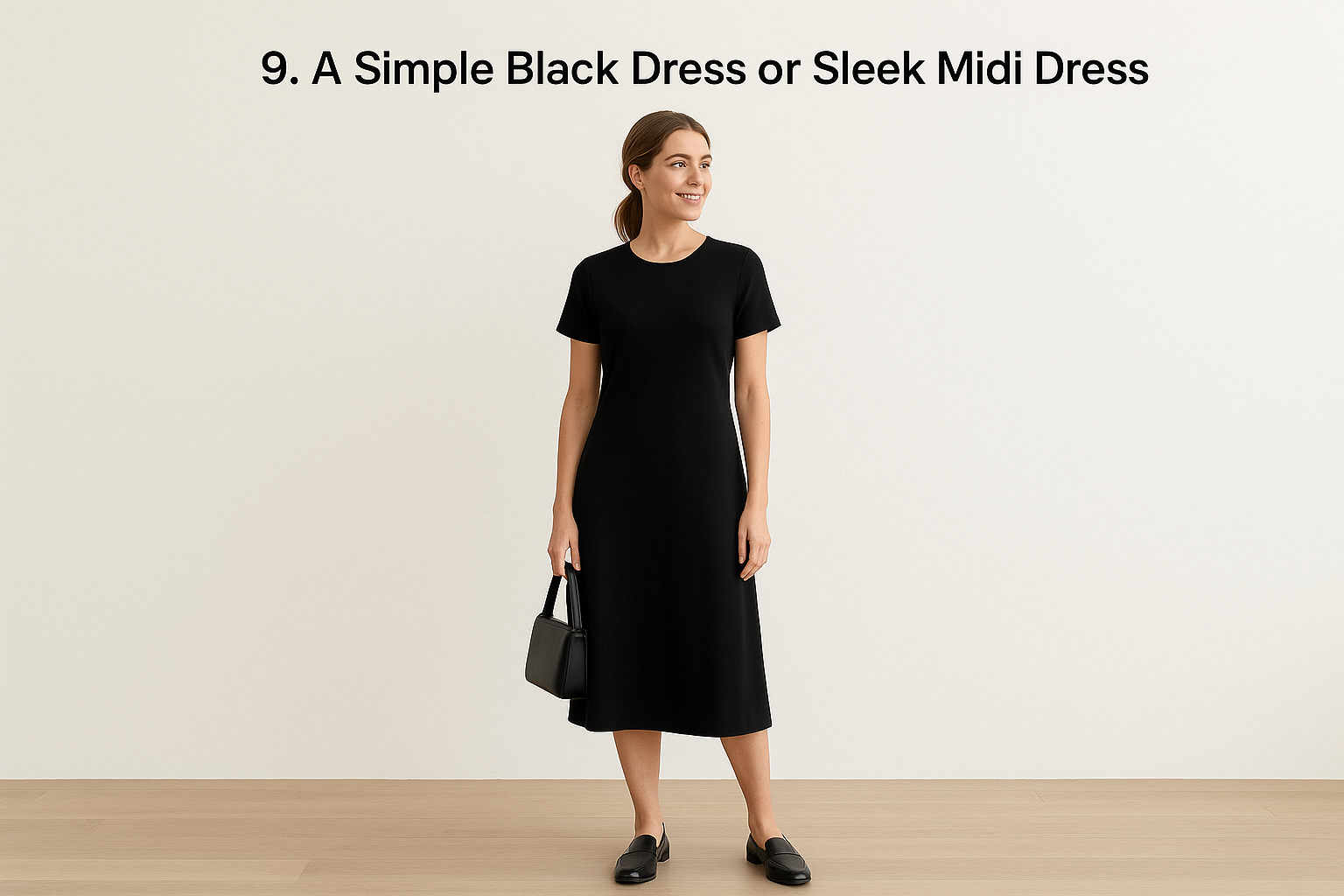
A black dress or sleek midi dress is one of the most underused items in minimalist wardrobe essentials women tend to build. It looks like a single piece, but it functions as a complete outfit framework that you can restyle with what you already own.
Why one dress acts like a full outfit plan
A simple black dress removes the decision entirely. You put it on and the outfit is already structured. Every layer, shoe, or accessory you add is a choice, not a requirement. That makes it one of the most efficient pieces you can own when you want to get dressed quickly without sacrificing how you look.
One well-chosen dress that layers cleanly is worth more to your wardrobe than five tops that only work with specific bottoms.
What to look for in neckline, fabric weight, and bra options
Choose a neckline that works with your everyday bras without adjustments. A crew, square, or V-neck in the 35 to 45 degree range covers the most situations. For fabric weight, look for something between 180g and 250g, which gives the dress enough body to drape cleanly without clinging. Avoid anything too sheer or too stiff, both extremes limit how the dress moves and layers.
How to style it with layers so it works year-round
In warmer months, wear the dress on its own with loafers or clean sneakers. When temperatures drop, add a fitted knit or your structured blazer over the top. Layer a long coat over everything for winter.
- Warm: dress alone with flat shoes
- Cool: add a knit or blazer
- Cold: structured coat over the top
How to pick a silhouette you will wear often
Choose a silhouette that already works with your body proportions without requiring shapewear or specific undergarments. A relaxed A-line or a clean column cut covers the broadest range of occasions and layers without creating fit problems at the shoulders or hips.
10. A Year-Round Outer Layer
A well-chosen outer layer ties together every outfit you build beneath it. Among the minimalist wardrobe essentials women need to get real use from a capsule wardrobe, a coat or jacket that works across multiple seasons removes the pressure to own five different outerwear options.
Why the right coat makes every outfit look intentional
Your outer layer is the first and last thing people see when you walk in or out of a room. A clean, well-fitting coat gives your entire outfit a sense of deliberate structure, even when everything underneath is simple. A poor coat choice undermines pieces that would otherwise look sharp.
The right coat does not just keep you warm. It finishes your outfit in a way nothing else can.
What to look for in a trench, wool coat, or insulated layer
A trench coat handles three seasons with minimal effort. Look for one in cotton gabardine with a water-resistant finish, which keeps it functional rather than just decorative. A mid-weight wool or wool-blend coat is the stronger choice for colder climates. For transitional weather, a quilted or insulated layer in a neutral tone fills the gap without looking overly casual.
How to choose length and color for maximum reuse
Knee-length coats work over dresses, trousers, and jeans without proportion problems. Shorter coats limit your layering options significantly. For color, camel, stone, navy, or black pair naturally with every neutral you already own, which means your coat never fights with the rest of your outfit.
How to cover weather swings with one main layer
Focus on fabric versatility over seasonal specificity. A trench in a medium weight handles cool spring mornings and autumn evenings without adjustment. If your climate swings hard between seasons, choose a coat with a removable liner, which gives you two functional layers without buying two separate coats.
11. A Two-Shoe Rotation
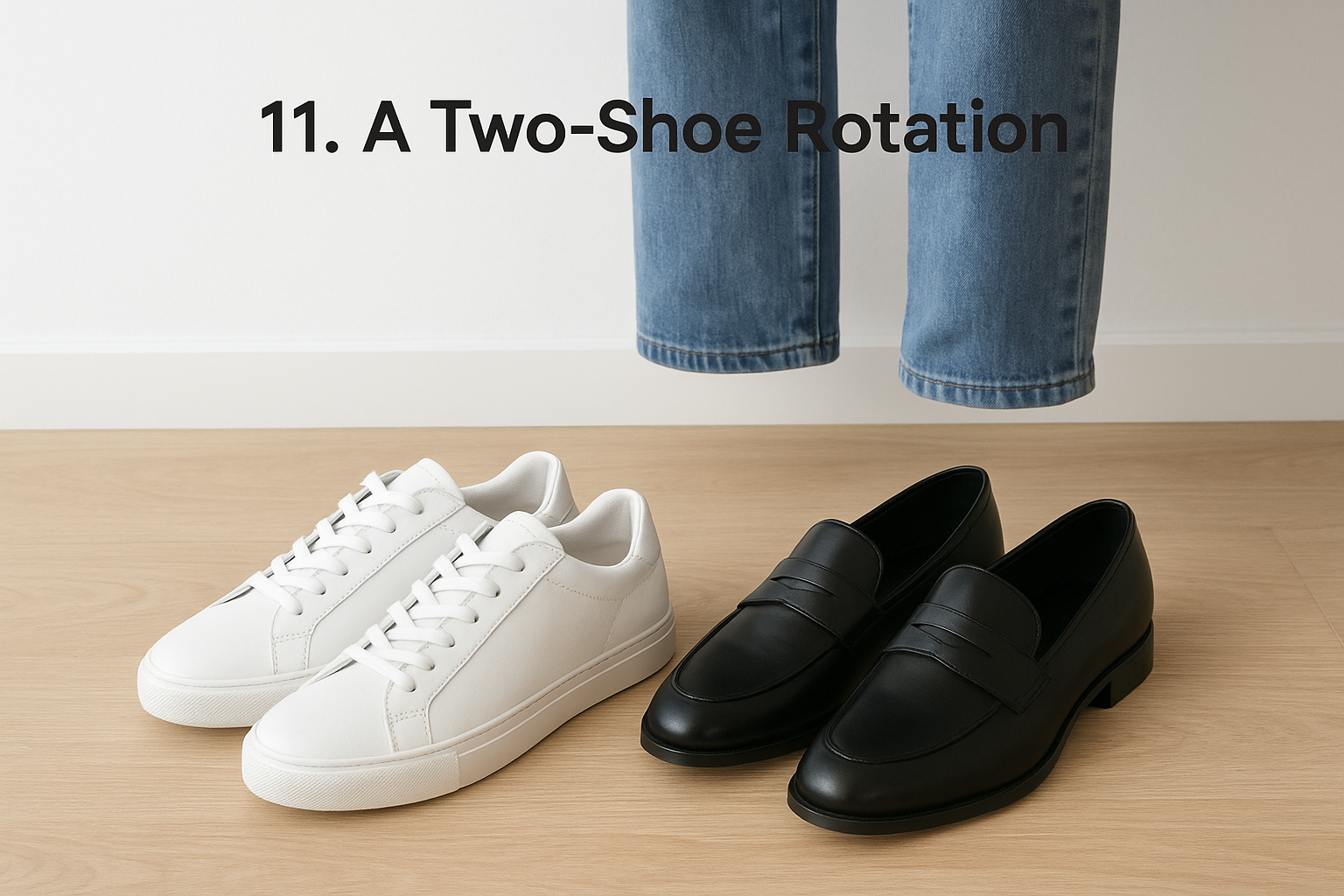
Shoes are where minimalist wardrobe essentials women often overcorrect. Most people own more shoes than they actually rotate through, which means a significant number of pairs sit unused while two or three do all the work. A deliberate two-shoe rotation removes that clutter and forces your footwear to earn its place.
Why two pairs of shoes simplify everything
When you limit your rotation to two carefully chosen pairs, every outfit decision becomes faster. You stop second-guessing whether your shoes match, because both pairs are built to work with everything else you own.
What to choose for pair one: clean sneakers
White or off-white leather sneakers are your most versatile casual option. They pair naturally with jeans, trousers, and even midi dresses without making any of those combinations look underdressed. Look for a low-profile silhouette with minimal branding, which keeps the sneaker from competing with the rest of your outfit.
A clean sneaker that blends into your outfit does more work than a statement pair that only works with specific pieces.
What to choose for pair two: loafers or sleek flats
Your second pair should handle polished and semi-formal contexts that sneakers cannot cover. A loafer in black or tan leather works with trousers, straight-leg jeans, and dresses without looking overdressed. Sleek flats in a neutral tone give you a similar range if you prefer a lower profile or need more walking comfort throughout the day.
When to add a third pair like an ankle boot
An ankle boot earns a spot in your rotation once your two core pairs leave a clear gap in cold-weather coverage. Choose a simple leather or suede ankle boot in black or cognac that layers over jeans and under trousers without requiring a full outfit rebuild.
12. A Leather Belt and a Structured Everyday Bag
Accessories are often treated as afterthoughts, but in a tightly edited wardrobe, they carry real weight. A leather belt and a structured bag give you variety without requiring more clothing, which makes them two of the smartest investments in any capsule setup.
Why accessories create variety without more clothes
The same pair of trousers looks different when you add a clean leather belt versus leaving the waistline bare. The same outfit reads sharper when your bag has structure rather than collapsing into your arm. For the minimalist wardrobe essentials women rely on daily, accessories are how you introduce variety without expanding your closet.
Two well-chosen accessories do more for outfit range than ten extra tops you rotate through once a month.
What to look for in belt width, buckle, and leather quality
Choose a belt in a medium width, roughly 1 to 1.5 inches, which works across both trousers and jeans without looking out of proportion. For the buckle, stick to a matte or brushed metal finish in gold or silver tone, depending on the hardware you already wear. Full-grain leather holds its shape and develops a better surface over time than bonded or split leather alternatives.
What to look for in a bag: size, strap options, and closure
Your everyday bag needs to fit your actual daily load without stretching or slouching. Look for a structured silhouette in black, tan, or camel with at least two strap configurations, a short carry handle and a longer shoulder or crossbody strap. A secure closure like a flap or zip keeps your bag looking tidy throughout the day.
How to use accessories to follow the 70 30 wardrobe rule
Your belt and bag sit in the 30% of your wardrobe reserved for pieces that add character to neutral basics. Keep both in tones that pair with every bottom you own, which means your accessories extend every outfit rather than limiting which pieces they work with.
Your next outfit plan
Building a wardrobe that actually works starts with choosing the right individual pieces, not buying more of them. The minimalist wardrobe essentials women on this list are not arbitrary selections. Each one earns its place because it connects to at least three or four other items you already own, which means every addition multiplies your outfit options rather than sitting idle.
Start with the pieces you wear most often and replace them with higher-quality versions before filling gaps. A 300g Supima cotton tee that holds its shape through a hundred washes costs less per wear than five cheaper versions that go limp after ten. That math applies to every category on this list.
When you're ready to build your foundation, shop SÖMNAD's premium everyday essentials and start with a tee that anchors everything else you own.