


Your closet is full, yet you still stand there most mornings thinking you have nothing to wear. That gap between quantity and usefulness is exactly why learning how to build a capsule wardrobe women actually rely on has become such a common search. A capsule wardrobe isn't about owning less for the sake of it. It's about cutting the noise so every piece you own works with everything else and earns its spot through repeated wear.
This guide gives you the real steps: how to audit what's already hanging in your closet, how to pick a workable number of pieces, which categories deserve your money, and how to build outfits that carry you through work, weekends, and travel without decision fatigue. No vague inspiration boards, just a practical process you can start this weekend.
We'll also talk about fabric and construction, because a capsule only holds up if the basics underneath it do. Pieces made from heavier, structured cotton hold their shape wash after wash, which matters more here than trend pieces ever will. By the end, you'll have a clear framework and a shopping list you can actually stick to.
What is a capsule wardrobe, and why build one?
A capsule wardrobe is a small, tightly curated set of clothing where every item works with almost every other item. The concept traces back to Susie Faux, a London boutique owner in the 1970s, and it usually lands somewhere between 25 and 40 pieces total, not counting sleepwear or workout gear. Fewer choices don't mean fewer outfits. The math actually works against you when you keep buying random pieces, since a closet stuffed with 150 items that don't coordinate produces fewer usable combinations than 30 items chosen to overlap in color and silhouette.
The math that makes it worth doing
Think about combinatorics for a second. If you own 8 tops, 5 bottoms, and 3 outer layers that all pair with each other, you get well over 100 outfit combinations from 16 pieces. Compare that to a closet where half your tops clash with half your bottoms, and you're stuck rewearing the same five outfits no matter how full the rack looks. Outfit math is the real reason capsule wardrobes work, not minimalism as an aesthetic.
A capsule wardrobe wins by making every piece compatible with every other piece, not by owning less for its own sake.
Why women specifically gravitate toward this method
Women's clothing sizing and styling carry more variables than menswear, more silhouettes, more seasonal shifts, more occasion-specific dressing. That variability is exactly what drives closet overwhelm and impulse buying. Building a capsule forces you to name your actual style preferences instead of reacting to whatever's trending on your feed that week, and it gives you a repeatable system for replacing worn-out basics instead of starting from zero every season.
What you gain beyond a tidier closet
Here's a quick side-by-side of what changes when you move from a typical mixed closet to a working capsule:
| Factor | Typical mixed closet | Capsule wardrobe |
|---|---|---|
| Morning decision time | 10-15 minutes | Under 3 minutes |
| Items worn regularly | 20-30% of total | 80-90% of total |
| Average cost per wear | High (many pieces worn once or twice) | Low (pieces worn weekly) |
| Shopping pattern | Frequent, impulse-driven | Seasonal, planned |
| Closet space needed | Large | Compact |
Those numbers aren't abstract. Cost per wear drops fast when a well-made tee gets worn twice a week for two years instead of sitting folded after one outing. That's also where fabric quality stops being a nice-to-have and becomes the whole point: a 300g Supima cotton tee holds its shape through fifty washes, while a thin blend stretches out and gets retired within a season.
Building one also changes how you shop going forward. Once you know your palette and your gaps, you stop browsing for inspiration and start buying with intention, which is the habit that keeps a capsule from sliding back into clutter six months later.
Step 1. Define your lifestyle and style needs
Before you buy or fold a single thing, figure out what your week actually looks like. Most women build a capsule around a fantasy version of their life, then wonder why the pieces sit unworn. Track your last two weeks honestly: how many days were office or client-facing, how many were errands and gym runs, how many were dinners or events. That breakdown, not a mood board, tells you what your capsule wardrobe needs to prioritize.
Audit your actual week
Grab a notebook or your phone's notes app and log every outing for 14 days. You're looking for patterns, not perfection.
- Days in structured settings (office, meetings, client visits)
- Days in casual settings (errands, coffee, casual friend hangouts)
- Days involving movement (gym, walking commute, travel)
- Days with a specific dress code (events, dinners, family functions)
Most women find their week splits roughly 40% casual, 30% work, 20% active, 10% dressed-up. That ratio should directly shape how many of each category you build later.
Build the capsule around the week you actually live, not the one you wish you had.
Name your style in three words
Grab three adjectives that describe how you want to look, not how you currently dress. Common combinations: relaxed, tailored, minimal. Or: soft, structured, neutral. Write them down and tape them somewhere you'll see them while shopping. Every purchase decision later gets run through that filter. If a piece doesn't match at least two of your three words, skip it regardless of how good it looks on the hanger.
Rank your priorities
You can't optimize for comfort, formality, and budget equally. Pick one lead priority and let the other two follow. A woman who spends 60% of her week in casual settings should weight the whole capsule toward comfort and versatility, even if that means fewer dressy pieces. Someone in client-facing work five days a week needs the opposite ratio, more tailored pieces, fewer weekend-only items.
This step feels slow compared to just shopping, but skipping it is why most capsule attempts fail within a season. Lifestyle mapping gives every later decision, color palette, gap list, outfit combos, a filter to run through instead of guesswork.
Step 2. Choose a color palette that works together
Once you know your lifestyle ratio, pick a palette before you touch a single hanger. A color palette is what lets a top from one season pair with pants you bought two years later. Skip this step and you end up with a closet full of nice pieces that simply refuse to talk to each other.
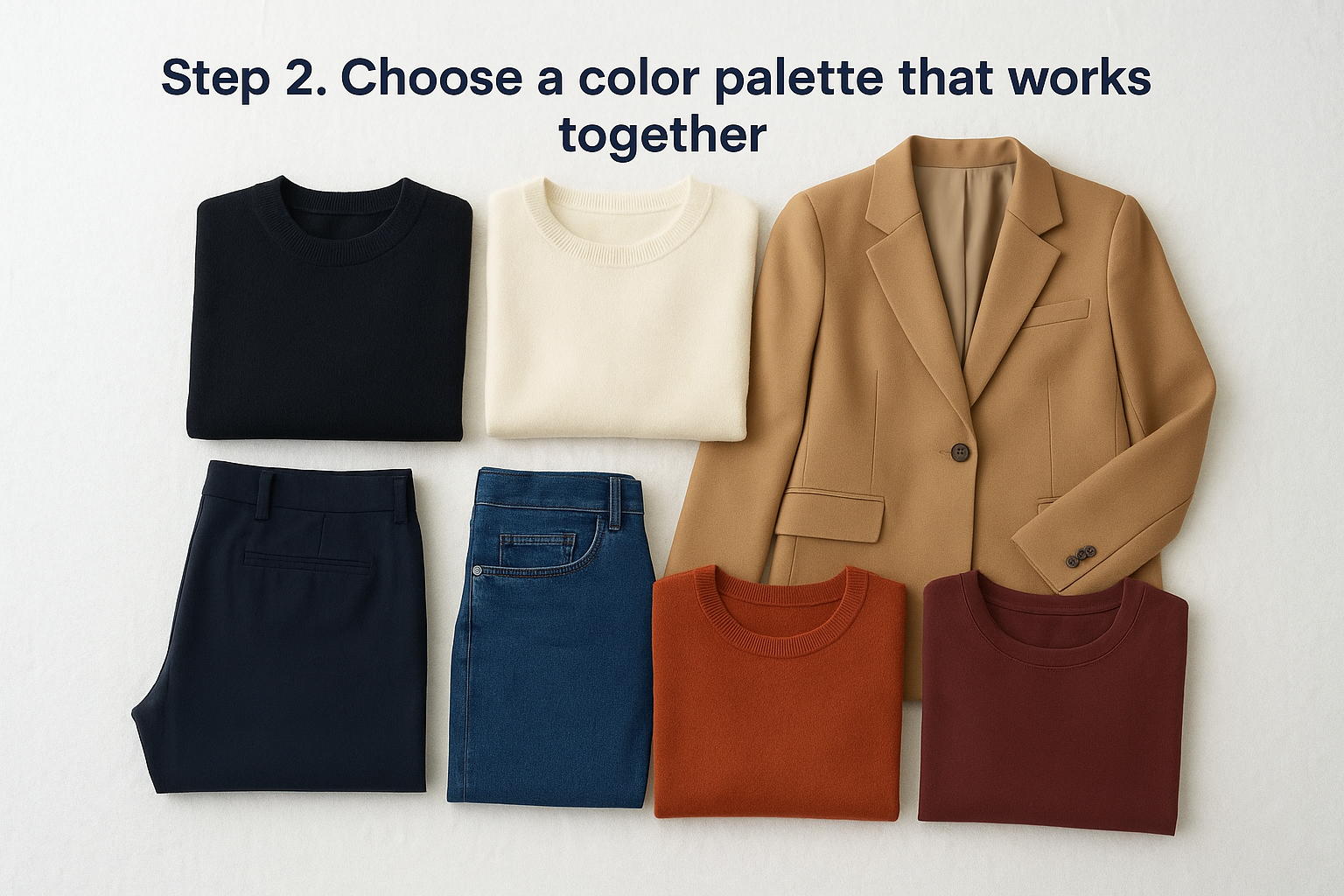
Start with a neutral base
Build around two or three neutrals that already dominate your closet, usually black, navy, camel, gray, or white. These carry roughly 70% of your capsule and should cover tops, bottoms, and outerwear. Pick neutrals based on your skin tone and what you already reach for, not what looks good on a mood board.
- Pick one dark neutral (black or navy) for structure
- Pick one light neutral (white or ivory) for contrast
- Pick one warm or earthy neutral (camel, gray, or olive) for depth
Add two or three accent colors
The remaining 20-30% comes from accent colors that pair with every neutral you picked. Choose colors you already own multiples of, that's a signal you genuinely like wearing them, not colors you think you should own. A rust orange, a deep burgundy, or a muted blue all work if they show up consistently across your existing closet.
A palette only works if every accent color pairs with every neutral you own, not just one favorite outfit.
Test the palette against your closet
Lay out everything you own in your chosen colors on the bed. If a piece doesn't visually connect with at least three other pieces, it's not part of your capsule, regardless of how much you paid for it. This test takes fifteen minutes and saves you from buying more mismatched pieces later.
| Palette role | Share of capsule | Example colors |
|---|---|---|
| Dark neutral | ~25% | Black, navy |
| Light neutral | ~20% | White, ivory |
| Warm neutral | ~25% | Camel, gray |
| Accent colors | ~20-30% | Rust, burgundy, muted blue |
Keep this table taped inside a closet door if you need a reminder. Locking the palette now means every future purchase, including replacement basics, gets easier to judge in seconds instead of guesswork at checkout.
Step 3. Edit and shop your existing closet
Now you actually go into the closet. Before you spend a dollar on anything new, pull every single item out and sort it against the lifestyle ratio and palette you just defined. This is the step most women skip, and it's exactly why closets stay cluttered even after a fresh round of shopping. Shopping your closet first means you find pieces you forgot you owned, and you avoid buying duplicates of things already hanging behind three other hangers.
Sort into four piles
Empty the closet completely, yes, all of it, onto the bed or floor. Then sort every piece into one of four categories:
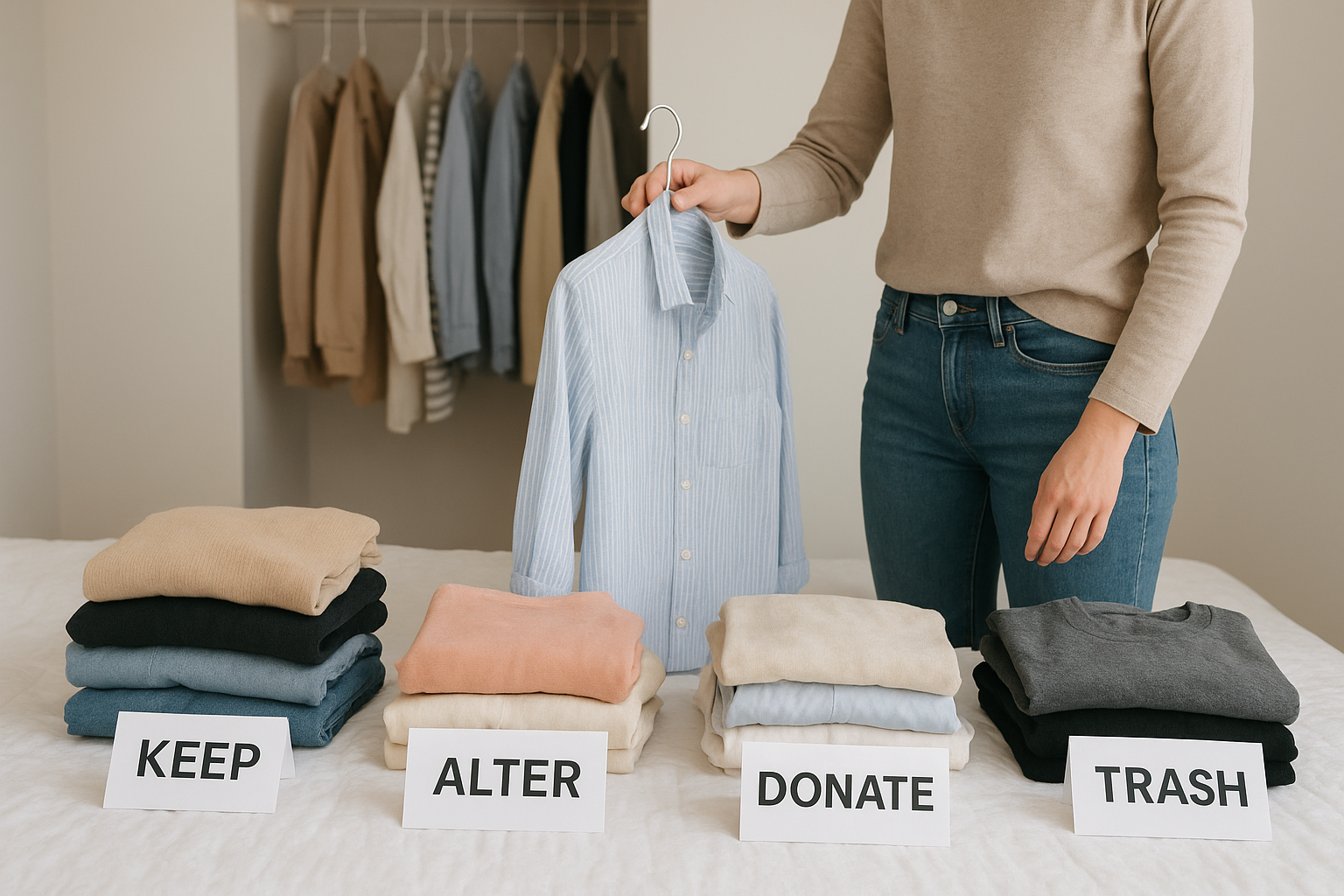
- Keep: fits your palette, matches your lifestyle ratio, still fits your body well
- Alter: good fabric and cut, but needs a hem, a button, or a small tailor fix
- Donate or sell: decent condition but doesn't match your palette or your actual week
- Trash: worn out, stretched, stained, or pilled beyond saving
Be honest about the trash pile. A tee that's gone thin and see-through isn't a casual layer anymore, it's a rag. Heavier cotton knits rarely land in that pile because they hold shape past the point cheaper blends give out.
If a piece doesn't fit your palette or your week, it doesn't belong in the keep pile, no matter the price tag you paid.
Try everything on
Don't trust your memory of how something fits. Bodies shift, and a blazer that worked two years ago might pull across the shoulders now. Try on every keep and alter item under real daylight, not the closet bulb, and check how it moves when you sit, reach, and walk.
Count what survives
Once the keep pile is final, count it by category: tops, bottoms, layers, dresses, shoes. Write the number next to each category on paper. This count becomes your baseline for Step 4, since you'll know exactly which categories are thin and which ones are already solid. Most women find they're overloaded on casual tops and short on structured layers, which is normal and exactly what the gap analysis is for.
Step 4. Identify and fill the gaps with essentials
With your keep pile counted, lay that number against a target capsule size of 25 to 40 pieces. Whatever's missing between your current count and that target is your shopping list, and it should map directly to the lifestyle ratio from Step 1. Skip this comparison and you'll shop the same way you always have, grabbing whatever catches your eye instead of filling an actual hole.
Build the essentials checklist
Most working capsules share a common backbone regardless of personal style. Use this as your starting checklist, then adjust quantities based on your own ratio:
- 4-6 tops (mix of tees, blouses, and one structured shirt)
- 2-3 bottoms (jeans, tailored trousers, one skirt)
- 2-3 layers (blazer, cardigan, denim jacket)
- 1-2 dresses (one casual, one that can dress up)
- 1 outerwear piece suited to your climate
- 2-3 pairs of shoes covering flat, heel, and casual
Prioritize by cost per wear, not price tag
Rank each gap by how often you'll actually wear the piece, not by how much it costs upfront. A relaxed tee you'll wear twice a week for two years beats a statement blazer you'll wear four times a year, even if the blazer costs less. Cost per wear should drive every purchase decision here, and fabric weight is the fastest predictor of it. A 300g Supima cotton tee holds its shape and color through dozens of washes, while a thin cotton-poly blend pills and stretches out within a few months, forcing you to replace it and start the gap-filling process over.
Buy for cost per wear, not price tag, and the gaps you fill will actually stay filled.
Shop one category at a time
Don't fill five gaps in one shopping trip. Pick the thinnest category from your Step 3 count, usually tops or layers, and fill that gap completely before moving to the next. This keeps you from overbuying in one area while ignoring another, and it forces you to check every new piece against your palette and your three style words before it comes home. If it doesn't pass both filters, put it back, no matter how good it looks on the hanger.
Step 5. Build outfits and maintain your capsum
Once every gap is filled, the real test starts: can you actually get dressed faster than before? Pull everything into one closet section and start pairing pieces before you need them for a specific day. Building outfits ahead of time turns your capsule from a pile of good pieces into a system you actually use at 7am when you're half awake.
Map outfits before you need them
Set aside one hour to build a running list of outfit combinations, not just favorites you already know work. Go category by category and force new pairings you haven't tried.
- Pair each top with every bottom it could realistically work with
- Add one layer option to each pairing (blazer, cardigan, or jacket)
- Note which combos work for work, casual, and dressed-up days
- Photograph the ones that click and save them in one folder on your phone
A capsule only proves itself once you've actually worn every piece in at least three different combinations.
That photo folder becomes your outfit reference for busy mornings, and it also shows you fast which pieces never got paired with anything, a clear sign they don't belong in the next round.
Set a seasonal check-in
Capsules drift over time as pieces wear out or your week changes. Block fifteen minutes every three months to repeat the Step 3 sort on a smaller scale: pull anything that's pilled, stretched, or faded, and check it against your palette again. Seasons shift what you need too, so swap heavier layers in and lighter pieces out rather than keeping both hanging at once.
Replace with the same standards you started with
Maintenance means replacing worn items with the same rigor you used the first time around, not grabbing whatever's on sale. Run every replacement through the same three filters: does it match your palette, does it fit your lifestyle ratio, and does the fabric weight suggest it'll survive fifty washes. Heavier cotton knits keep passing that last test long after thinner blends have pilled and stretched out of shape, which is exactly why they're worth the extra few dollars per piece.
Treat this check-in as non-negotiable. Skip it for a year and you'll wake up back where you started, a closet full of things that don't quite work together.
Your closet, simplified
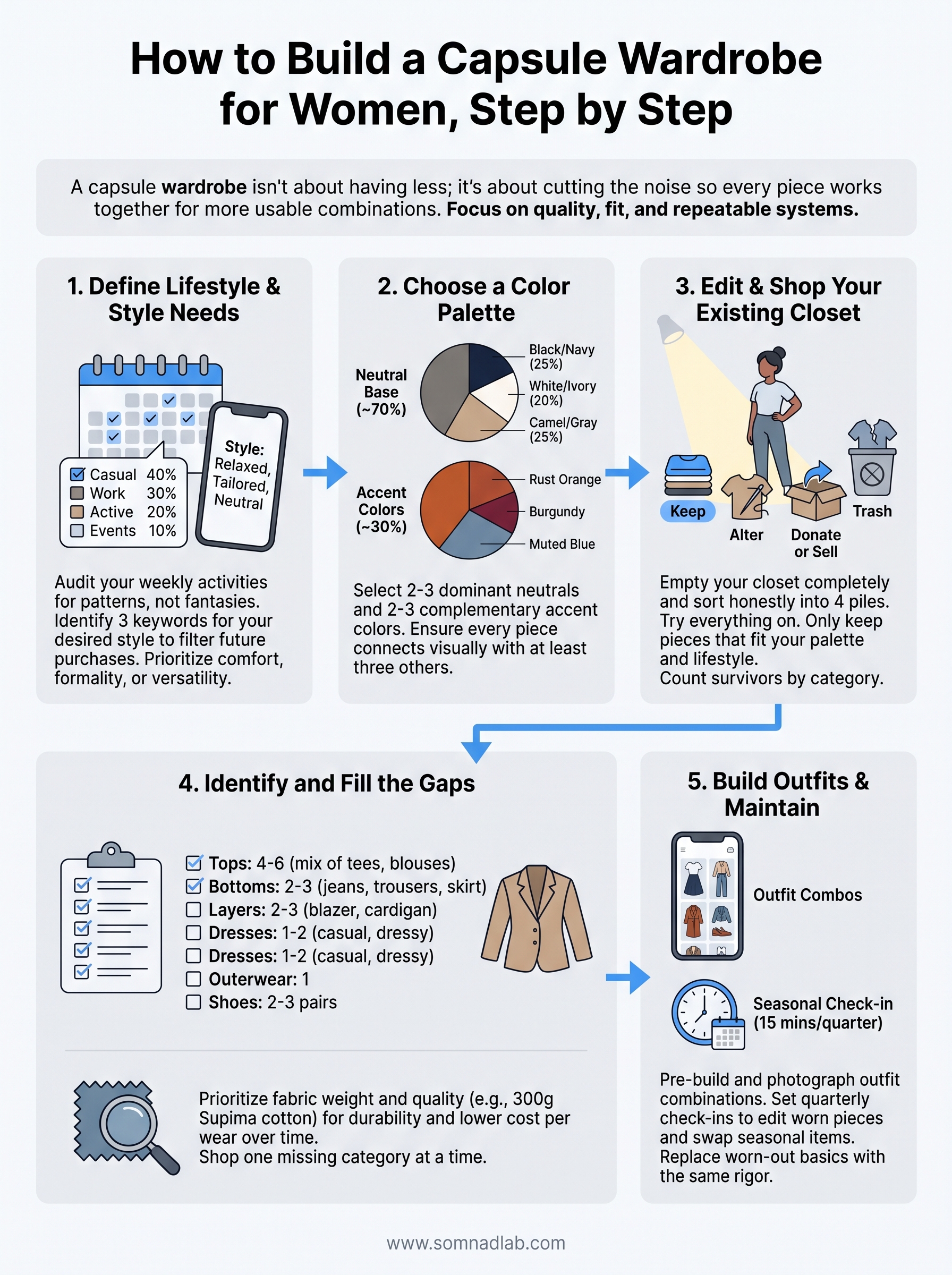
A capsule wardrobe isn't a one-weekend project you finish and forget. It's a repeatable system: know your week, lock a palette, edit honestly, fill real gaps, then keep proving each piece earns its spot. Follow those five steps and you stop standing in front of a full closet feeling like you own nothing to wear.
What holds the whole thing together is fabric that actually survives the wear you're asking of it. A thin blend stretches out in a season and undoes all that planning, forcing you back into the gap-filling cycle you just escaped. Heavier, well-constructed basics are what let a 25-to-40-piece closet keep performing two years in.
If you're ready to fill those gaps with pieces built to last, start with SÖMNAD's relaxed tee, cut from 300g Supima cotton to hold its shape wash after wash, and build your capsule on something worth keeping.