


Your closet is full, but you still stand there every morning with nothing to wear. That's the exact problem how to build a capsule wardrobe solves, and it's not about owning less for the sake of minimalism. It's about owning fewer things that actually work together, fit well, and hold up after fifty washes instead of five.
Most guides tell you to buy a random list of "essentials" without explaining why those pieces matter or how to choose them for your own body and life. A real capsule wardrobe starts with auditing what you own, cutting what doesn't earn its place, then filling the gaps with pieces built on fabric quality and fit, not trends you'll retire in a year.
In this guide, you'll get a practical process: how to assess your current clothes, which categories deserve investment pieces versus cheap fillers, how many items you actually need, and how to build outfits that mix and match without effort. We'll also cover what separates a tee that survives years of wear from one that's pilled and shapeless by fall.We treat this the way we approach every piece we make: less, but better.
What is a capsule wardrobe, and why build one
A capsule wardrobe is a small, curated set of clothes, usually somewhere between 25 and 40 pieces, chosen so that nearly everything in it can be worn together. The term comes from British boutique owner Susie Faux, who coined it in the 1970s to describe a core collection of timeless items you build a seasonal wardrobe around. It's not a rigid number or a lifestyle cult. It's a system for outfit math: fewer pieces, more possible combinations, less decision fatigue every morning.
What actually counts as a capsule item
Not every piece in a small closet qualifies as a capsule item. A true capsule piece meets three tests: it works with at least three other things you own, it fits your actual body today (not your goal body), and it survives repeated washing without losing shape or color. A $12 t-shirt that pills after eight washes fails the third test even if it passes the first two, which is why fabric weight and construction matter as much as color coordination.
A capsule wardrobe isn't about owning less. It's about every piece earning its place.
Why building one actually pays off
The appeal isn't just aesthetic minimalism. Fashion research firm Cotton Incorporated has found that the average American wears only about 20% of their closet regularly, which means most people are storing, laundering, and mentally sorting through clothes they never touch. Building a capsule wardrobe reverses that ratio. Here's what changes when you do it right:
- Faster mornings. With fewer options, all of which fit and match, you stop staring at a full closet feeling like you have nothing to wear.
- Lower cost per wear. A $68 shirt worn 100 times costs less per use than a $15 shirt worn six times before it stretches out.
- Less laundry, more life. Fewer items in heavy rotation means you do laundry in smaller, more frequent batches instead of marathon weekend loads.
- Better packing. A capsule mindset translates directly to travel: a handful of coordinating pieces covers a week away without checking a bag.
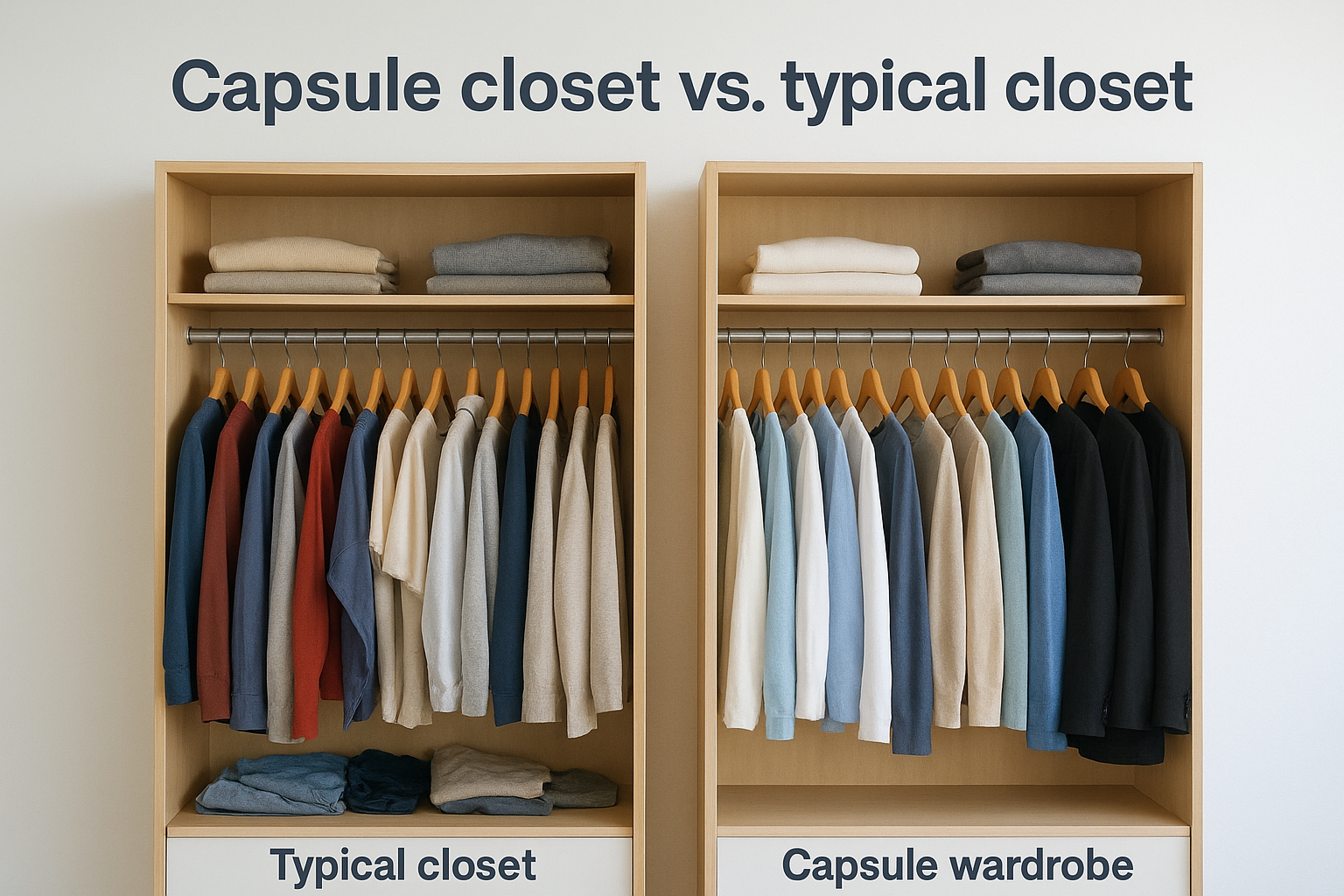
Capsule closet vs. typical closet
Seeing the difference side by side makes the case clearer than any abstract argument about minimalism.
| Typical closet | Capsule wardrobe | |
|---|---|---|
| Average item count | 100+ pieces | 25-40 pieces |
| Items worn regularly | ~20% | 80-90% |
| Time spent choosing outfits | 10-15 min/day | Under 3 min/day |
| Cost per wear | Often high (unworn items) | Low (heavy rotation) |
| Fabric quality priority | Mixed, price-driven | High, durability-driven |
Going from the left column to the right one isn't about deprivation. It's about shifting the budget you already spend on clothes toward fewer, better pieces instead of a constant stream of cheap replacements. The next steps in this guide walk you through exactly how to make that shift without guessing.
Step 1. Audit your current closet
Every capsule wardrobe worth building starts with a brutal inventory, not a shopping trip. Before you learn how to build a capsule wardrobe that actually holds up, you need to know exactly what you own, what fits, and what you've been avoiding for months. Pull every single item out of your closet and drawers, including the stuff shoved in the back you forgot about.
Sort into three piles
Lay everything on your bed and sort ruthlessly into three categories. This part takes an hour, maybe two, but it's the foundation everything else in this guide builds on.
- Keep: fits well right now, matches at least three other pieces, and shows no visible wear (pilling, stretching, fading).
- Fix or alter: good fabric and fit potential, but needs a hem, a button, or a trip to the tailor.
- Let go: doesn't fit, hasn't been worn in a year, or is visibly worn out.
Don't skip the letting-go pile out of guilt. Donating or recycling clothes you never wear clears mental and physical space for pieces that actually earn their spot.
Ask the fit and fabric questions
As you sort, hold each keep-pile item up to two tests: does it still fit your body today, and does the fabric feel substantial or thin and see-through? A tee that's gone see-through at the shoulders or a pair of pants that gap at the waist doesn't belong in a capsule, no matter how much you paid for it originally.
If you wouldn't buy it again today, it doesn't belong in your capsule.
Track what you actually wear for two weeks
Before you finalize anything, spend two weeks wearing only from your keep pile and jot down what you reach for daily. This short wear log reveals patterns fast:
Mon: gray tee, dark denim, white sneakers
Tue: same tee, chinos, loafers
Wed: navy sweater, dark denim, boots
If you notice you're wearing the same three or four combinations on repeat, that's not a failure of imagination. That's your actual style telling you what to build around in the next steps.
Step 2. Define your lifestyle and style constraints
Once your closet audit is done, you know what you own. Now you need to know what you actually need, and that depends entirely on how you spend your days. Someone who works from home in sweats has a completely different capsule than someone who's in client meetings four days a week and hits the gym on weekends. Skipping this step is why so many capsule wardrobe guides fail people: they assume everyone lives the same life.
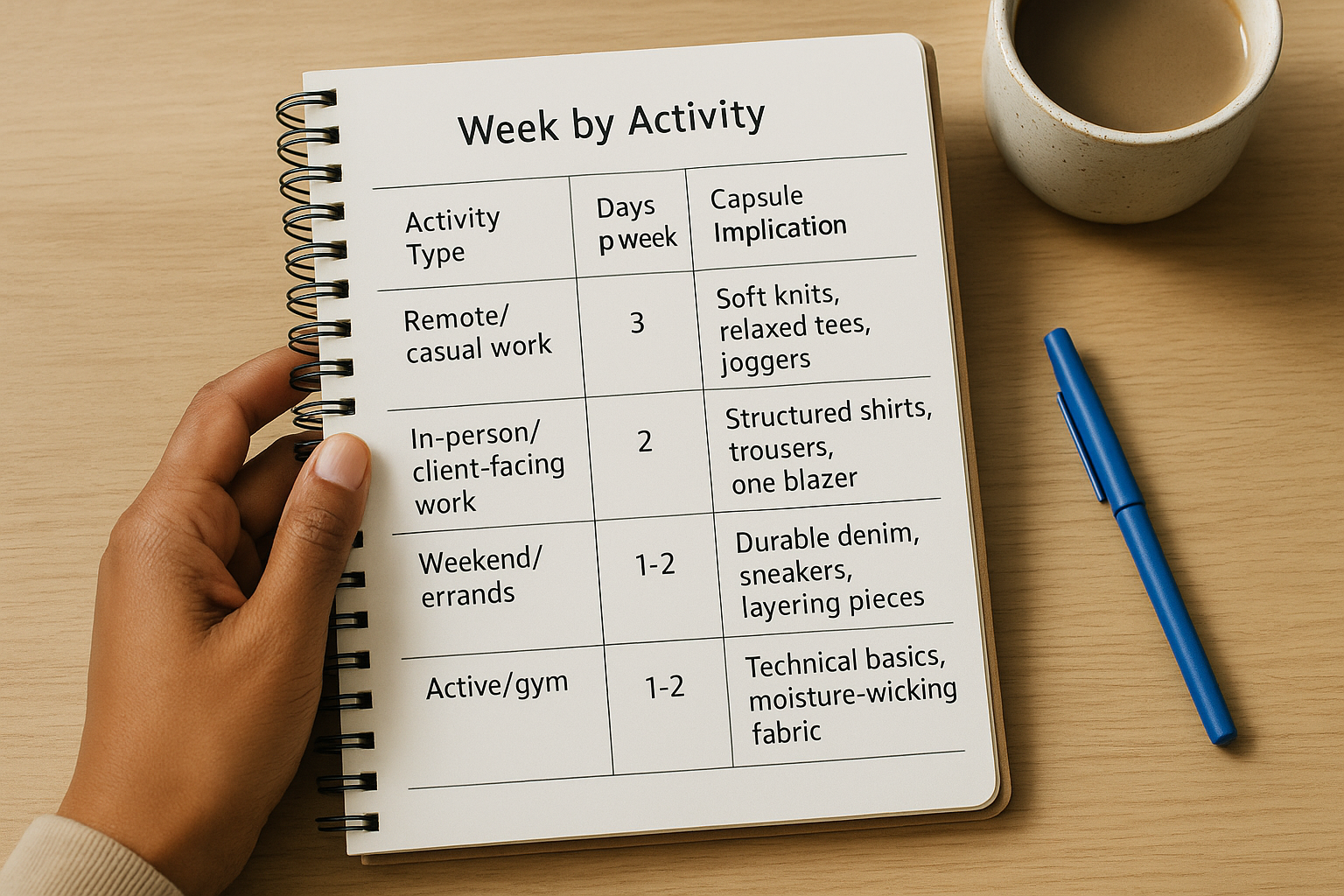
Map your week by activity, not by wish
Grab a notebook and break down an average week by how many days you spend in each type of activity. Be honest about your real week, not the one you wish you had (skip the "I'll wear blazers more" fantasy if you haven't worn one in six months).
| Activity type | Days per week | Capsule implication |
|---|---|---|
| Remote/casual work | 3 | Soft knits, relaxed tees, joggers |
| In-person/client-facing work | 2 | Structured shirts, trousers, one blazer |
| Weekend/errands | 1-2 | Durable denim, sneakers, layering pieces |
| Active/gym | 1-2 | Technical basics, moisture-wicking fabric |
Build your capsule around the week you actually live, not the one you wish you had.
Set your non-negotiable constraints
Beyond activity, list the hard constraints that shape what you can realistically wear. These usually fall into three buckets:
- Climate: if you live somewhere with real winters, your capsule needs layering pieces a warm-climate capsule doesn't.
- Dress code: even loose workplace rules narrow your color and silhouette choices more than you'd think.
- Body and comfort preferences: fabrics that itch, waistbands that dig, or fits you avoid no matter how good they look on the hanger.
Writing these down feels tedious, but it saves you from buying pieces that look great in a lookbook and sit unworn in your closet for the reasons above.
Define your style in three words
Finally, pick three words that describe how you want to look and feel in your clothes: relaxed, sharp, and durable, for example, or clean, warm, and versatile. Every piece you consider adding to your capsule later should match at least two of those three words. This filter keeps your future purchases consistent instead of a grab bag of unrelated trends.
Step 3. Choose your core color palette
Color is what makes or breaks a capsule wardrobe's math. Pick a palette that clashes, and even great pieces won't mix. Pick one that works together, and a handful of items can produce dozens of outfits. This step is where how to build a capsule wardrobe stops being about individual pieces and starts being about the system they form together.
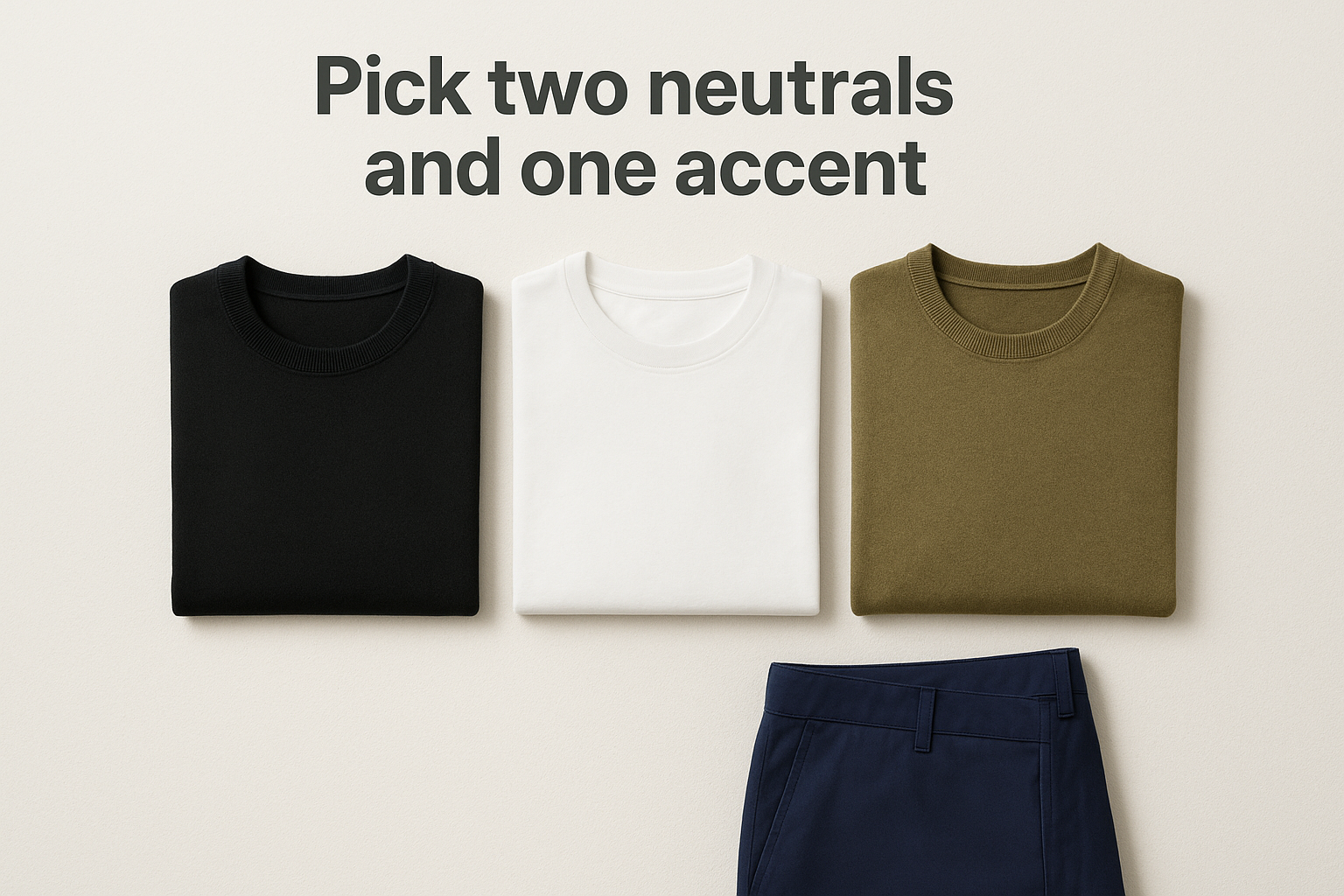
Pick two neutrals and one accent
Most working capsules run on two neutrals and a single accent color, nothing more. Neutrals do the heavy lifting (tees, pants, outerwear), while the accent adds variation without complexity. A common, reliable split looks like this:
| Role | Example colors | Where it shows up |
|---|---|---|
| Base neutral | Black, navy, or charcoal | Pants, outerwear, one sweater |
| Secondary neutral | White, gray, or oatmeal | Tees, shirts, layering pieces |
| Accent color | Olive, burgundy, or camel | One or two statement pieces |
Resist the urge to add a second accent color right away. Every extra hue you introduce multiplies the number of items you need to keep everything matching, which quietly undoes the whole point of a capsule.
A capsule wardrobe lives or dies on how many colors you let in.
Test the palette against your skin and your existing pieces
Hold your proposed neutrals and accent up against your face in natural light before committing. Colors that wash you out get worn less, no matter how well they coordinate on paper. Then cross-check the palette against your keep pile from Step 1: if half your closet is already navy and gray, don't fight that pattern by forcing in black. Building around colors you already gravitate toward means your existing pieces integrate instead of getting replaced.
Write your palette down before you shop
Once you've settled on your two neutrals and one accent, write them down somewhere you'll actually check before buying anything new. A simple list works:
- Base neutral: navy
- Secondary neutral: white
- Accent: olive
Keep that list on your phone. It turns every future purchase decision into a quick yes-or-no check instead of a debate, and it's the single easiest way to keep your capsule from drifting back into a closet full of one-off pieces that don't talk to each other.
Step 4. Build your wardrobe in modules
Building a capsule wardrobe one random item at a time is how people end up with a closet full of things that don't talk to each other. Instead, think in outfit modules: small groups of three to five pieces that create multiple complete looks on their own. This is the part of learning how to build a capsule wardrobe where the math actually clicks, because you're not shopping for individual shirts anymore, you're shopping for combinations.
Group pieces into functional modules
Start with the module tied to your most frequent activity from Step 2, then add modules for the rest of your week. Each module should stand alone as a mini-capsule before you move to the next one.
| Module | Core pieces | Outfits produced |
|---|---|---|
| Everyday base | 3 tees, 2 pants, 1 sweater | 6+ combinations |
| Work layer | 2 shirts, 1 blazer, 1 trouser | 4+ combinations |
| Weekend | 1 denim, 2 casual tops, sneakers | 4+ combinations |
| Outerwear | 1 jacket, 1 coat | Layers over every module |
Build one complete module before you start the next. A half-finished wardrobe never fits together.
Test each module before expanding
Once a module exists on paper, wear only from it for a few days before adding the next one. This catches gaps early, maybe your "everyday base" pants don't actually pair well with the sweater you picked, and it's far cheaper to fix that on paper than after you've bought five more pieces assuming it worked. Resist the pull to build every category at once; sequencing modules keeps your spending focused and your closet coherent.
Let modules overlap on purpose
The strongest capsules share pieces across modules instead of keeping them siloed. A single navy sweater that works with your everyday base and your work layer effectively doubles its value, which is exactly the kind of overlap you're aiming for. As you build, ask of every new piece: which modules does this join, not just which single outfit does it complete. That question alone will save you from buying pieces that look good but only work in isolation.
Step 5. Fill the gaps with quality essentials
By now you know what you own, what your week demands, and what colors tie it all together. What's left is the honest gap list: the specific pieces missing from your modules that no amount of outfit planning can fake. This is the step where how to build a capsule wardrobe actually turns into a shopping list, and it's also where most people overspend on the wrong things or underspend on the ones that matter.
Rank gaps by how often you'll wear them
Go back to your module table from Step 4 and circle every slot with an X or a question mark. Order that list by frequency of wear, not by what's fun to shop for. A missing everyday tee that fills a five-day-a-week gap outranks a statement jacket you'll wear twice a month, even if the jacket photographs better.
Spend where the fabric does the work
Not every gap deserves the same budget. High-contact, high-frequency items (tees, base layers, anything against your skin daily) are worth paying for fabric weight and construction, since that's what determines whether a piece survives fifty washes or five.
Spend on what touches your skin every day. That's where cheap fabric fails first.
- Daily wear items: invest in weight and stitching (a 300g Supima cotton tee holds shape far longer than a thin blend).
- Occasional pieces: mid-range spend is fine since wear and wash cycles are lower.
- Trend-adjacent extras: skip entirely, or buy cheap if you must, since they won't survive long-term rotation anyway.
Spending this way means your budget tracks how a piece performs over years, not how it looks in a single photo.
Buy one, live with it, then buy the next
Resist filling every gap in one order. Purchase the single highest-priority item, wear it into your rotation for two weeks, and confirm it earns its place before moving to the next gap. Rushing a full gap list at once is how closets fill back up with pieces that seemed necessary on paper but never got worn, which defeats the entire point of the audit you did in Step 1.
Step 6. Maintain and rotate your capsule each season
A capsule wardrobe isn't a one-time project. Even the best-built system drifts if you don't check in on it, and how to build a capsule wardrobe that lasts really means how you maintain one after the initial work is done. Fabric wears down, your activities shift with the seasons, and pieces that felt essential in spring can sit unworn by winter. Treat maintenance as a recurring 30-minute task, not an afterthought.
Swap seasonal modules, don't rebuild them
When the weather turns, pull out your outerwear and heavy-layer modules and store the pieces you won't wear for the next few months. Swap in seasonal modules rather than starting over: a lightweight base layer becomes a foundation you add a sweater or jacket module on top of, not a wardrobe you replace entirely. This keeps your core neutrals and everyday base intact year-round while only the outer layers rotate.
A capsule wardrobe isn't finished once you build it. It's finished every season you tend it.
Care for fabric like it's the investment it is
High-quality pieces earn their price tag only if you treat them right. Follow a few habits that extend the life of your heaviest-rotation items:
- Wash cold, skip the dryer heat for anything with structure, since heat is what breaks down elastic fibers and shrinks natural fabrics.
- Rotate pairs of shoes and pants so fibers rest between wears instead of compressing daily.
- Spot-treat instead of over-washing, since every wash cycle stresses fabric even when it looks clean.
Re-audit every three months
Set a recurring reminder every three months to repeat a mini version of Step 1. Pull everything out, check for pilling or fading, and confirm each piece still earns its spot in a module. Anything that's fallen out of rotation for two full seasons goes into the same let-go pile you built at the start. This quarterly habit is what separates a capsule that stays sharp for years from one that quietly bloats back into a full closet by next fall.
Making it stick
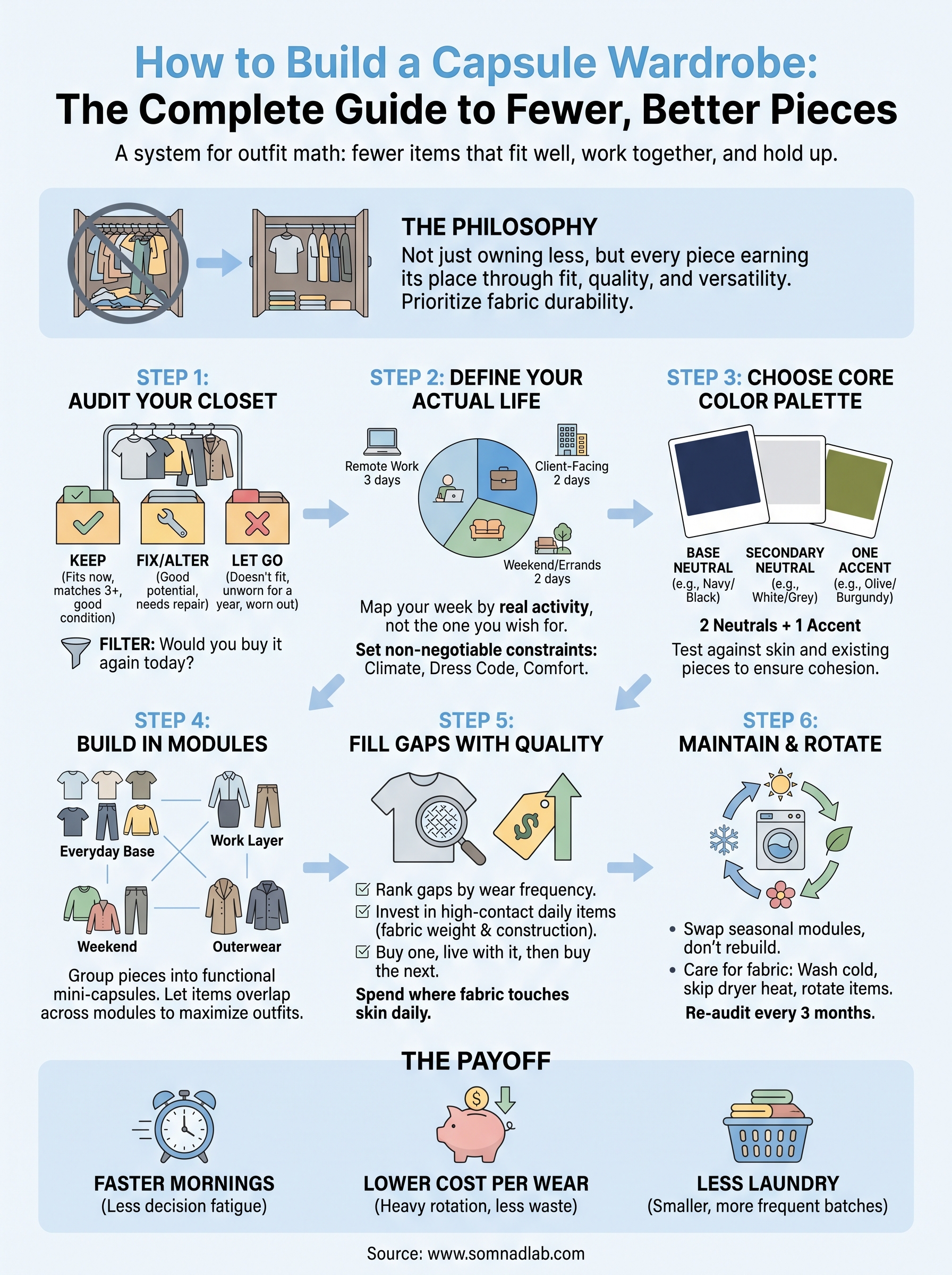
A capsule wardrobe isn't a weekend project you finish and forget. It's the audit, the modules, the quarterly re-check, repeated until fewer, better pieces just becomes how you dress. The reward is real: faster mornings, lower cost per wear, and a closet where almost everything you own actually gets worn.
The hardest part isn't the planning, it's resisting the pull to fill gaps with cheap fillers that fail your fabric test in a few months. Every piece you add should meet the same bar: it fits today, it matches what you own, and it survives real wear. That's the whole philosophy behind less, but better, and it's worth holding onto long after your first audit.
If you're ready to fill one of those gaps with a tee built to actually last, start with the piece that touches your skin every day. Shop the relaxed tee at SÖMNAD and see what a 300g Supima cotton basic is supposed to feel like.