


Standing in front of your closet trying to decide between a crew neck vs v-neck t-shirt shouldn't take ten minutes, but it often does. The two necklines look similar on a hanger, yet they change how a shirt sits on your shoulders, how it layers under a jacket, and how it reads with everything from jeans to tailored pants. Get the wrong one for your build or your wardrobe, and even a well-made tee can look off.
The short answer: crew necks suit broader shoulders and layering, while v-necks elongate the neckline and work better solo or under open collars. But the real decision comes down to your face shape, chest width, and what you're pairing the shirt with, not just personal taste.
This article breaks down the practical differences between the two, from fit and proportion to styling scenarios, so you can stop guessing. We'll also touch on why fabric weight and construction, not just neckline shape, determine whether a basic tee actually holds up and looks sharp wear after wear.
Why your neckline choice matters more than you think
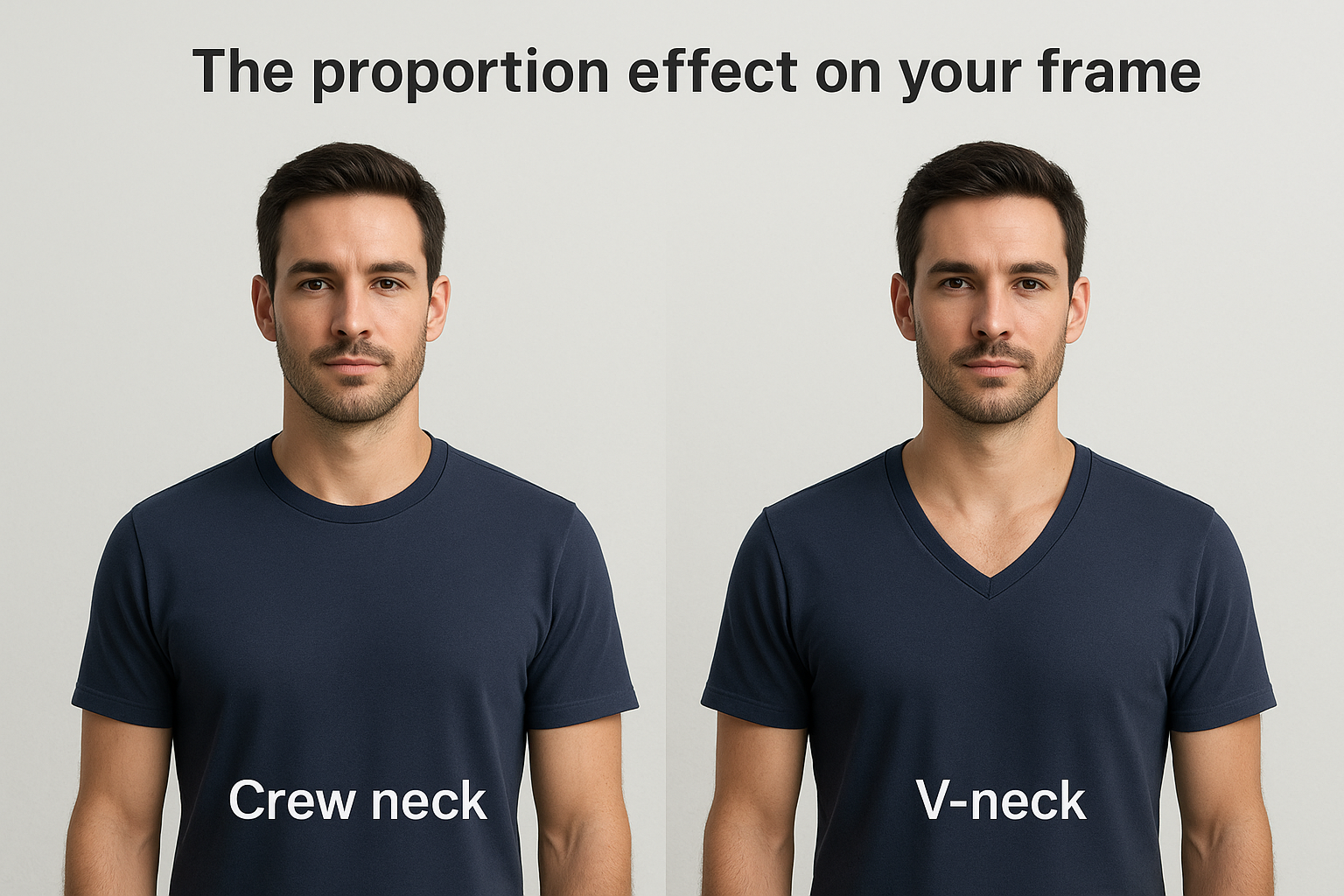
Most people treat neckline as a coin flip, crew or v, whatever's clean in the drawer. That's a mistake. The neckline is the first thing anyone sees when they look at your face, and it either frames your jawline or competes with it. A crew neck sits high and horizontal, drawing the eye across your shoulders. A v-neck cuts a vertical line down your chest, pulling attention toward your face and throat. That single geometric difference changes how broad or narrow you look, how tall your torso reads, and how the shirt sits under a blazer or an open flannel.
The proportion effect on your frame
Consider what happens with a round or square face. A crew neck's horizontal band can make a wide face look wider, while a v-neck's downward point breaks up that width and adds visual length. The reverse holds for narrow, long faces: a deep v-neck can exaggerate length you don't need, while a crew neck's straight line balances things out. This isn't vanity, it's basic visual proportion, the same principle a tailor uses when picking a lapel width for your shoulders.
| Trait | Crew neck effect | V-neck effect |
|---|---|---|
| Broad shoulders | Squares them off, adds width | Softens width, lengthens the torso |
| Round face | Can emphasize width | Slims and elongates |
| Long neck | Neutral, no added length | Can read as overly long |
| Short neck | Balances proportions | Adds needed visual length |
| Broad chest | Fills the space evenly | Opens the chest, draws the eye down |
The neckline you pick changes how your entire upper body reads before anyone even notices the fabric.
Why the neckline changes how fabric wears
Beyond looks, construction affects how long a tee actually lasts. Crew necks use a closed, continuous ribbed collar that distributes stretch evenly around the neck, which is one reason they hold their shape through years of washing and stretching over your head. V-necks require a mitered seam at the point, a small structural weak spot that can pucker, gap, or fray if the fabric's too thin or the stitching's rushed. That's a big part of why cheap v-neck tees look tired within a few months, even when they started from decent cotton. A 300g weight cotton, like Supima, holds that seam far better than the thin, stretchy blends most fast-fashion brands use.
Your daily wardrobe context
Your habits matter just as much as your face shape. If you layer constantly, flannels, cardigans, jackets, a crew neck's clean horizontal line stays hidden and neat under a collar. If you wear tees solo more often, a v-neck opens up your chest and reads more relaxed without a jacket over it. Notice how often you actually wear a tee alone versus tucked under something else before you settle on one shape as your everyday default, because that habit will decide which neckline earns more wear in your rotation.
How to choose between a crew neck and a v-neck
Deciding between the crew neck vs v-neck t-shirt debate gets easier once you stop guessing and start measuring. Look at three things: your shoulder width, your neck length, and how much chest you want to show under an open jacket. Skip the mirror-only approach and actually try both necklines in the same fabric weight, because a thin v-neck and a heavy crew neck will never give you a fair comparison.
Start with your body, not your closet
Broad-shouldered guys usually look better in a v-neck because it breaks up width instead of adding to it. If your shoulders are narrower or your torso reads short, a crew neck's straight line adds structure without exaggerating anything. Here's a quick way to sort it:
- Broad shoulders, shorter neck: lean v-neck, it lengthens the upper body
- Narrow shoulders, longer torso: lean crew neck, it adds width and structure
- Average build, no strong preference: own one of each and let the outfit decide
- Muscular or athletic build: a slightly deeper v-neck shows shoulder definition without looking like a costume
Your shoulders and neck length should decide the neckline, not whatever shirt happens to be on top of the pile.
Factor in what you already wear
Think about your existing wardrobe before buying either style blind. If half your closet is button-downs and quarter-zips, a crew neck disappears cleanly underneath them. If you wear tees as the main event, a v-neck gives you more visual interest without needing a jacket to finish the look. Pull up a photo of your last five outfits and check which neckline actually shows in each one.
Test before you commit
Running a quick side-by-side comparison beats overthinking it in a fitting room. Try this simple check the next time you're shopping:
- Put on a crew neck tee alone, no layers
- Switch to a v-neck in the same size and fabric
- Note which one makes your neck and shoulders look more proportional
- Repeat the test with a jacket or overshirt on top
Whichever neckline wins both rounds is the one that should anchor your everyday rotation.
Styling crew necks and v-necks for every occasion
Picking a neckline for a single outfit is easier than picking one for your whole wardrobe. Context matters: a crew neck vs v-neck t-shirt decision that works at brunch might fall flat at a client dinner. Once you know the occasion, matching the neckline to it becomes a five-second decision instead of a debate.
Weekend and casual outfits
Weekends call for the shirt to do the talking, since there's rarely a jacket layered on top. A v-neck paired with slim jeans and sneakers opens the chest just enough to look relaxed without trying too hard. Crew necks work here too, especially with a chest pocket or subtle texture, but they read a touch more sporty than refined. If your weekend uniform includes shorts and canvas shoes, either neckline holds up fine, so let color and fit decide instead.

Smart-casual and work settings
Work settings reward a cleaner silhouette, and this is where fabric weight starts to matter as much as neckline shape. A crisp v-neck tee under an unbuttoned overshirt or blazer adds a small triangle of visual interest at the collarbone. A crew neck under that same jacket disappears entirely, which is exactly the point if you want the outer layer to lead. Both work, but the overall vibe shifts noticeably depending on which one you choose.
| Occasion | Better pick | Why |
|---|---|---|
| Brunch or errands | V-neck | Opens chest, relaxed feel |
| Gym or weekend sport | Crew neck | Stable collar, no gaping |
| Smart-casual dinner | V-neck under blazer | Adds shape at collarbone |
| Office with jacket | Crew neck | Stays hidden, structured look |
The occasion should dictate the neckline just as much as your shoulders do.
Dressed-up evenings
Evenings out ask for a bit more polish, and a v-neck in a heavier cotton reads dressier than a crew neck in the same color and cut. Swapping sneakers for leather shoes makes the same tee suddenly look intentional rather than thrown on. Layering a structured jacket over it still lets the v-neck's point peek through, giving the outfit a finished edge that a crew neck can't quite match on its own.
Crew neck vs v-neck for layering and undershirts
Layering exposes the real functional gap between these two necklines. When a tee sits under a dress shirt or henley, its job isn't to look good on its own, it's to stay invisible. This is where the crew neck vs v-neck t-shirt decision stops being about face shape and starts being about collar height, button placement, and how much neck skin you want showing above your outer layer.
Why crew necks dominate as undershirts
A crew neck's higher collar tucks neatly under almost any dress shirt without peeking out, which is exactly why it's the default choice for undershirts. The ribbed band sits close to the throat, so it won't gap or shift when you reach, bend, or shrug off a jacket. Button-down collars, in particular, pair better with crew necks because both sit at a similar height and never fight for space at your neckline.
A crew neck stays out of sight, which is the entire point of an undershirt.
When a v-neck actually works better underneath
V-necks earn their spot under lower-cut shirts, especially henleys or button-downs worn open at the top button. If your dress shirt collar sits low or you like leaving a button or two undone, a v-neck keeps the tee from showing above the fabric line, something a crew neck almost always fails at in that scenario. The tradeoff is a bit less structure at the shoulder, since the point cut removes some of the fabric that would otherwise anchor the collar in place.
A quick layering reference
Use this as a rule of thumb before you grab a shirt out of the drawer:
| Outer layer | Recommended undershirt | Reason |
|---|---|---|
| Buttoned dress shirt, top button closed | Crew neck | Stays hidden below the collar |
| Dress shirt, one button open | V-neck | Prevents tee from showing at the chest |
| Henley or crew-neck sweater | V-neck | Avoids doubled-up neckline bulk |
| Flannel or overshirt | Crew neck | Adds structure, no visible gapping |
Getting this wrong is a small thing, but it's the kind of detail that separates a put-together outfit from one that looks slightly careless. Match the undershirt to the collar, not the other way around, and you'll stop noticing your tee altogether, which is exactly how a good layering piece should behave.
What fabric and fit mean for how a tee wears over time
Neckline shape gets all the attention, but fabric weight and construction decide whether either style still looks good after fifty washes. A crew neck vs v-neck t-shirt choice matters less than the cotton behind it once you're a year into ownership. Thin, cheap jersey stretches out at the collar within weeks regardless of which neckline you picked, while a heavier weave holds its shape wash after wash.
Why weight determines longevity
Heavier cotton, especially something in the 300g range like Supima, resists the stretching and thinning that ruins thinner tees. Lightweight blends feel soft on day one, but they lose density fast, and that's when v-neck seams start to pucker and crew neck collars start to sag. Fabric density is the difference between a tee that still looks sharp at month twelve and one that's relegated to yard work by month three.
A great neckline built on thin fabric still fails within a year.
How fit interacts with fabric weight
A relaxed fit works best with heavier cotton because the fabric has enough structure to hold its own drape without clinging or sagging. Slimmer fits can work with lighter fabric, but they show wear faster since there's less material absorbing the stress of daily movement. Construction quality, reinforced shoulder seams, double-stitched hems, ribbed collars that don't lose elasticity, matters just as much as the weight of the cotton itself.
What to check before buying either style
Run through this short list before you commit to a tee, no matter which neckline you're leaning toward:
- Fabric weight: look for something in the 180g to 300g range for tees meant to last
- Collar construction: ribbed knit for crew necks, clean mitered seams for v-necks
- Shrinkage: check care instructions, since cheap cotton can shrink two sizes after one wash
- Pilling: rub the fabric between your fingers, low-quality cotton pills within a few wears
Getting the neckline right matters for how you look today. Getting the fabric right decides whether the shirt still looks the same way a year from now, which is arguably the bigger investment.
Finding the fit that's right for you
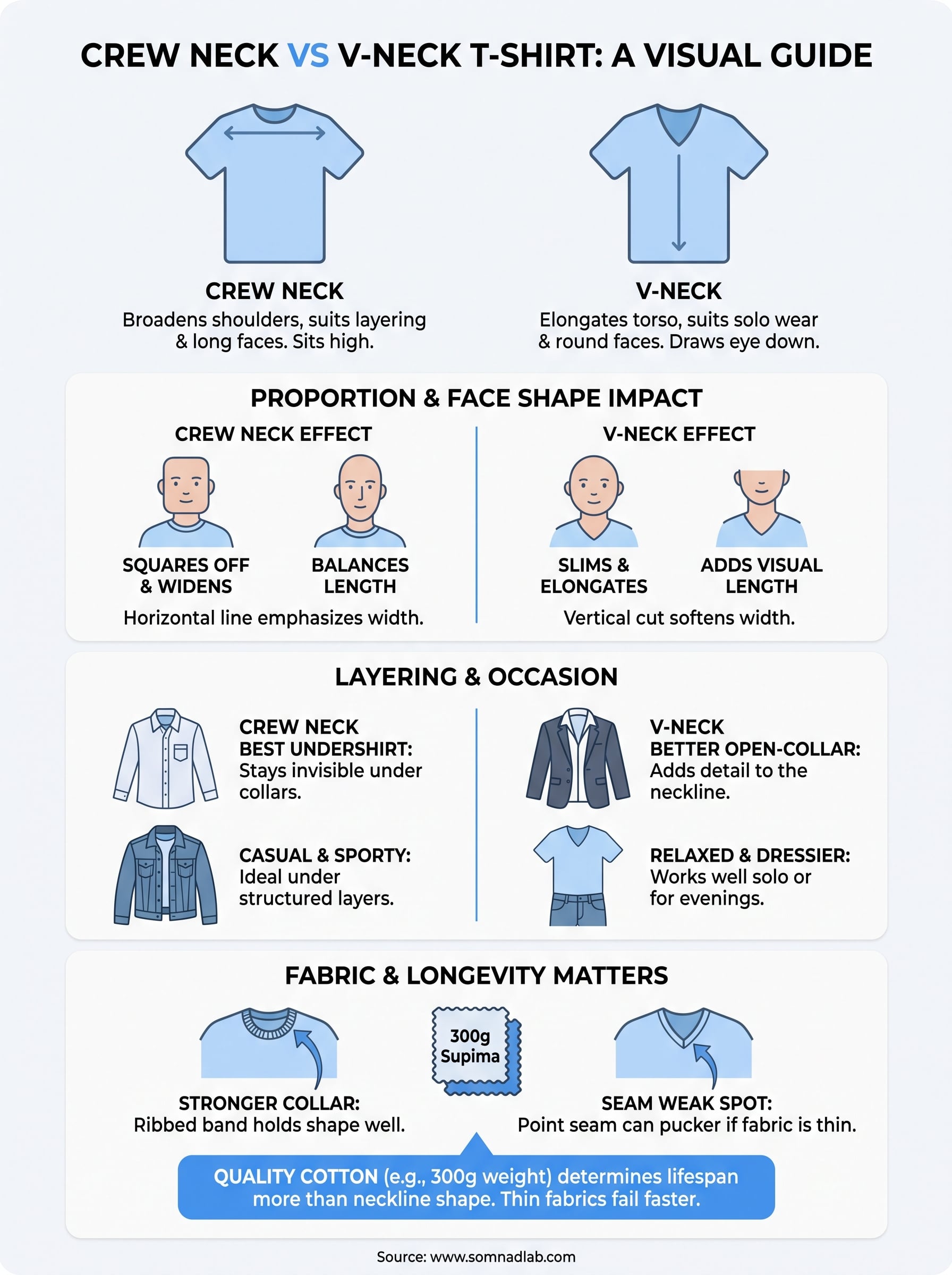
The crew neck vs v-neck t-shirt question isn't really about trends, it's about your shoulders, your neck length, and what you actually wear over or under the shirt. Crew necks hold their shape and disappear under layers. V-necks lengthen your frame and carry a look on their own. Neither wins outright, and the right pick changes depending on the outfit you're building around it.
What does matter, regardless of neckline, is the fabric behind it. A 300g Supima cotton tee keeps its collar tight and its seams clean long after a thin blend has stretched out and gone see-through. That's the whole point of buying fewer, better basics instead of restocking cheap tees every few months.
If you've settled on your neckline, put it to the test on a shirt built to last. Shop SÖMNAD's relaxed tee and see what a properly made basic actually feels like.