


You're staring at two shirts that look nearly identical, but one costs twice as much and the tag says "Supima" instead of just "Pima." That price gap raises a fair question, and the supima vs pima cotton debate matters more than most shoppers realize once you understand what's actually different between the fibers.
Here's the short answer: Pima is a type of extra-long staple cotton, while Supima is a trademarked term for American-grown Pima cotton that meets strict quality standards set by the Supima Association. Not all Pima is Supima, but all Supima is Pima. That distinction affects fiber length, softness, and how well a garment holds its shape after repeated washes.
In this article, we'll break down how these fibers differ in strength, feel, and longevity, and we'll also cover supima cotton vs organic cotton, since that's another comparison that trips people up when they're trying to buy a tee that actually lasts. If you've ever wondered why some basics pill after a few washes while others get softer, this is where you'll find the answer.
Why the Supima vs Pima difference actually matters
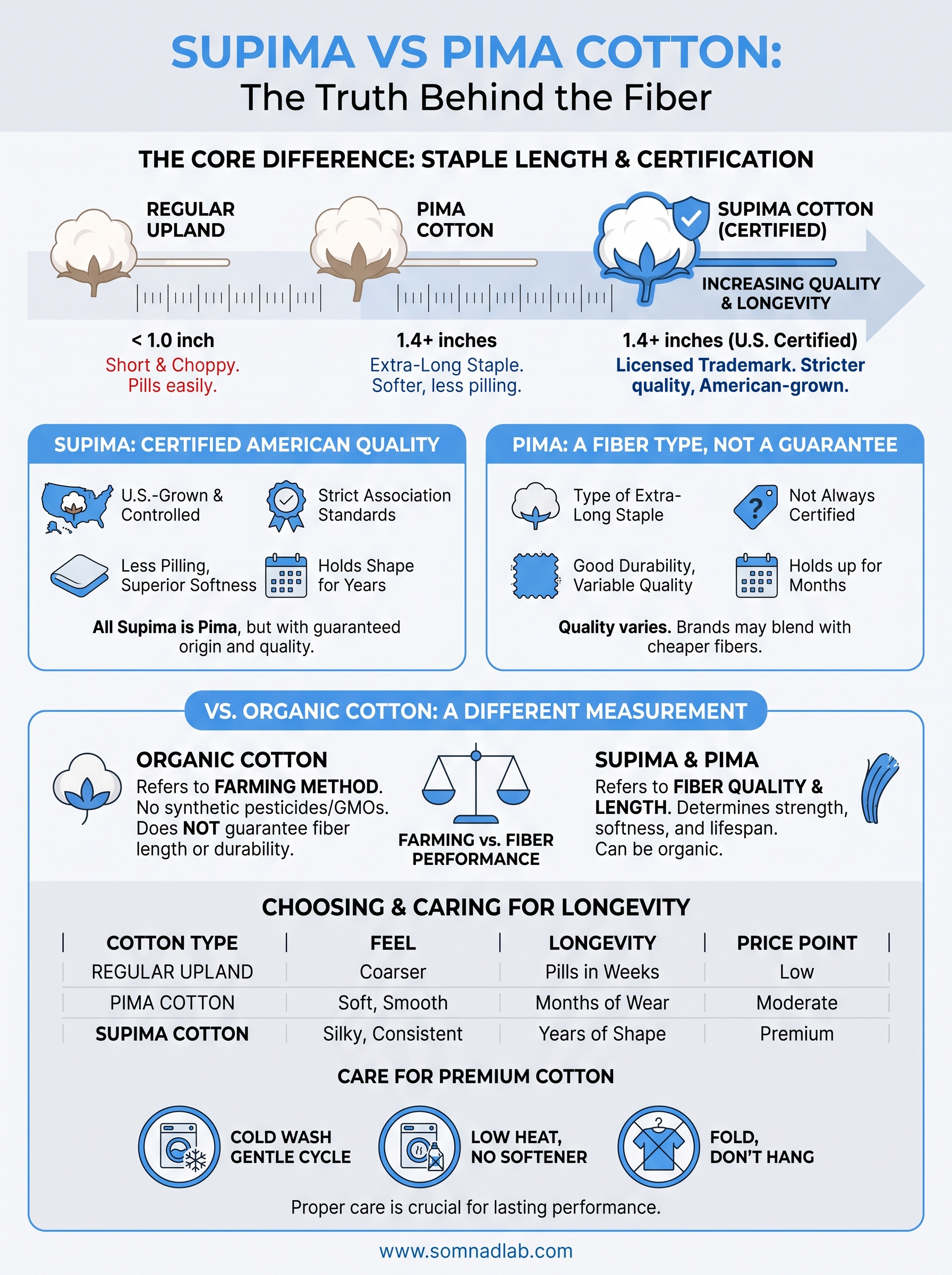
Cotton quality comes down to one measurement most shoppers never think about: staple length. That's the length of the individual cotton fiber before it gets spun into yarn. Regular upland cotton, the kind used in most fast-fashion basics, has short, choppy fibers averaging under an inch. Pima cotton fibers stretch beyond 1.4 inches, and Supima cotton, grown exclusively in the U.S. under strict certification standards, often exceeds that. Longer fibers mean fewer loose ends poking out of the yarn, which is the direct cause of pilling, fuzzing, and that worn-out look after a dozen washes.
The fiber length effect on everyday wear
Does staple length actually change how a shirt feels a year from now? Yes, and dramatically. Short-staple cotton yarn has thousands of tiny fiber ends exposed on the surface. Every wash cycle, every friction point against your skin or a car seat, snags those ends and creates the little balls of fuzz you see on cheap tees. Extra-long staple fibers like Pima and Supima lie flatter and tighter in the yarn, so there's less to snag in the first place. That's why a 300g Supima cotton tee can go through 50 washes and still look nearly new, while a budget cotton shirt starts looking tired after ten.
Longer cotton fibers mean fewer loose ends to pill, which is the real reason premium tees outlast cheap ones.
Where the price difference actually comes from
Growing extra-long staple cotton isn't cheap. It requires specific climates (mainly the American Southwest for Supima), more careful harvesting, and lower yields per acre than upland cotton. That cost gets passed down, but it buys you real, measurable benefits that explain whether Supima is worth the price: strength, softness that improves with washing instead of degrading, and shape retention that keeps a crew neck from stretching out at the collar. Manufacturers who cut corners often blend in shorter fibers to save money, which is exactly why two shirts can look identical off the rack but perform completely differently after a season of wear.
| Cotton Type | Staple Length | Common Feel | Typical Longevity |
|---|---|---|---|
| Regular Upland | Under 1.0 in | Coarser, less breathable | Pills within weeks |
| Pima | 1.4+ in | Soft, smooth | Holds up for months of regular wear |
| Supima | 1.4+ in, U.S.-certified | Silky, consistent | Holds shape and softness for years |
Understanding this staple length hierarchy is the foundation for everything else in this comparison, including how to actually verify what you're buying before you hand over your money.
How to spot genuine Supima and Pima cotton before you buy
Labels lie more often than you'd think. A tag that says "100% Pima cotton" tells you the fiber type, but it doesn't guarantee the percentage or the grade used in the actual yarn. Some brands blend a small amount of Pima with cheaper upland cotton and still slap the name on the tag, since there's no strict legal threshold for the term "Pima" the way there is for Supima, which is a licensed trademark controlled by the Supima Association. Only brands that meet certification requirements and source their cotton from approved American growers can legally use that word.
What the certification actually guarantees
Genuine Supima cotton comes with a paper trail. Licensed manufacturers agree to sourcing and quality standards enforced by the association, and you can often find a Supima logo or explicit certification claim on the product page or hangtag. If a brand mentions Supima but never explains sourcing, treat that as a red flag rather than proof.
If a brand can't tell you where the cotton was grown, assume it's cutting corners on the fiber.
Practical checks before you buy
Running through a short checklist of fabric and stitch tests saves you from paying premium prices for a mediocre shirt:
- Look for explicit certification language, not just the word "Pima" alone
- Check if the brand names its cotton source (U.S.-grown points to genuine Supima)
- Feel the fabric weight; quality tees using 300g Supima cotton or similar density feel substantial, not paper-thin (here's how 210gsm and 300gsm tees compare)
- Read reviews mentioning long-term wear, since pilling complaints after a few washes signal shorter fibers hiding behind a fancy label
- Avoid unusually low prices on anything marketed as Supima, since the growing and certification costs make rock-bottom pricing nearly impossible
Spotting these details takes an extra minute at checkout, but it's the difference between a tee that lasts years and one that pills by winter.
Supima vs Pima vs organic cotton: which one fits your needs
Organic cotton confuses the comparison because it measures something entirely different from staple length. Organic certification tracks how the cotton was grown, meaning no synthetic pesticides, no GMO seeds, and regulated water use. It says nothing about fiber length, softness, or how long the fabric will hold up. That's the core of the supima cotton vs organic cotton question: one label is about farming method, the other is about fiber quality. A shirt can be organic and still use short-staple cotton that pills within a month.
What organic cotton actually certifies
Certifying bodies like the Global Organic Textile Standard verify farming practices, not durability. You can absolutely find organic Pima or even organic Supima blends, but plain "organic cotton" on a tag usually means standard upland fiber grown without chemicals. That's a meaningful environmental choice, but it won't give you the same wear performance as extra-long staple cotton.
Organic tells you how the cotton was farmed. Supima and Pima tell you how long it will last.
Picking the right cotton for your goals
Your priority determines which label matters most:
| Priority | Best Choice | Why |
|---|---|---|
| Softness and shape retention | Supima | Certified U.S.-grown, longest staple, consistent quality |
| General durability on a budget | Pima | Extra-long staple without the certification premium |
| Farming practices and chemical use | Organic cotton | Verified low-impact growing, but variable fiber length |
| Both durability and lower environmental impact | Organic Supima or Pima blends | Rare, but combines certified fiber with cleaner farming |
Most shoppers chasing longevity over marketing claims land on Supima, since fiber quality directly determines whether a tee still looks new after a year of regular wear. If chemical-free farming matters more to you than fabric performance, prioritize organic certification instead, and check the staple length separately.
Caring for Supima and Pima cotton so it lasts
Even the best fiber can wear out fast if you treat it wrong. Extra-long staple cotton resists pilling naturally, but heat, harsh detergents, and high-speed spinning still stress the fibers over time. Washing habits matter almost as much as the fiber itself when it comes to keeping a tee looking new past the one-year mark.
Wash and dry settings that protect the fibers
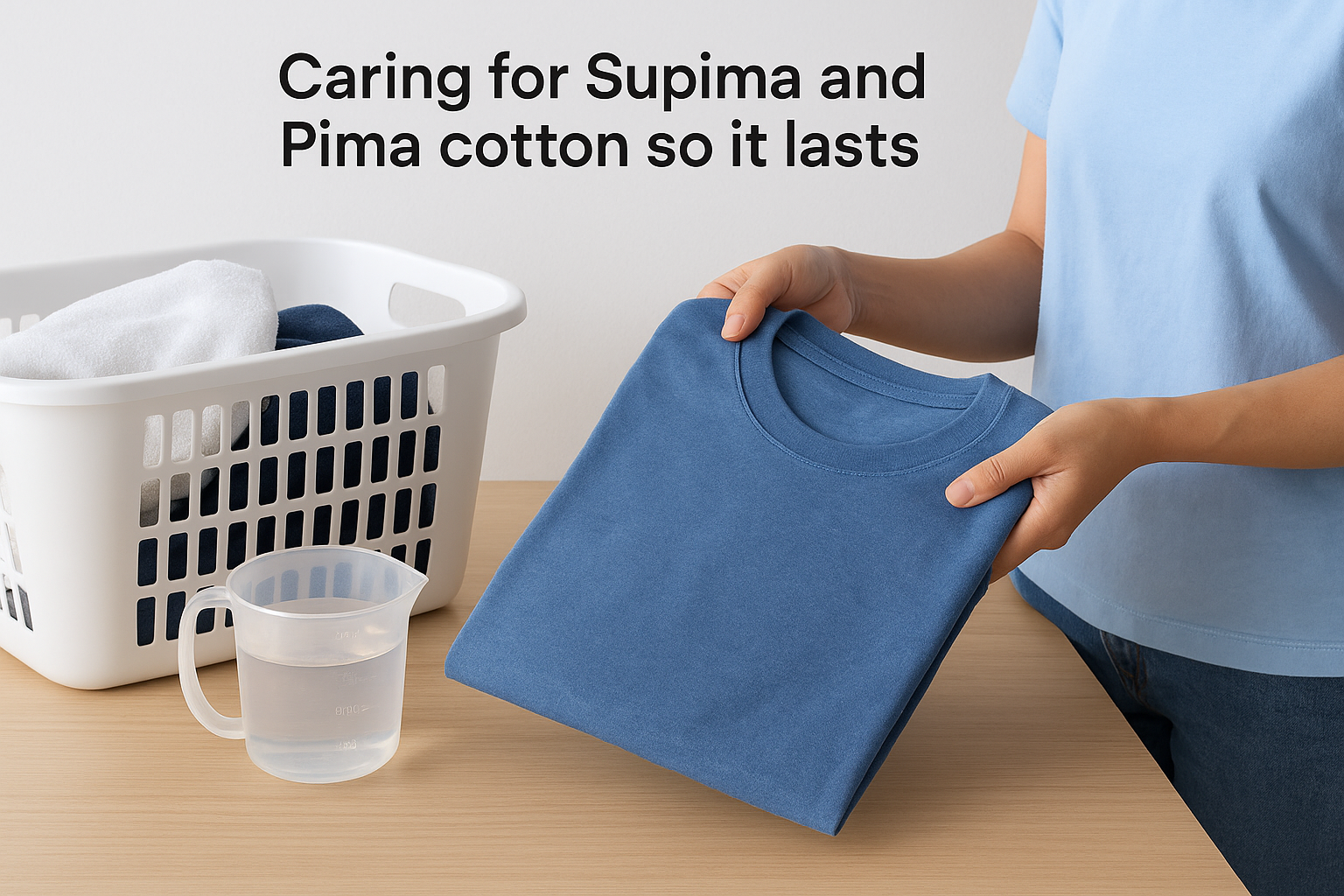
Cold water is your default setting for any Supima or Pima piece, and it's the starting point of a proper Supima cotton care routine. Hot water breaks down the natural fiber structure and speeds up fading, especially on darker colors. Skip fabric softener too, since it coats fibers with a residue that traps heat and actually reduces the fabric's breathability over time.
Cold water and low heat do more to protect a premium tee than any special detergent ever will.
Here's a quick reference for keeping your basics in shape:
- Wash in cold water on a gentle cycle
- Skip fabric softener; it dulls the natural softness of long-staple cotton
- Turn shirts inside out before washing to reduce surface friction
- Air dry when possible, or use low heat if you need the dryer
- Fold instead of hanging on wire hangers to prevent shoulder stretching
Why proper care extends the value you paid for
Good care habits pay off exactly where the fiber quality already gave you an advantage. A 300g Supima cotton tee washed cold and dried low can hold its shape and softness for years, while the same shirt tossed in hot water repeatedly will pill and shrink more than you'd expect no matter how good the original fiber was. Treating premium cotton with basic care isn't extra effort, it's just protecting the investment you already made.
Choosing cotton that's built to last
The supima vs pima cotton debate boils down to one thing: fiber length determines how a shirt performs long after checkout. Pima gives you extra-long staple fibers at a fair price, Supima adds American-grown certification and a stricter quality bar, and organic cotton addresses farming practices rather than durability. None of these labels matter if you ignore care, since cold water and low heat protect the fiber investment you already paid for.
Once you know what to look for, spotting a genuine premium tee takes seconds, not guesswork. Check the certification, feel the weight, and read reviews before you trust a hangtag. Quality basics shouldn't require logos or hype to prove themselves, just fabric that holds up wash after wash.
If you want a tee built on real Supima standards instead of marketing claims, see the Supima cotton t-shirts that feel truly premium and feel the difference for yourself.