


You've probably owned a dozen crew neck tees without ever asking what makes them a crew neck t-shirt in the first place. It sounds like a simple question, but the term gets thrown around loosely, often confused with round neck or mixed up with ribbed collars that have nothing to do with the actual cut. Once you're paying attention to fit and construction, the differences start to matter.
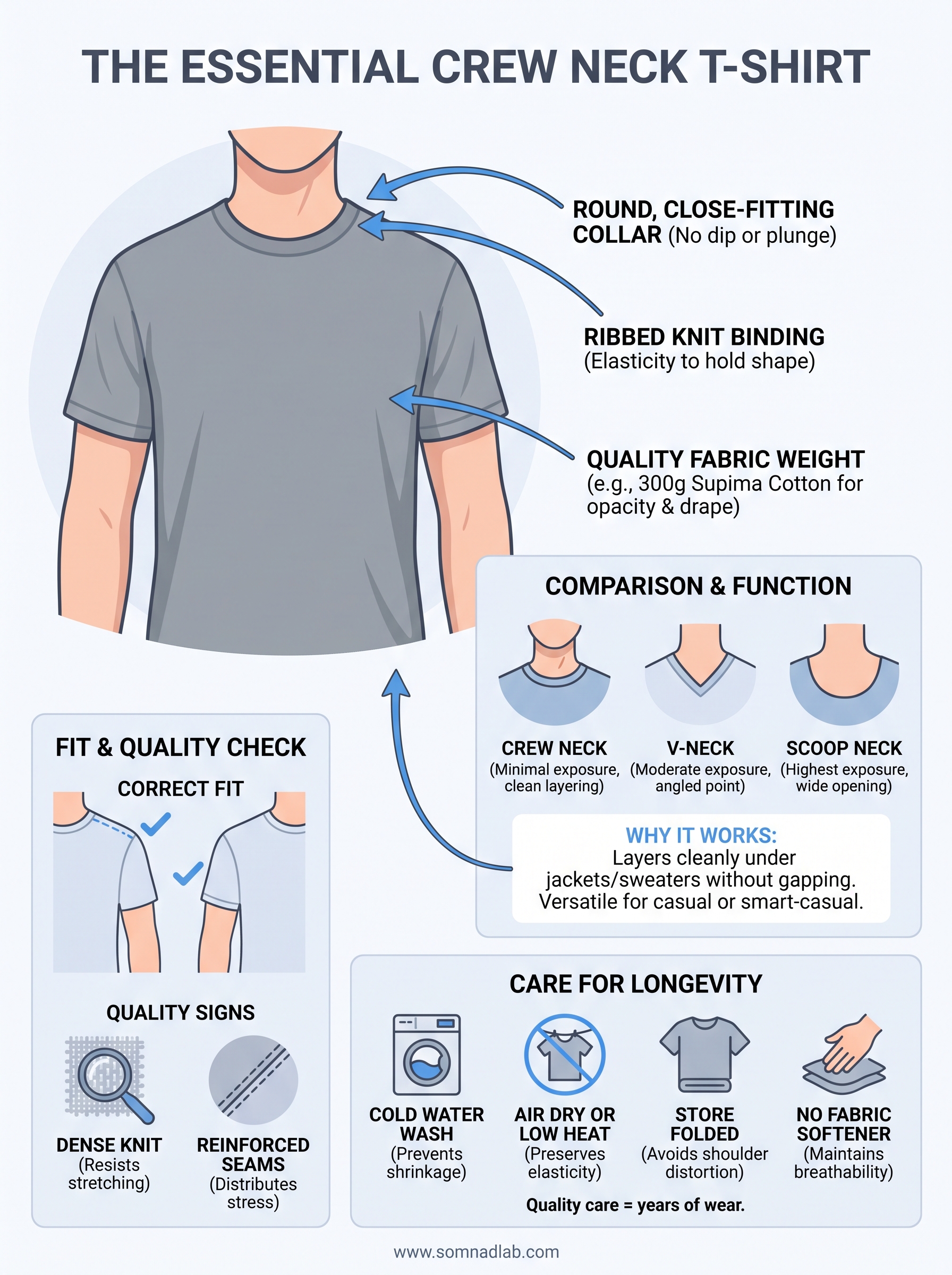
A crew neck is defined by its round, close-fitting collar that sits at the base of your neck without any dip or plunge, built with a ribbed knit binding that holds its shape wash after wash. That's the short answer. The longer answer involves how it compares to V-necks, why the ribbing matters more than most people realize, and how collar height changes the way a shirt sits under a jacket or on its own.
This breakdown covers the exact anatomy of a crew neck, how it stacks up against other neckline styles, and what separates a shirt that holds its shape for years from one that stretches out after a few washes. That last part is where fabric weight and construction come in, and it's the difference we build into every SÖMNAD tee.
Why the crew neck t-shirt remains a wardrobe essential
From undershirt to icon
Athletes wore crew necks under their uniforms in the early 1900s, and the military standardized them because the ribbed collar kept sweat off the outer layers and held its shape through hard wear. That practical origin explains a lot about why the crew neck t-shirt still works today. The shift from underlayer to standalone shirt happened decades later, once Marlon Brando and James Dean started wearing plain white tees on screen without a jacket over them. That single styling choice turned a piece of underwear into a wardrobe staple, and the round collar has stayed the default neckline for basics ever since.
It solves a problem other necklines don't
Collars that dip or stretch too wide create a specific headache: they expose your chest, they gap under button-downs, and they read as either too casual or too revealing depending on the room you're in. A round neckline sitting flush at the base of your throat avoids all of that. It doesn't compete with a collared shirt worn open over it, it doesn't shift around during the day, and it looks intentional whether you're wearing it alone or as a layer. This is really the answer to what is a crew neck t-shirt built to do in practical terms: give you one neckline that works in almost every context without demanding a second thought.
Think about the situations where a crew neck holds up without you having to adjust it:
- Under an open flannel or overshirt, where a V-neck would leave an awkward gap
- Solo on a warm day, where the clean collar line looks finished rather than unfinished
- Under a blazer for a smart-casual look, where the ribbing keeps the shirt from sagging by noon
- Layered under a crewneck sweater, where the two collars sit close enough that neither one crowds the other
A crew neck earns its place in your closet by disappearing into whatever you build around it.
It's built for durability, not just looks
Material matters more than most people realize when they're picking basics. A cheap tee with thin ribbing loses its shape within a few washes, and the collar starts to sag and flop instead of sitting flush. That's the difference between a shirt you replace every season and one you wear for years. Heavier cotton, tighter knit construction, and a properly reinforced collar band are what keep a crew neck tee looking the same in month twelve as it did in week one. SÖMNAD builds every tee from 300g Supima cotton specifically because that weight holds the ribbing's shape wash after wash, which is the whole point of choosing a crew neck over a looser, less structured cut in the first place.
Why it still beats trend-driven alternatives
Fashion cycles push new neckline shapes every few years, from boat necks to deep scoops to asymmetric cuts, but the crew neck never really leaves rotation. Part of that is fit. A classic crew neck flatters more body types than a plunging neckline because it doesn't draw attention to the chest or collarbone in a way that only works for certain proportions. Part of it is function, since a round collar layers cleanly under jackets, hoodies, and button-downs without peeking out in odd places. And part of it is just familiarity. People know what to expect from a crew neck, which means it never looks dated or overly trendy in a photo five years from now. That's a rare quality in clothing, and it's exactly why the crew neck has outlasted nearly every neckline trend that's tried to replace it.
How to style a crew neck t-shirt for any occasion
Styling a crew neck tee comes down to one thing: the collar never fights with what you put around it. That's why the same shirt works under a suit jacket on Monday and with gym shorts on Saturday. You're not managing gaps or adjusting a plunging neckline all day, so the shirt disappears into the outfit and lets the rest of your clothes do the talking. Whether you're building a casual daily uniform or dressing something up for a dinner reservation, the crew neck gives you a clean, predictable base to work from.
Casual and everyday wear
On its own, a crew neck tee paired with raw denim and clean white sneakers is about as close to a uniform as menswear and womenswear both get. The trick is fit, not effort. A relaxed fit through the body with sleeves that hit mid-bicep looks put together without looking like you tried. Tuck the front half into your jeans for a slightly more finished look, or leave it untucked with a cropped jacket for something more relaxed. Either way, the round collar keeps the neckline from stretching out or drooping by the afternoon, which is the whole reason people reach for a crew neck instead of a stretched-out V-neck for daily wear.
Layering for cooler weather
This is where the crew neck actually earns its reputation. Slide it under an open flannel, a denim jacket, or a wool overshirt, and the collar sits flush against your throat instead of gapping open the way a wide scoop neck does. Layer it under a crewneck sweater and you get a subtle double-collar effect that reads as intentional, not accidental. Add a field jacket over both and you've got a cold-weather outfit that took under two minutes to put together.
A good crew neck should work as hard under a jacket as it does on its own.
Dressing it up for smart-casual
A crew neck tee under a blazer has replaced the button-down as the default smart-casual move, and for good reason. The clean neckline sits close enough to the collarbone that it reads as deliberate rather than sloppy, especially in a solid neutral like black, white, or heather gray. Pair it with tailored trousers and loafers for dinner, or with dark denim and a structured jacket for a work event that doesn't require a full suit. Here's a quick reference for building outfits around the same shirt:
| Occasion | Bottoms | Layer | Footwear |
|---|---|---|---|
| Weekend errands | Raw denim | None or light jacket | Clean sneakers |
| Cold-weather layering | Chinos or denim | Flannel or overshirt | Boots |
| Smart-casual dinner | Tailored trousers | Blazer | Loafers |
| Gym or workout | Athletic shorts | None | Training shoes |
That range is the real answer to how versatile a crew neck t-shirt actually is. One shirt, four completely different contexts, and the collar never becomes the reason an outfit doesn't work.
Crew neck vs v-neck vs scoop neck: what sets them apart
Comparing necklines side by side is the fastest way to answer what is a crew neck t-shirt without getting lost in vague descriptions. The three most common shapes, crew, V-neck, and scoop, all start from the same basic tee pattern, but the collar cut changes how the shirt fits, layers, and photographs. Once you see them next to each other, the differences stop being subtle.
The collar shape makes the difference
Crew necks sit high and round, tracing a tight circle at the base of your throat with almost no drop. V-necks cut a sharp angle down toward the sternum, exposing more chest and drawing the eye downward instead of across the shoulders. Scoop necks widen the opening into a shallow curve that sits lower and wider than either of the other two, often exposing collarbone on both sides. The collar depth is really the whole story here: crew necks minimize skin exposure, V-necks moderate it, and scoop necks maximize it. That single variable changes everything else about how the shirt behaves under a jacket or on its own.
Collar depth decides everything else, from how a shirt layers to who it flatters.
Comparing the three at a glance
Here's how the three necklines stack up on the details that actually affect daily wear:
| Feature | Crew Neck | V-Neck | Scoop Neck |
|---|---|---|---|
| Collar shape | Round, high | Angled point | Wide, shallow curve |
| Chest exposure | Minimal | Moderate | Highest |
| Layering under jackets | Excellent | Can gap open | Often gaps |
| Best under button-downs | Yes | Sometimes shows | Rarely |
| Visual effect | Balanced, neutral | Elongates neck | Widens shoulders |
Notice that layering is where the crew neck pulls ahead. A V-neck's point can peek out from an open collared shirt in a way that looks unintentional, and a scoop neck's width tends to slide sideways over the course of a day. The crew neck's tighter ribbing holds its position, which is exactly why it became the default undershirt style decades before it became a standalone piece.
When each neckline actually works best
Picking between the three comes down to what you're building around the shirt, not which one is objectively better. A V-neck makes sense when you want a slightly dressier look under an open jacket or when you're intentionally drawing attention toward the neck and chest. A scoop neck works well for a relaxed, worn-in aesthetic, especially in warmer weather when a wider opening feels less confining. But for anyone who wants one shirt that layers cleanly, photographs consistently, and doesn't need adjusting throughout the day, the round neckline on a crew neck tee is the safer default. It's also why crew necks dominate basics collections built around versatility rather than statement pieces, SÖMNAD's included.
How to choose the right crew neck fit for your body
Fit changes everything about how a crew neck t-shirt reads on you, and it's the part most people skip when they're shopping online. A shirt with the exact same collar and fabric can look sharp or sloppy depending on where the shoulder seam falls and how the body tapers below it. Getting this right doesn't require a tailor. It just means paying attention to a handful of measurements before you buy, instead of guessing based on a size label that varies wildly between brands.
Start with the shoulder seam
The single most reliable indicator of a good fit is where the shoulder seam sits. On a well-cut crew neck, that seam lands right at the edge of your shoulder bone, not halfway down your arm and not bunched up near your neck. Go too far past the shoulder and the shirt reads as oversized in a way that looks unintentional rather than relaxed. Go too short and the sleeves pull tight across your arms every time you move. Once the shoulder seam is right, everything else on the shirt tends to fall into place, because the pattern was built around that anchor point.
Match sleeve and body length to your frame
Sleeve length should hit somewhere between the top of your bicep and mid-bicep for a relaxed fit that still looks tailored. Shorter than that and it reads as a compression shirt. Longer and it starts to look like a cheap oversized tee. Body length matters just as much: a crew neck should sit long enough to stay tucked in comfortably but short enough that it doesn't bunch when you sit down. If you're between sizes, size up rather than down. A slightly loose crew neck still layers well, but a tight one restricts movement and shows every wash-related shrinkage.
The right fit is invisible. You only notice a crew neck when it's wrong.
Fit guidance by build
Use this as a starting point, then adjust based on how a specific brand's sizing runs:
| Build | Recommended Fit | What to Watch For |
|---|---|---|
| Slim or narrow shoulders | Fitted through chest, standard sleeve | Avoid boxy cuts that add bulk |
| Athletic or broad shoulders | Room through chest, standard shoulder seam | Don't size up just for chest room, it wrecks shoulder fit |
| Broader midsection | Relaxed fit, straight hem | Skip tapered or fitted cuts that cling at the waist |
| Tall frame | Longer body length, standard sleeve | Check torso length specifically, not just size |
Avoid these common fit mistakes
A few habits lead to a poorly fitting crew neck more often than anything else:
- Buying based on chest measurement alone and ignoring shoulder width
- Assuming sizing is identical across brands, when it rarely is
- Choosing a size down expecting stretch, when quality cotton like Supima holds its shape instead
- Ignoring sleeve length because the fabric feels soft, then finding it too tight after one wash
Getting the fit right is really the last piece of understanding what is a crew neck t-shirt supposed to do for your body, since even a well-made shirt with the wrong shoulder seam or sleeve length undercuts the clean, structured look the collar is designed to create.
What makes crew neck fabric and construction high quality
Quality in a crew neck tee comes down to three things you can actually check before buying: fabric weight, knit density, and how the collar is finished. Skip any one of these and the shirt might look fine on the hanger but fail within a month of real wear. This is the part of understanding what is a crew neck t-shirt that most shoppers never learn, because a product photo can't show you how a cotton blend behaves after ten washes. Once you know what to look for, though, spotting a well-made tee gets a lot easier.
Fabric weight tells you almost everything
Generic cotton tees run somewhere between 140g and 180g per square meter, which is light enough to feel breathable but also light enough to go sheer and thin out fast. A 300g Supima cotton shirt sits in a different category entirely. That extra weight means more fiber per square inch, which translates directly into opacity, drape, and how long the fabric resists pilling. Supima itself matters here too, since its extra-long staple fibers create a smoother yarn than standard upland cotton, with less fuzzing and a noticeably softer hand feel that doesn't fade after repeated washing. The USDA's cotton classification standards treat staple length as one of the core quality measures for exactly this reason.
Heavier fabric isn't just about feel. It's the reason a collar holds its shape past wash number fifty.
Knit construction and collar ribbing
Beyond weight, the knit itself matters. A tightly looped jersey knit resists stretching out of shape far better than a loose, open weave, which is why two shirts with the same fabric weight can still feel completely different in hand. The collar band deserves separate attention, since it's ribbed rather than flat for a specific reason: rib knit has natural elasticity built into its structure, letting it stretch over your head and then snap back to its original circumference instead of sagging permanently wider. Cheap tees skimp on ribbing width or use a thinner yarn there, which is exactly why the collar is usually the first part of a shirt to go.
Here's a quick comparison of what separates a durable crew neck from one that won't survive a season:
| Feature | Budget Tee | High-Quality Tee |
|---|---|---|
| Fabric weight | 140-180g | 280-320g |
| Cotton type | Standard upland | Supima or pima |
| Collar ribbing | Thin, loose | Dense, structured |
| Seam finish | Single-stitch, exposed edges | Reinforced, clean finish |
| Shrinkage after washing | Noticeable | Minimal |
Seams and stitching hold it together
Stitching rarely gets attention until it fails, usually at the shoulder or the collar joint where stress concentrates every time you pull the shirt over your head. Reinforced seams, particularly a double-needle stitch at the shoulders and hem, distribute that stress instead of letting it pull apart at a single weak point. Combined with heavier fabric and dense ribbing, solid seam work is what lets a crew neck tee go from a few months of wear to several years without losing its shape. That combination, not the neckline alone, is what actually defines whether a shirt earns its price tag.
How to care for your crew neck t-shirt so it lasts
Even the best 300g Supima cotton tee falls apart fast if you wash it wrong. Care matters just as much as fabric weight when it comes to keeping a crew neck's collar tight and its shape intact, and most of the damage people blame on "cheap fabric" actually comes from high heat, harsh detergent, or a dryer set too aggressively. Get the routine right and a well-built crew neck t-shirt should look nearly identical after fifty washes as it did on day one.
Washing without wrecking the fit
Cold water is the single biggest factor in preventing shrinkage and collar distortion. Hot water relaxes cotton fibers and causes them to contract unevenly as they dry, which is exactly what makes a once-fitted crew neck feel boxy or short after a few cycles. Turn the shirt inside out before washing to protect the outer surface from friction against zippers or rough fabric in the same load, and skip fabric softener entirely since it coats cotton fibers and reduces the natural breathability that makes Supima cotton feel soft in the first place. A normal or gentle cycle works fine for a well-constructed tee. You don't need a delicates bag unless you're washing it with heavier items like jeans or towels.
Cold water and low heat do more for a tee's lifespan than any fabric claim on the tag.
Drying without stretching the collar
Heat is where most crew necks actually die. High dryer heat breaks down the elasticity in rib knit collars, which is the same stretch-and-recover mechanism that lets the neckline snap back into shape after you pull the shirt over your head. Once that elasticity is gone, the collar stays permanently stretched and starts to gap and flop instead of sitting flush. Line drying is the safest option, and it's faster than most people expect with a lightweight tee. If you need a dryer, use low heat and pull the shirt out slightly damp rather than running a full cycle.
A simple care routine
Follow this sequence and you'll extend the life of a quality crew neck by years, not months:
1. Turn the shirt inside out
2. Wash in cold water on a normal or gentle cycle
3. Skip fabric softener and bleach
4. Air dry flat or on a line whenever possible
5. If using a dryer, select low heat and remove while slightly damp
6. Store folded rather than hung to avoid shoulder distortion
Spotting wear before it becomes a problem
A few early warning signs tell you a crew neck is heading toward the end of its useful life, and catching them early lets you adjust your care routine before the damage sets in:
- Collar ribbing that stays stretched out instead of snapping back after wear
- Thinning fabric at the shoulders or under the arms where friction is highest
- Pilling across the chest, usually a sign of lower-quality cotton or a loose knit
- Color fading faster on one side, often from repeated exposure to direct sunlight while drying
Catching any of these early and adjusting your wash routine, rather than waiting until the shirt is unwearable, is what separates a crew neck tee you replace every season from one that becomes a genuine wardrobe staple.
A staple worth understanding
A crew neck t-shirt isn't complicated, but now you know why it works: a round collar that sits flush against your throat, ribbed knit binding that holds its shape, and fabric weight that determines whether the whole thing survives past a dozen washes. Compare that to a V-neck or scoop, and the crew neck wins on versatility every time, layering cleanly under jackets and sweaters without gapping or shifting.
Understanding the anatomy is one thing. Owning a shirt built to that standard is another. Most tees on the market cut corners on fabric weight or collar ribbing, which is exactly why they stretch out and get replaced every season instead of becoming a real staple. If you want a crew neck tee built from 300g Supima cotton with the fit and construction to back it up, shop SÖMNAD's crew neck tees and see what "less, but better" actually feels like.