


You've probably bought a shirt that fit fine on the hanger and wrong on your body. Too tight across the chest, boxy in the shoulders, or clingy in a way that makes you tug at the hem all day. That's usually a fit problem, not a size problem, and it's why so many men are switching to a relaxed fit t shirt men actually feel comfortable wearing from morning to night.
A relaxed fit isn't the same as oversized or baggy. It means room through the body and sleeves without extra fabric bunching up, so the shirt moves with you instead of fighting you. The best versions use a soft relaxed fit t shirt men can layer under a jacket or wear alone, built from fabric with enough weight and stretch recovery to hold its shape wash after wash.
In this guide, we'll break down what actually makes a t-shirt "relaxed fit," how it differs from regular and oversized cuts, and what to check on the label before you buy. You'll also get a clear picture of the fabric weight and construction details that separate a shirt that lasts years from one that stretches out by week three.
Why relaxed fit matters for everyday comfort
Comfort isn't about how much fabric hangs off your frame. It's about freedom of movement paired with a shape that still looks intentional. A relaxed fit gives your shoulders room to rotate, your chest room to breathe, and your arms room to move without the sleeve seam creeping up every time you reach for something. Compare that to a slim tee, which locks you into one posture, and you start to understand why so many guys quietly retire their tight shirts after a few wears.
Heat and airflow matter more than most men think when picking a shirt. A shirt that clings to your skin traps heat and sticks when you sweat, which gets uncomfortable fast in warm weather or a heated office. Relaxed fit t shirts create a small air gap between the fabric and your body, so air actually circulates instead of getting trapped against your skin. That gap is the difference between a shirt that feels clammy by noon and one you forget you're wearing.
A shirt should move the way you do, not fight you every time you reach, bend, or sit down.
The layering advantage
Relaxed fit also solves a practical problem: layering. If your base tee is snug, adding a flannel or jacket over it creates bunching at the shoulders and pulling across the back. A soft relaxed fit t shirt men wear under outerwear sits flat and even, so the layers stack cleanly instead of fighting each other. This matters more in fall and winter, when a tee often becomes the first layer of a three-piece outfit rather than a standalone shirt.
Where tight fits actually go wrong
A snug tee looks fine standing still in front of a mirror, but daily life isn't a mirror test. Sitting at a desk, driving, carrying groceries, or bending to tie your shoes all pull at different points on your body, and a slim shirt has no slack to give. Here's where the strain typically shows up first:

- Across the shoulders and upper back, where slim cuts restrict overhead reach
- At the underarm seam, which can rip or fray under repeated stretching
- Around the midsection, where the fabric rides up when you sit
- At the hem, which pulls out of your waistband every time you move
A relaxed cut avoids all four of these failure points because it's built with intentional ease, not just a bigger size number.
Comfort that holds up over time
Fit that feels good on day one should still feel good on day one hundred. Fabric stretches slightly with wear and washing, and a shirt that started tight only gets tighter in the wrong places as the fibers relax and lose recovery. Starting with a relaxed fit means you've got a built-in buffer, so the shirt still drapes correctly after a summer of regular washing instead of turning into a second skin. This is also why fabric weight matters alongside cut. A heavier cotton, like the 300g Supima cotton used in premium basics, holds its structure through hundreds of wash cycles instead of thinning out and clinging the way lightweight jersey tends to.
Ultimately, comfort and fit are the same conversation. Sizing up in a slim tee doesn't solve the problem because the shoulder seams and armholes stay in the same place. A true relaxed fit redesigns the block itself, adjusting the chest, shoulder, and sleeve proportions together so the shirt fits how your body actually moves, not just how it measures standing still.
How to choose the right relaxed fit for your build
Not every relaxed tee works the same way on every body, and picking the right one starts with knowing your own proportions. Guys with broader shoulders usually want extra room through the chest and back without excess length, while leaner builds often need a shirt that tapers slightly at the hem so it doesn't read as shapeless. A relaxed fit t shirt men with a wider frame wear often looks best hitting right at the hip bone, since anything longer starts to look like a cover-up instead of a considered fit.
Shoulder seam placement is the detail most guys skip and the one that matters most. On a well-cut relaxed tee, the seam sits slightly past your natural shoulder line, not down on your arm. Try this quick check before buying:
- Raise your arms overhead. The hem shouldn't ride up past your belt line.
- Look at the shoulder seam in a mirror. It should sit just off your shoulder, not sliding down your bicep.
- Pinch the fabric at the chest. You want two fingers of ease, not a fistful.
- Check the sleeve length. It should land mid-bicep, not bunch at the elbow.
Fit isn't about the size on the tag, it's about where the seams land on your actual body.
Matching fit to body type
Body type changes what "relaxed" should mean for you specifically. A shorter, stockier build usually looks better in a slightly cropped relaxed tee, since extra length adds visual bulk. Taller, leaner builds can handle more length and drape without looking swallowed by the shirt.
| Build | What to look for |
|---|---|
| Broad shoulders, athletic | Room in the chest, fitted shoulder seam, standard length |
| Lean, average height | Slight taper at the waist, mid-hip length |
| Shorter, stockier | Shorter body length, avoid boxy sleeves |
| Taller frame | Longer body length, room to layer without shrinking up |
Sizing up versus true relaxed cut
A lot of men default to buying one size larger in their usual slim tee, assuming that solves the fit problem. It doesn't. Sizing up adds width everywhere, including the shoulders and sleeves, which throws off the whole proportion instead of just loosening the body. A genuine relaxed fit is drafted differently from the start, so the ease lands where you actually want it instead of everywhere at once.
Relaxed fit vs other t-shirt fits explained
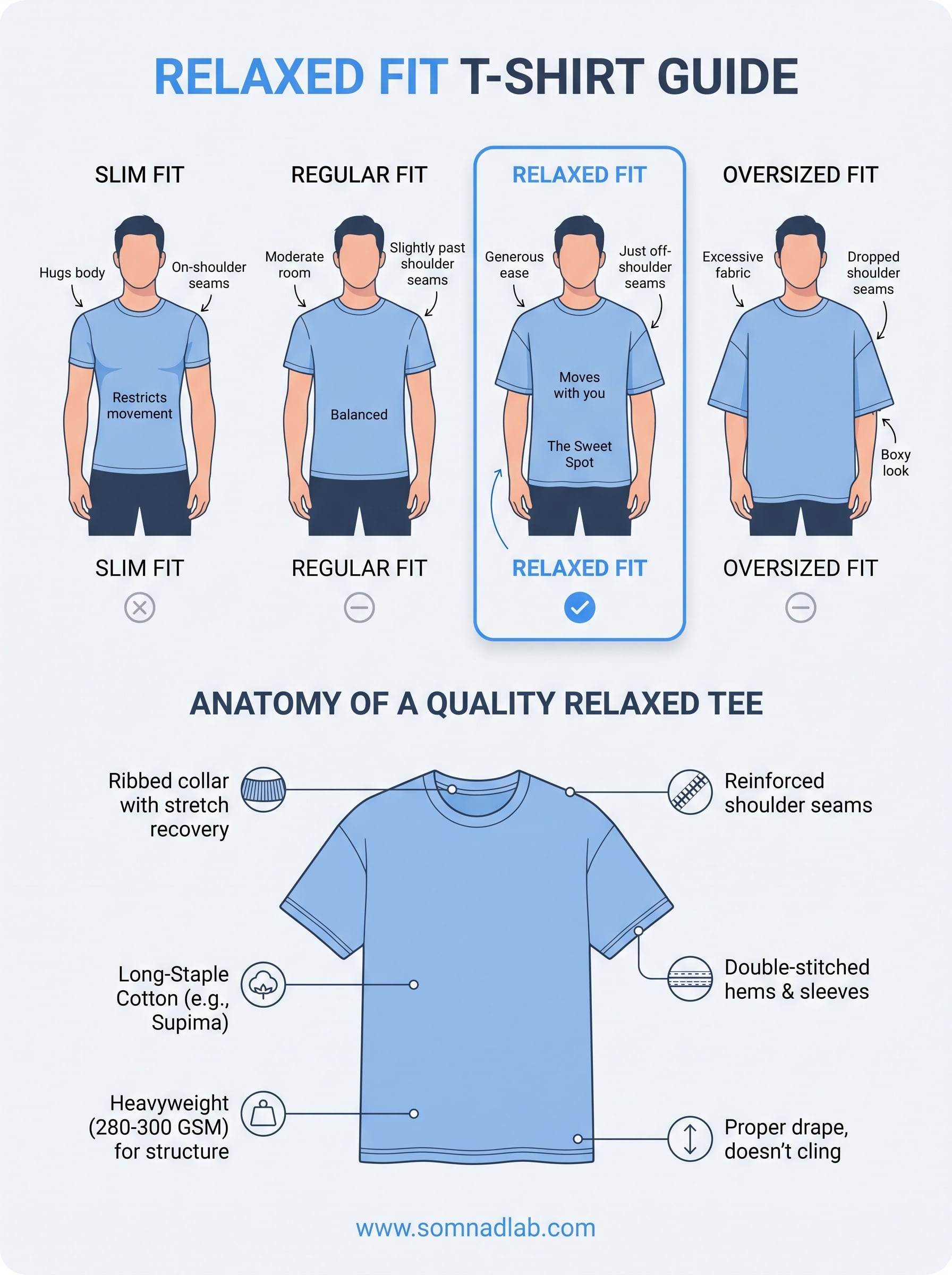
Comparing cuts side by side makes the differences easier to spot than any product description. Slim fit hugs the chest, shoulders, and arms with almost no ease, tracing your body's outline closely. Regular fit sits in the middle, offering a little breathing room without much drape. Oversized fit goes the other direction entirely, dropping the shoulder seam well past your natural shoulder line and adding length and width that reads as intentionally loose. A relaxed fit t shirt men wear daily lands between regular and oversized: roomier than a standard tee but still shaped to your frame instead of hanging off it.
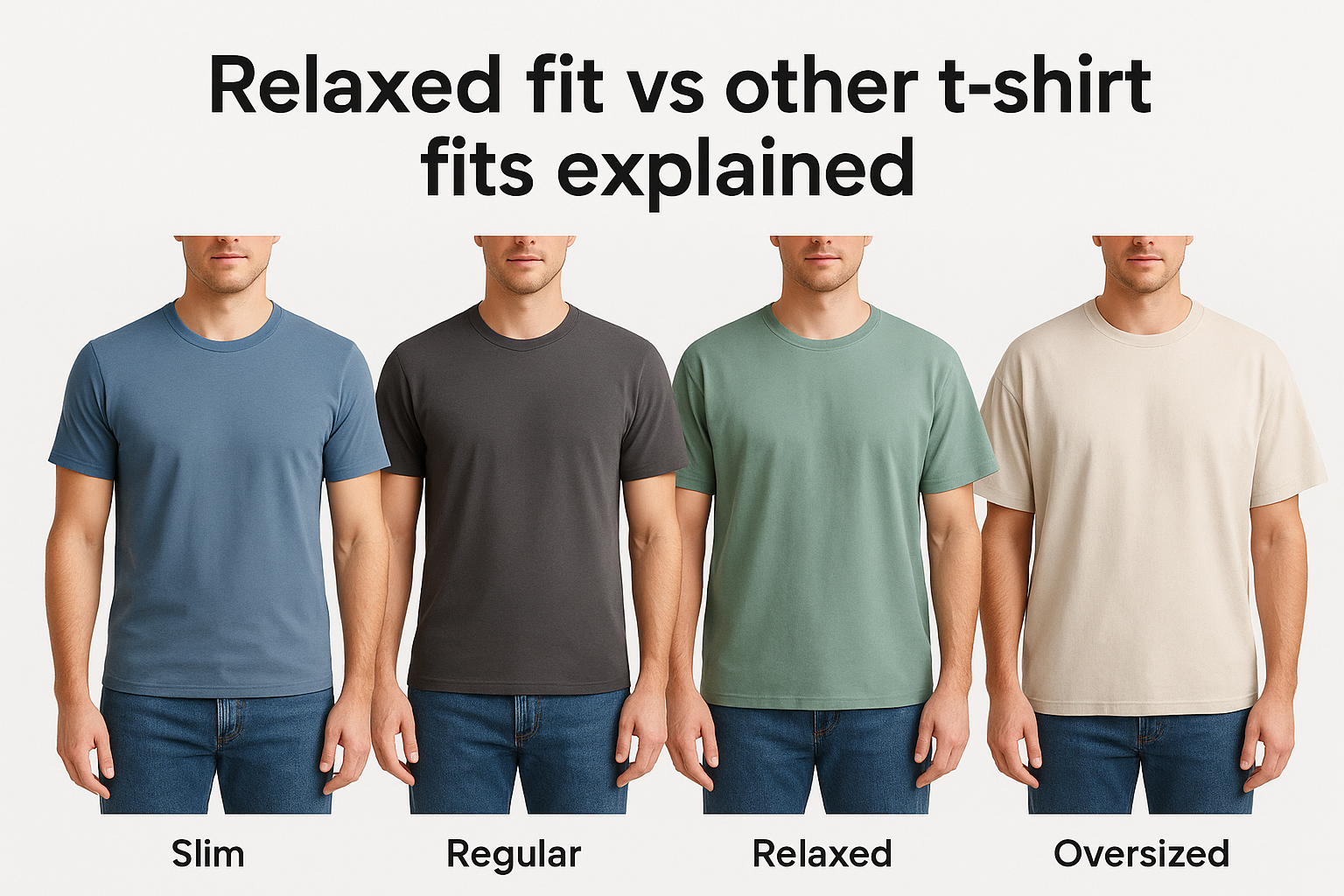
Relaxed isn't loose for the sake of looking loose, it's ease placed exactly where your body needs to move.
Side by side comparison
Seeing the specs together clears up most of the confusion between these cuts:
| Fit | Shoulder seam | Chest ease | Hem length | Best for |
|---|---|---|---|---|
| Slim | On the shoulder | Minimal | Hip or shorter | Layering under fitted jackets |
| Regular | Slightly past shoulder | Moderate | Hip | Everyday wear, no strong statement |
| Relaxed | Just past shoulder | Generous, structured | Hip to slightly below | Daily comfort, layering, all-day wear |
| Oversized | Well past shoulder, dropped | Excessive | Below hip | Streetwear styling, deliberate looseness |
Why relaxed sits in the sweet spot
Oversized shirts trade fit for volume, which works for a specific streetwear look but falls apart the moment you tuck it in or layer it under a structured jacket. The extra fabric bunches at the waist and the dropped shoulder seam makes your frame look smaller, not sharper. Slim shirts trade comfort for shape, restricting movement and showing every flex point when you reach or bend. Relaxed fit keeps the shape of a well-cut shirt while adding just enough room to move freely, which is why it works across more situations than either extreme.
Somewhere else in the sizing conversation, guys ask about a soft relaxed fit t shirt men can wear both under a flannel and on its own at the gym. That flexibility is really a fit question in disguise. A tee cut too slim restricts the layering, and one cut too oversized looks sloppy standing alone. Relaxed fit is the only cut built to do both jobs without compromise, which is exactly why it's become the default recommendation for everyday basics.
What makes a relaxed tee feel soft and last longer
Fit gets you the right silhouette, but fabric decides whether the shirt still feels good in year two. Fabric weight is the first thing to check, and it's usually listed in grams per square meter (GSM) on better product pages. Anything under 180 GSM feels thin and see-through after a few washes. Heavier cotton in the 280 to 300 GSM range, like the Supima cotton SÖMNAD uses in its relaxed tee, has enough substance to hold its shape and drape properly instead of clinging or sagging.
Cotton type matters just as much as weight. Standard upland cotton has shorter fibers that pill and roughen up fast, while Supima cotton uses extra-long staple fibers that resist pilling and stay soft through repeated washing. According to the USDA's cotton research, longer staple lengths produce stronger, smoother yarn, which is exactly why premium tees lean on it instead of cheaper blends.
Soft on day one is easy. Soft after fifty washes is what separates a good tee from a forgettable one.
Construction details that hold up
Beyond the fabric itself, the way a shirt is sewn together determines how long it survives regular wear. A soft relaxed fit t shirt men can trust for years usually shares a few construction traits:
- Double-stitched hems and sleeves, which resist fraying at the exact stress points a relaxed cut sees most
- Ribbed collar with stretch recovery, so the neckline doesn't stretch out and sag after a dozen washes
- Pre-shrunk fabric, meaning the shirt you buy is close to the shirt you'll have after the first wash, not a size smaller
- Reinforced shoulder seams, since relaxed cuts put more fabric in motion with every reach or stretch
Why weight and construction work together
Neither factor works alone. A heavy fabric with sloppy stitching still falls apart at the seams, and tight construction on thin fabric still pills and thins out within months. The tees that actually earn repeat purchases combine both: substantial cotton that holds structure, paired with stitching built to handle a relaxed cut's extra movement. That combination is what turns a shirt from a one-season purchase into a wardrobe staple you reach for every week.
How to style a relaxed fit t-shirt day to day
Styling a relaxed tee comes down to one rule: let the shirt be the quiet piece while everything else does the talking. Because the fit already has structure, you don't need to compensate with tucking tricks or cinching. A relaxed fit t shirt men wear well tends to work best half-tucked or left loose, since a full tuck can flatten the drape that makes the cut look intentional in the first place. Pairing it with slightly tapered pants balances the volume on top, keeping the whole outfit from reading as sloppy.
Denim and chinos both work, but the shirt color changes the math slightly. Lighter tees, like white or heather gray, pair cleanly with dark denim for a simple two-tone look that takes no real effort. Darker tees, like navy or black, look sharper against lighter chinos or washed denim, since the contrast keeps the outfit from feeling too flat.
The fit does the heavy lifting, so keep everything else simple and let the shirt sit right.
Building a few reliable outfits
Having two or three combinations you know work removes the guesswork on busy mornings. Here's a simple starting list:
- Relaxed tee, dark denim, white sneakers for a clean everyday look that needs no thought
- Relaxed tee under an open flannel, chinos, boots for cooler weather layering
- Relaxed tee, joggers, low-top sneakers for errands or weekend downtime
- Relaxed tee tucked half-in, tailored pants, loafers for a slightly dressed-up option
Layering without losing the shape
Outerwear is where relaxed fit really earns its keep. Slip a relaxed tee under a denim or work jacket and the shoulders stack evenly instead of bunching, since the tee already has room built in. Blazers work the same way for guys who want a smarter look without switching to a button-down underneath. Weather also plays into the choice: a heavier 300g cotton tee holds its shape under a jacket in cooler months, while the same shirt breathes fine on its own once temperatures climb. That range is exactly why one well-made relaxed tee can carry you through most of the year instead of sitting in rotation for just one season.
Finding your go-to relaxed tee
Getting fit right isn't complicated once you know what to check. Look for a shoulder seam that sits just off your natural line, enough chest ease to pinch two fingers of fabric, and a hem that stays put when you raise your arms. Pair that fit with heavier cotton, somewhere in the 280 to 300 GSM range, and construction details like double-stitched hems and reinforced shoulders, and you've got a shirt that holds up far past the first wash.
Most guys land on one relaxed fit t shirt men trust and just keep buying it in different colors, because once the fit and fabric are right, there's no reason to keep experimenting. That's the whole point of a good basic. If you want to feel that difference firsthand, check out SÖMNAD's relaxed tee built from 300g Supima cotton, and see what a shirt designed around actual comfort feels like.