


Most t-shirts are made from one fiber. Cotton. Maybe polyester. Pick one, call it done. But single-fiber fabrics always involve a trade-off, cotton wrinkles and absorbs too much moisture, polyester traps heat and feels synthetic, silk is fragile. A cupro t-shirt blended with mulberry silk, lyocell, linen, and modal takes a fundamentally different approach: each fiber compensates for the others' weaknesses while amplifying their strengths.
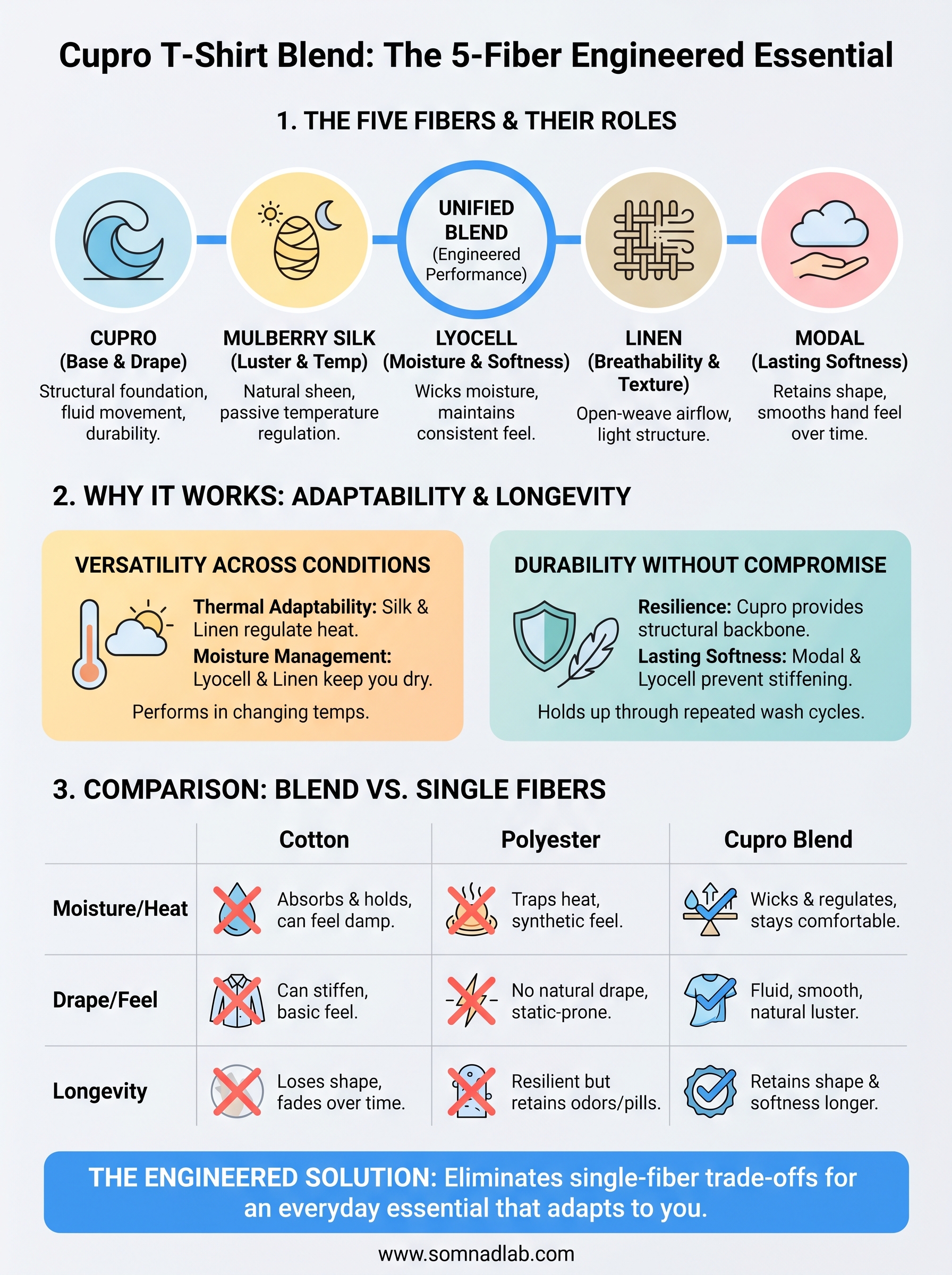
This kind of multi-fiber construction isn't new in high-end textiles, but it's rare in the t-shirt category. Cupro brings a silk-like drape with better durability. Mulberry silk adds natural luster and temperature regulation. Lyocell contributes moisture management. Linen offers breathability and structure. Modal delivers softness that holds up wash after wash. Together, they create a fabric that performs across conditions in ways no single fiber can match.
At SÖMNAD, we've built our entire brand around one conviction: the fabric is the product. Our 300g Supima cotton tee exists because we believe a basic shirt should be defined by what it's made of, not what logo sits on it. That same material-first philosophy is exactly why a blend like cupro-silk-lyocell-linen-modal deserves serious attention. It represents where premium basics are heading, toward engineered compositions that serve the wearer, not the trend cycle.
This article breaks down the full composition of a cupro blend tee, fiber by fiber. You'll learn what each material actually contributes to the finished garment, how the blend affects fit, feel, breathability, and longevity, and what to look for when evaluating whether a cupro blend shirt is worth the price. Whether you're considering your first purchase or comparing it against other premium options, everything here is grounded in fabric science and practical wear, no vague luxury marketing attached.
What is a cupro blend t-shirt
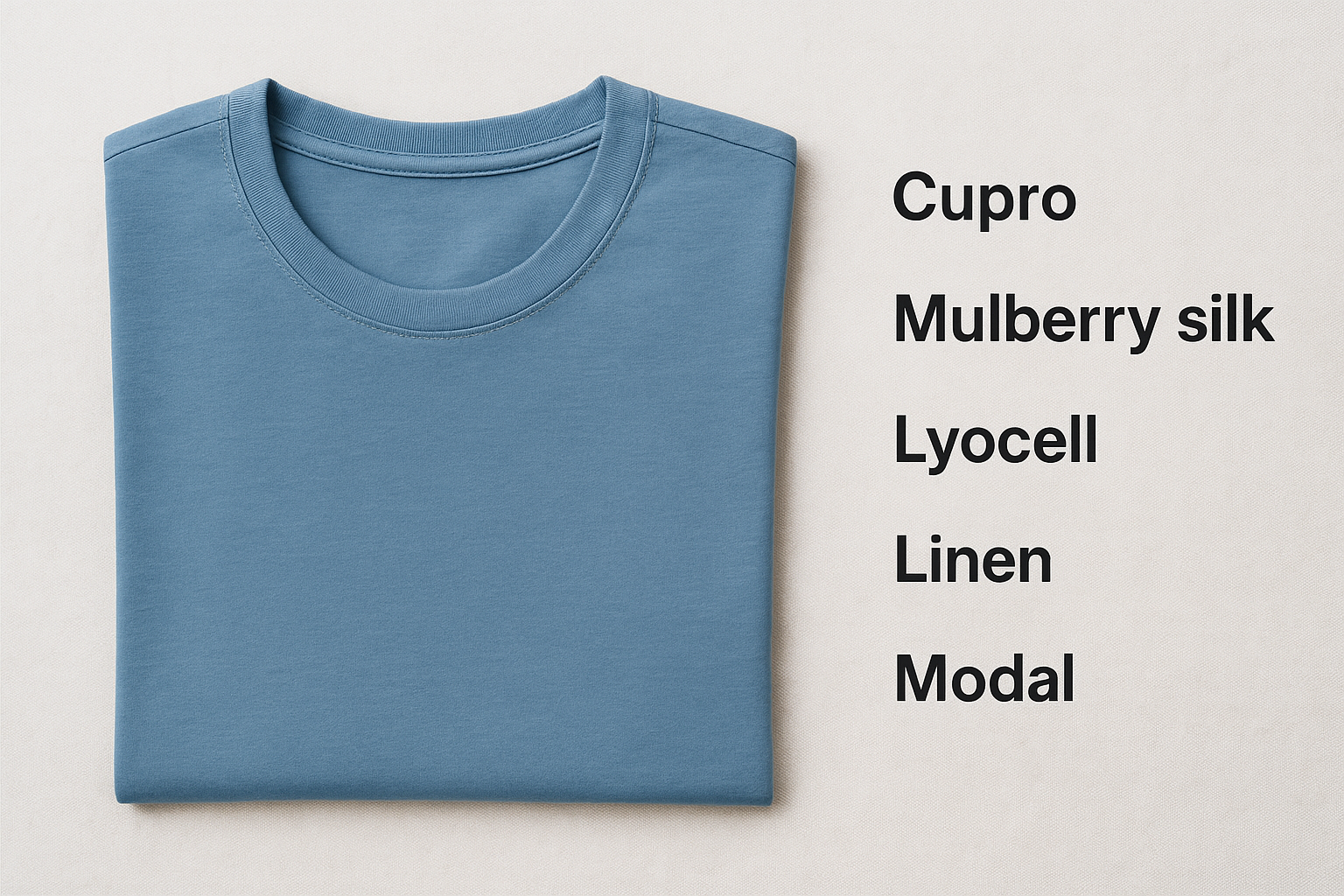
A cupro blend t-shirt is a garment built from a multi-fiber fabric that combines cupro with two or more complementary materials to produce a single, unified textile. In this specific construction, five fibers work together: cupro, mulberry silk, lyocell, linen, and modal. Each fiber carries distinct properties, and blending them at deliberate ratios produces a fabric that no individual fiber could replicate on its own. You end up with a shirt that drapes like silk, breathes like linen, manages moisture like lyocell, and holds its softness like modal, all anchored in cupro's structural foundation.
This is not the same as layering fabrics or bonding separate materials. In a true fiber blend, individual fibers are spun or woven together at the yarn level, meaning every centimeter of the finished fabric contains all five materials simultaneously. That integration is what gives the fabric its consistency: it behaves the same way across the entire garment, from the collar to the hem, rather than shifting in texture or weight across different panels.
A blend isn't a compromise. It's an engineered decision to make each fiber perform better than it would alone.
The five fibers and what each one does
Before you can evaluate whether a cupro blend tee is worth buying, you need to understand what each fiber actually contributes to the final product. The table below gives you a quick reference for the core function of each material in this specific composition.
| Fiber | Primary contribution |
|---|---|
| Cupro | Drape, fluid movement, durability |
| Mulberry silk | Natural luster, temperature regulation |
| Lyocell | Moisture wicking, softness through wash cycles |
| Linen | Breathability, light structure, subtle texture |
| Modal | Lasting softness, shape retention over time |
Each material has a specific job. Cupro acts as the structural base, providing the smooth drape and long-term durability that anchor the entire blend. Mulberry silk raises the tactile quality and contributes a natural temperature-regulating property that synthetic fibers cannot replicate. Lyocell keeps moisture moving away from your skin without creating a clammy surface. Linen introduces enough texture and airflow to prevent the fabric from feeling heavy in warmer conditions. Modal smooths out the overall hand feel and ensures the garment doesn't stiffen or feel rough after repeated washing.
Why the blend ratio matters
The finished fabric behaves differently depending on how much of each fiber is present by weight. A blend that leans heavily on linen will feel crisper and more structured. One weighted toward modal will feel softer and more relaxed at rest. Cupro typically serves as the dominant fiber in compositions like this because it provides the base drape and structural stability that keep the other fibers cohesive rather than competing with each other.
When you're evaluating a specific garment, look for the fiber content label. Brands that take material quality seriously list each fiber alongside its percentage. A well-constructed cupro, mulberry silk, lyocell, linen, and modal blend tee will show you those percentages clearly, and the ratios will reflect deliberate choices about how the garment is meant to perform across different conditions. Vague labeling, such as a single catch-all descriptor like "luxury blend" with no percentages attached, signals that the manufacturer is prioritizing marketing language over material transparency. That's a red flag worth paying attention to before you commit to a purchase.
Why this blend works for everyday essentials
The t-shirt is the most demanding item in your wardrobe. You wear it in changing temperatures, wash it constantly, and expect it to look composed whether you're running errands or sitting at a desk. Single-fiber fabrics struggle to meet all of those demands at once, which is precisely why a cupro t-shirt made with mulberry silk, lyocell, linen, and modal outperforms most basics you'll find on a standard rack. The blend was designed around how people actually wear clothing, not around what's cheapest to manufacture.
The best everyday fabric isn't the softest or the strongest in isolation. It's the one that holds up across the full range of conditions you put it through.
Versatility across temperature and activity
One of the most practical reasons this blend works is thermal adaptability. Mulberry silk and linen both regulate temperature passively, meaning the fabric responds to your body heat rather than trapping it. In warm conditions, linen allows air to circulate through the weave. In cooler environments, silk's natural protein structure provides a mild insulating effect without bulk. You're not switching between a summer shirt and a layering piece; this blend handles both roles in a single garment.
Lyocell reinforces that versatility by managing moisture efficiently. When you're active, it pulls sweat away from your skin and releases it through the fabric surface so it can evaporate. The result is that the shirt stays dry against your body even when conditions change throughout the day. That combination of temperature regulation and moisture management means the garment doesn't limit where or when you can wear it.
Durability without sacrificing softness
Most premium fabrics trade longevity for feel. Silk is soft but fragile. Linen is durable but can stiffen over time. Modal is consistently soft but lacks structural resilience on its own. In this five-fiber composition, those weaknesses get distributed and neutralized. Cupro provides the structural backbone that keeps the blend intact through repeated washing cycles, while modal maintains the soft hand feel that most people associate with a well-worn favorite shirt.
What this means practically is that you don't have to treat the garment with excessive caution to keep it looking good. The blend is built to perform over a long wear life, not just through the first season. For an everyday essential, that durability-to-softness ratio is the difference between a shirt you rotate through regularly and one that sits in a drawer.
What cupro is and how it is made
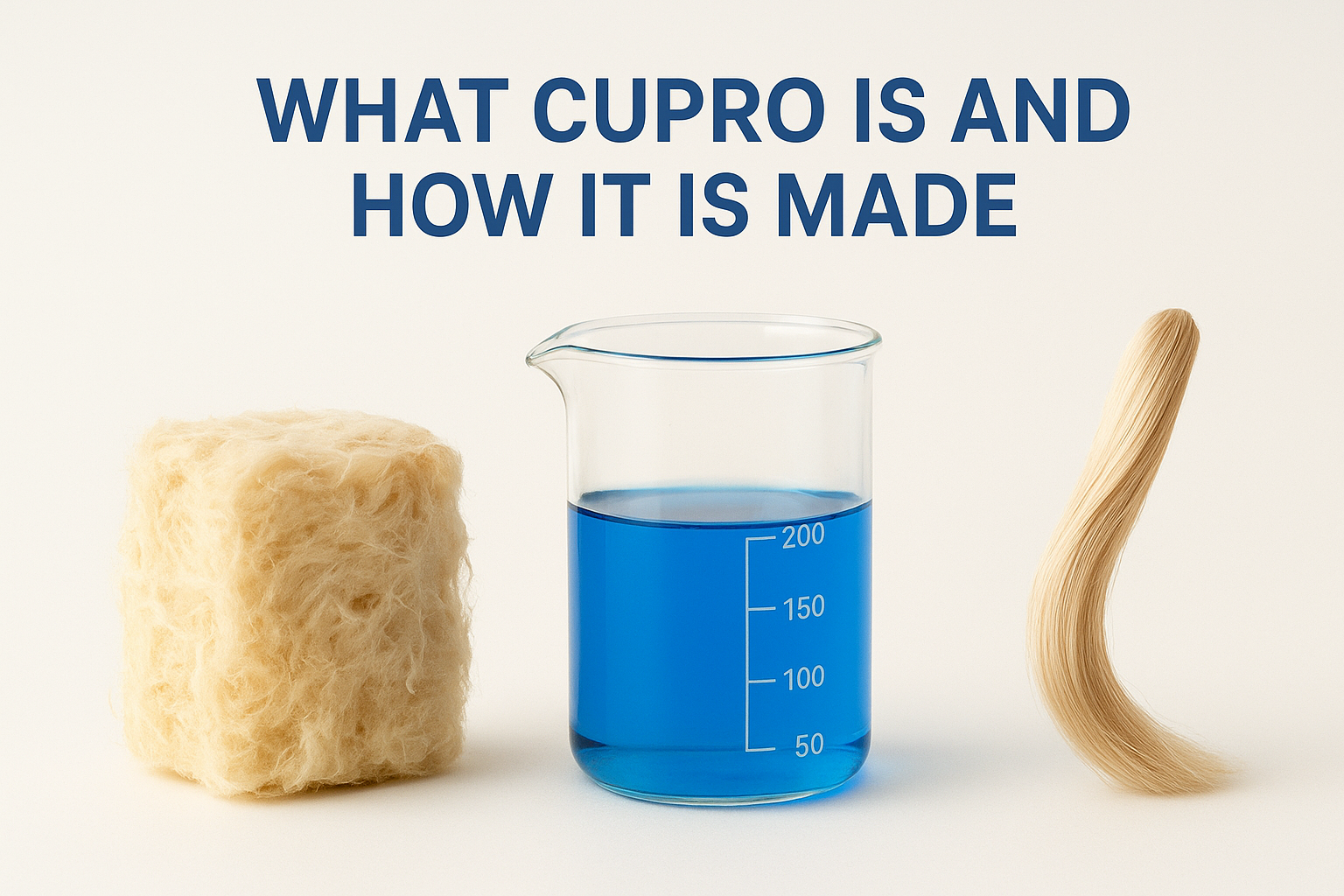
Cupro is a regenerated cellulose fiber derived from cotton linter, the short fibers that cling to cottonseed after the primary cotton staple has been harvested. Manufacturers dissolve those linters in a copper-ammonium solution to create a viscous liquid, then force that liquid through fine spinnerets to produce continuous filament fibers. The resulting material behaves more like silk than cotton in its finished form, which is why cupro earns its reputation as a luxury alternative to synthetic linings and blended base fabrics in premium apparel.
The raw material: cotton linter
Cotton linter is a byproduct of the cotton ginning process, meaning cupro production begins with material that would otherwise be discarded or used in lower-value applications like paper or insulation. That starting point gives cupro a distinct advantage in terms of resource efficiency compared to virgin fiber production. The linter itself is too short to spin into conventional cotton yarn, but its cellulose content is high enough to dissolve cleanly into the copper-ammonium solvent that the cuprammonium process relies on. The fiber that emerges after processing carries none of the coarseness associated with raw cotton; instead it takes on a smooth, fluid character that translates directly into how the garment falls and moves against your skin.
Cupro doesn't feel like cotton because, at the fiber level, it no longer behaves like cotton. The processing transforms its physical structure entirely.
How the cuprammonium process shapes the final fiber
The cuprammonium rayon process is what separates cupro from other regenerated cellulosic fibers like standard viscose. After the cotton linter dissolves in the copper-ammonium solution, the liquid gets extruded through spinnerets into a water bath that precipitates the cellulose back into solid fiber form. The resulting filaments are finer and more uniform than most natural fibers can achieve, which contributes directly to cupro's characteristic drape. Once washed and dried, the fibers shed the copper compound almost entirely, leaving behind a soft, smooth cellulose structure.
In a cupro t-shirt blend with mulberry silk, lyocell, linen, and modal, that uniformity is what makes cupro such an effective base fiber. It gives the other materials something stable to integrate with at the yarn level, ensuring the finished fabric holds its shape and drape across the full garment rather than behaving inconsistently from panel to panel.
What mulberry silk adds to a t-shirt
Mulberry silk is the highest grade of silk available, produced by Bombyx mori silkworms fed exclusively on white mulberry leaves. Unlike wild or tussah silk, mulberry silk filaments are uniform in diameter and exceptionally smooth, which is why it earns a place in premium blends like a cupro t-shirt with mulberry silk, lyocell, linen, and modal rather than lower-cost alternatives. In a blended tee, even a modest percentage of mulberry silk changes how the fabric interacts with both your body and the light around you.
How silk regulates temperature
Silk is a natural protein fiber, which means its molecular structure responds to your body heat in a way that synthetics cannot replicate. It absorbs warmth when your skin is cool and releases it when your body temperature rises, functioning as a passive thermal buffer throughout the day. That behavior is what makes mulberry silk particularly valuable in a multi-fiber blend designed for everyday wear across shifting conditions.
In a cupro blend tee, mulberry silk acts less like a luxury addition and more like a functional layer woven directly into the fabric.
The thermal regulation works without adding weight or thickness to the garment. You get temperature management built into the weave itself, not through a separate lining or treatment that degrades over time. That durability of function is one reason silk continues to appear in performance-oriented premium blends rather than staying confined to formal or eveningwear categories.
What silk does to drape and surface feel
Mulberry silk filaments are triangular in cross-section, and that geometry scatters light across multiple angles rather than reflecting it flat. The result in a blended fabric is a subtle, natural sheen that reads as refinement without looking shiny or formal. You get surface quality that elevates how the garment looks without crossing into territory that limits how you can wear it.
Beyond appearance, silk contributes directly to the fluid drape that separates a cupro blend tee from a standard cotton shirt. Because silk filaments are long and smooth, they allow yarns to move freely relative to each other, which translates into a garment that follows your body's movement rather than resisting it. Combined with cupro's structural foundation, the silk component amplifies the drape of the entire blend rather than simply adding one isolated property to the mix.
What lyocell, linen, and modal contribute
The three remaining fibers in a cupro blend tee serve distinct but complementary roles. While cupro and mulberry silk establish the foundational drape and surface quality of a cupro t-shirt with mulberry silk, lyocell, linen, and modal, these three materials handle the practical performance side of the blend. Together, they address moisture management, breathability, texture, and long-term softness in ways that make the garment hold up as well after fifty washes as it does the first time you put it on.
What lyocell does for moisture and feel
Lyocell is a regenerated cellulose fiber derived from wood pulp, typically eucalyptus, and processed through a closed-loop solvent system that recovers and reuses the majority of its chemical inputs. That production method gives lyocell a clean manufacturing profile, but its value in a blended tee isn't primarily about credentials. It's about how efficiently it moves moisture away from your skin. Lyocell fibers absorb water into their core structure rather than leaving it on the surface, which means the fabric pulls sweat outward for evaporation without creating a damp, clingy sensation against your body.
Lyocell doesn't just manage moisture; it does so without the rough surface texture that high-absorbency fibers often develop after extended washing.
Beyond moisture, the fiber contributes to consistent softness across wash cycles. Unlike some natural fibers that stiffen as they dry or lose their smooth hand feel after repeated laundering, lyocell retains its surface quality reliably over time. That stability makes it a logical inclusion alongside modal in a composition built for long-wear use.
What linen and modal bring to the composition
Linen is a plant-based bast fiber extracted from the flax plant, and it introduces two specific qualities that no other fiber in this blend fully provides: open-weave breathability and a subtle structural texture that prevents the fabric from feeling limp or flat. Its natural hollow fiber structure allows air to circulate freely through the weave, which keeps the garment from feeling dense or heavy in warm conditions. That same structure also helps the shirt dry faster after absorbing moisture, reinforcing what lyocell already contributes.
Modal rounds out the blend by delivering consistent softness and shape retention wash after wash. Produced from beech tree pulp, modal fibers are finer than standard cotton, giving them a smooth, close feel against your skin. Where linen adds texture and airflow, modal smooths the overall hand feel so the composition reads as refined rather than rough. The two fibers counterbalance each other directly: linen keeps the fabric from feeling too uniform or flat, while modal keeps it from feeling coarse.
How this blend feels on skin and in heat
The first thing you notice when you put on a cupro blend tee is the temperature of the fabric against your skin. The combination of cupro and mulberry silk gives the shirt a naturally cool, smooth initial contact that feels unlike cotton, which tends to feel neutral or slightly rough depending on the weave. That cool-to-the-touch quality isn't a finish or a treatment; it's a direct result of how these fiber surfaces interact with your skin temperature.
The initial contact and how it settles with wear
When you first put on this blend, the silk and cupro components deliver a smooth, almost liquid contact that settles quickly against your skin. The fabric doesn't grip or cling at rest; it falls along your body's contours rather than pulling taut or bunching. That behavior matters more than it might seem on a shirt you're wearing for hours at a time, since friction and resistance against your skin accumulate into discomfort over a full day.
After a few minutes of wear, the fabric adjusts to your body temperature without trapping it. This is where mulberry silk's thermal regulation becomes directly perceptible rather than theoretical. The shirt doesn't feel progressively warmer the way a dense cotton tee does after extended use; the temperature stays relatively stable at the fabric surface.
The blend doesn't just feel soft at purchase; it delivers consistent skin contact throughout the day, not only during the first hour of wear.
How the fabric responds in warm and humid conditions
In warm conditions, the linen and lyocell fibers take on the active role. Linen's open structure keeps air moving through the weave, which prevents the fabric from pressing heavily against your back or chest the way denser fabrics do when you heat up. You'll notice the garment stays off your skin slightly rather than adhering to it as moisture builds, which is the functional outcome of linen's breathability working alongside lyocell's moisture-wicking structure.
The cupro t-shirt, mulberry silk, lyocell, linen and modal cupro blend tee performs particularly well in transitional conditions where temperatures shift throughout the day. Modal keeps the fabric from stiffening as it absorbs and releases moisture, so the garment maintains its soft hand feel even after a full day in variable heat. You don't end the day with a shirt that feels rigid or worn out from the conditions it moved through.
How it compares with cotton, rayon, and poly
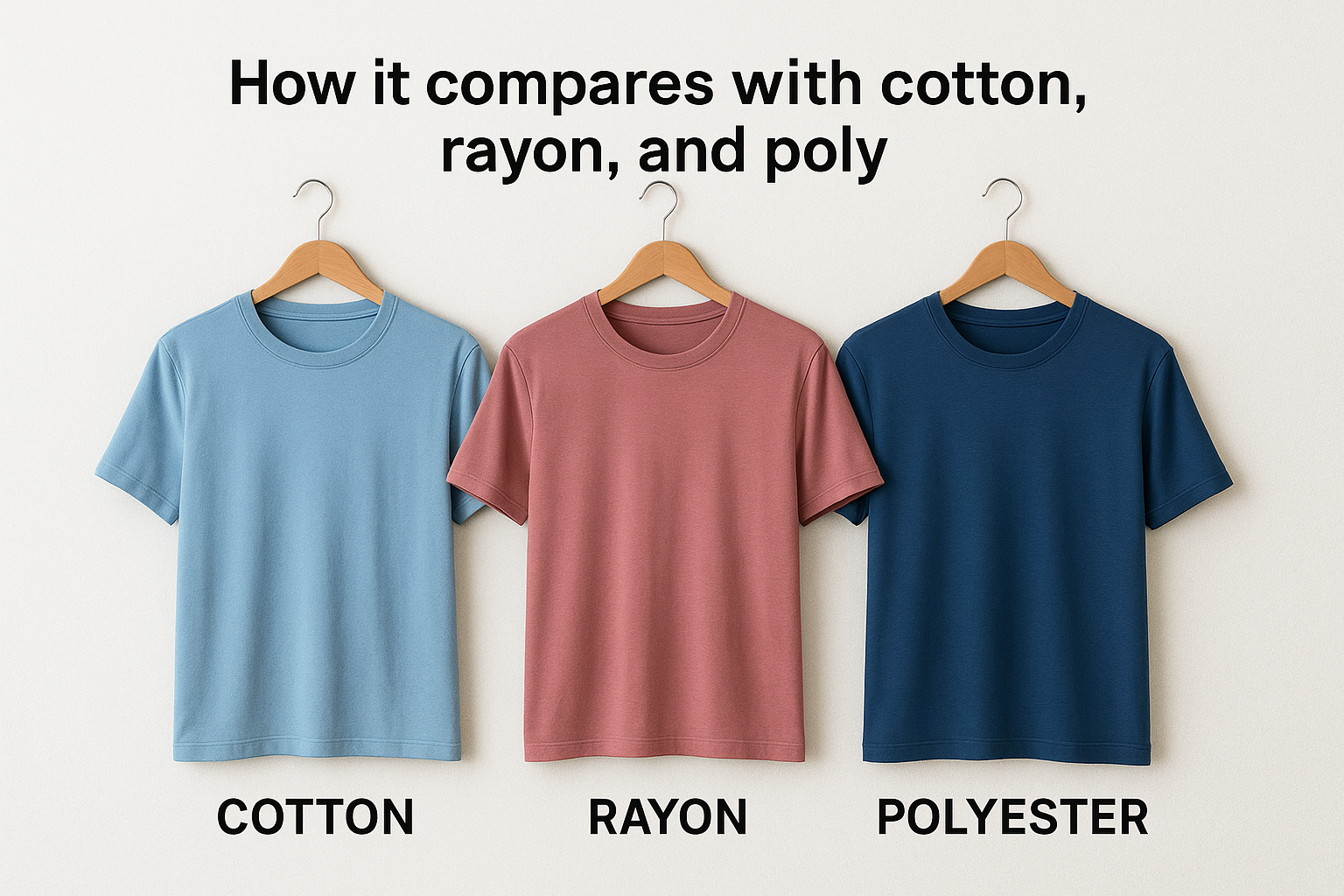
Knowing where a cupro t-shirt, mulberry silk, lyocell, linen and modal cupro blend tee sits relative to familiar fabrics helps you make a better purchase decision. Cotton, rayon, and polyester each dominate different segments of the t-shirt market, and each comes with real trade-offs that a multi-fiber blend addresses directly. This comparison isn't about declaring a winner across all use cases; it's about showing you where the blend outperforms and where the trade-offs apply depending on what you need from a shirt.
How the blend compares to cotton
Cotton is the default fabric for t-shirts because it's affordable, widely available, and comfortable in mild conditions. The problem is that cotton absorbs moisture and holds it against your skin rather than releasing it quickly, which creates a heavy, damp feel during activity or in warm weather. Standard cotton also tends to stiffen and lose shape over repeated washes, particularly in lower thread counts. The cupro-mulberry silk-lyocell-linen-modal composition handles moisture more efficiently, maintains its drape through wash cycles, and delivers a noticeably smoother surface against your skin without relying on a tight, dense weave to achieve that quality.
Cotton earns its place as a wardrobe staple, but it does not adapt to changing conditions the way a multi-fiber blend does.
Even premium cotton like Supima or Egyptian long-staple improves significantly on standard cotton, but it still operates within the limits of a single-fiber fabric. A blended construction distributes performance responsibilities across materials, which means no single fiber's weakness dominates the finished garment's behavior throughout the day.
How it compares to rayon and polyester
Rayon shares a cellulosic origin with cupro but lacks the structural stability that the cuprammonium process delivers. Standard rayon softens with moisture rather than managing it, which causes the fabric to feel limp against your body when conditions heat up. It also loses its shape more readily under physical stress, meaning garment longevity falls short compared to a cupro blend reinforced by modal and lyocell working together.
Polyester sits at the opposite extreme. It resists moisture absorption entirely, which keeps the fabric surface technically dry but traps heat against your skin and produces the synthetic, static-prone feel most people associate with athletic wear. Polyester also lacks any natural breathability, and no blend percentage of it compensates for how it restricts airflow. The cupro blend breathes, regulates temperature passively, and moves with your body in ways polyester physically cannot replicate.
How to choose a high-quality blend tee
Selecting a cupro t-shirt, mulberry silk, lyocell, linen and modal cupro blend tee comes down to three areas: what the label tells you, how the garment is constructed, and whether the brand gives you enough information to make a confident decision. Most blended shirts on the market use vague marketing language as a substitute for actual material transparency, so knowing what to look for puts you ahead before you commit.
Check the fiber content label
Every garment sold in the United States is legally required to carry a fiber content label, and that label is your first and most reliable quality signal. A well-made cupro blend tee will list all five fibers by name along with their individual percentages. If the label groups fibers under generic descriptors, or if it lists fewer than five materials for what's marketed as a multi-fiber blend, that's a clear sign the composition has been simplified or misrepresented. Look for cupro listed as the dominant fiber by percentage, typically above 40%, with mulberry silk, lyocell, linen, and modal each filling specific performance roles.
A label that hides percentages behind marketing language tells you more about the brand's priorities than it does about the fabric.
Evaluate construction and weight
Beyond fiber composition, fabric weight and finishing quality reveal a great deal about how a blended tee will perform over time. A well-constructed multi-fiber blend should feel substantial but not heavy, with a drape that flows rather than pulls tight. Inspect the seam construction and finishing at the hem and collar: flat-lock seams reduce friction against your skin during extended wear, and clean, consistent stitching indicates the garment received proper manufacturing attention rather than being rushed through production. Hold the shirt up to light. Uneven weave density or thin spots near the seams signal poor quality control regardless of what the fiber content label says.
Assess the brand's transparency
Brands that take material quality seriously provide specific, verifiable information about where their fibers originate and how the fabric is produced. Look for garment pages that explain why each fiber is present, not just what fibers are listed. Transparency about sourcing and construction indicates the brand built the garment around deliberate performance choices rather than marketing an attractive-sounding ingredient list. If the only information available is a name and a price, the blend itself is doing the marketing work, and that's rarely a sign the final product lives up to what it implies.
How to wash, dry, and store it
A cupro t-shirt, mulberry silk, lyocell, linen and modal cupro blend tee requires slightly more attention than a standard cotton shirt, but the care routine is straightforward once you understand what each fiber needs. The key principle is simple: avoid heat and agitation, the two forces most likely to damage the delicate protein structure of mulberry silk and disrupt the smooth surface of cupro.
Washing guidelines
Turn the shirt inside out before washing to protect the outer fiber surface from friction against other garments. Use cold water, not cool or lukewarm, and select a delicate or hand-wash cycle if you're using a machine. Cold water preserves both the silk component's protein structure and the dimensional stability of the cupro and lyocell fibers, keeping the garment from losing its shape or developing an uneven texture over time. Use a mild, pH-neutral detergent designed for delicate fabrics, and skip fabric softener entirely. Softener coats fibers with a waxy residue that builds up over repeated cycles and gradually dulls the natural luster that mulberry silk contributes to the blend.
Harsh detergents break down protein fibers at the molecular level over time, which means the damage from a single wash with the wrong product may not appear until several cycles later.
Drying without damage
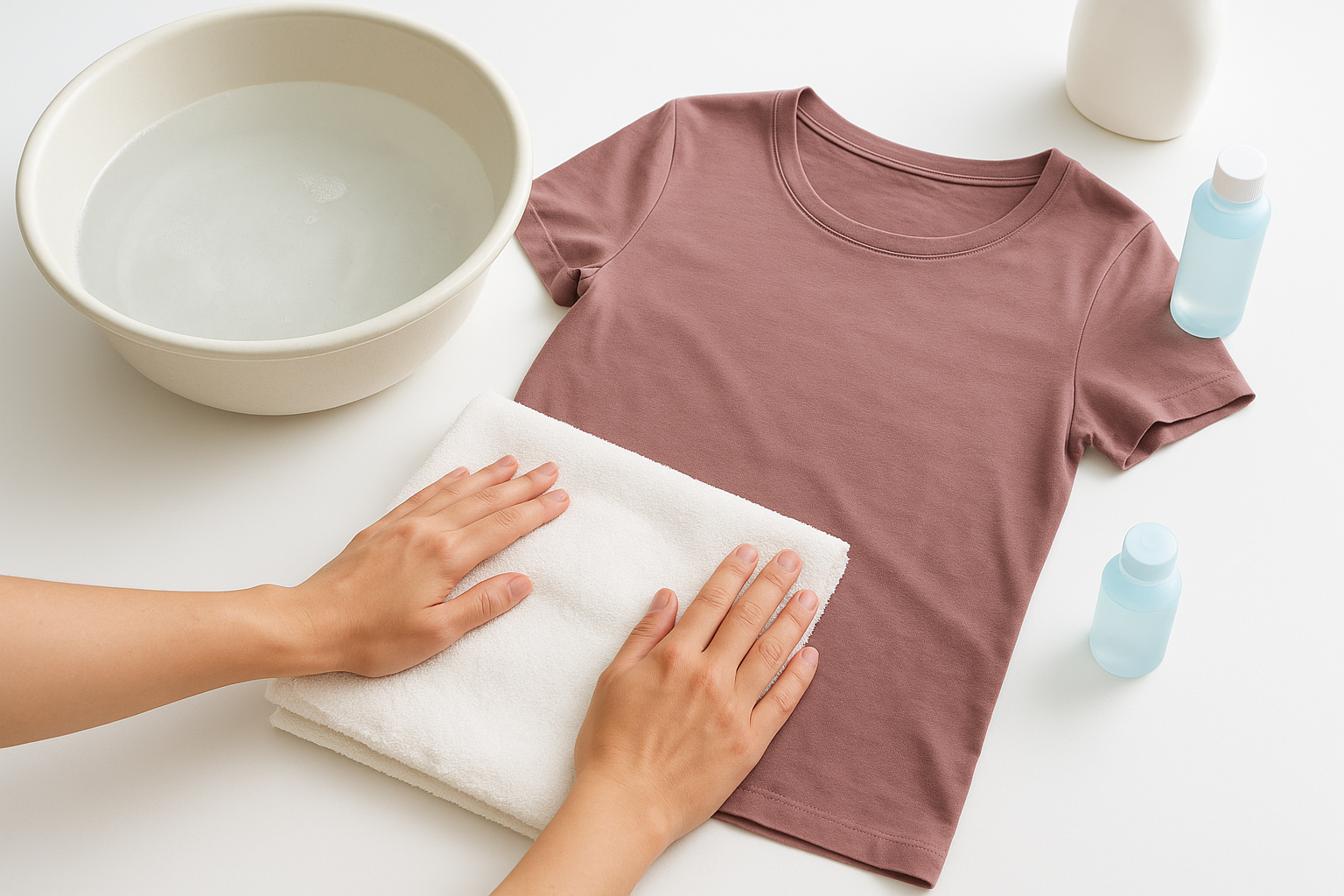
Never put this blend in a dryer. High heat degrades mulberry silk, causes lyocell to shrink, and accelerates fiber breakdown across the entire composition. After washing, press the shirt gently between two dry towels to remove excess water without wringing or twisting the fabric. Then lay it flat on a clean surface to dry away from direct sunlight. Hanging a wet blended garment can stretch the shoulder seams and distort the drape that cupro and silk work together to create, so flat drying is the only method that preserves the garment's original shape reliably.
How to store it long-term
Store the shirt folded rather than hung for extended periods. Hanging a lightweight blended tee on a standard hanger over weeks or months allows gravity to pull the fibers at the shoulder points, gradually distorting the fit. Fold it cleanly along the seams and keep it in a cool, dry drawer away from direct light, which can yellow silk fibers and fade the fabric surface over time. Cedar blocks or breathable fabric bags work well for longer storage by discouraging moths without exposing the fibers to chemical treatments that could affect the fabric's hand feel.
How to style it year-round
A cupro t-shirt, mulberry silk, lyocell, linen and modal cupro blend tee earns its place in your wardrobe precisely because it doesn't belong to one season. The fabric's temperature-adaptive properties mean you're not pulling it out for three months and retiring it for nine. You can work it across every season by adjusting what you pair it with rather than replacing the shirt itself.
Warm weather and transitional months
In summer and late spring, the linen and lyocell components do the heavy lifting. Wear the shirt untucked with straight-leg trousers or chino shorts for a clean, unfussy look that reads as intentional rather than casual by default. The natural sheen from mulberry silk gives the garment enough surface quality that it works equally well at a casual dinner as it does during an afternoon outside. You don't need to dress around the shirt; the fabric handles that for you.
The cupro-silk drape means this shirt looks more considered than a standard cotton tee without requiring you to change how you get dressed.
Transitional months, specifically early fall and late spring, are where the blend's thermal regulation becomes most visible in practice. On days that start cool and warm up by midday, you're not stuck choosing between a shirt that overheats you by noon or one that leaves you cold in the morning. Pair it with an unlined jacket or a lightweight overshirt that you can remove, and the tee handles the temperature shift underneath without performance loss.
Cooler months and layering
In fall and winter, the blend works as a mid-layer without adding bulk. Wear it under an open button-front shirt or a lightweight knit and the cupro's smooth surface prevents the awkward bunching that thicker cotton tees create under layered pieces. The modal component keeps the fabric soft against your skin even when it's sandwiched between other layers throughout the day, which matters on long days when friction becomes a real discomfort.
For colder temperatures, pull a structured overshirt or an unlined blazer over the tee and you have a complete outfit that doesn't require a base layer separate from your shirt. The blend's drape makes it visible at the collar and cuffs in a way that reads as deliberate styling rather than accidental layering, which is a practical benefit most single-fiber shirts can't deliver at the same weight.
Final thoughts
A cupro t-shirt, mulberry silk, lyocell, linen and modal cupro blend tee is not a novelty item or a trend-driven product. It's a specific engineering solution to a real problem: most single-fiber shirts require you to accept trade-offs that compound over time into dissatisfaction with what you're wearing. This blend eliminates those trade-offs by distributing performance responsibilities across five complementary materials, each pulling in the same direction.
What you're investing in is a garment that adapts to your conditions rather than limiting them, holds its quality through consistent wear, and requires straightforward care in return. The fabric does the work so you don't have to think about it. That's the standard every everyday essential should meet, and it's the one most fall short of. If you're ready to build your wardrobe around materials that earn their place, explore SÖMNAD's premium essentials and see what a material-first approach looks like in practice.