


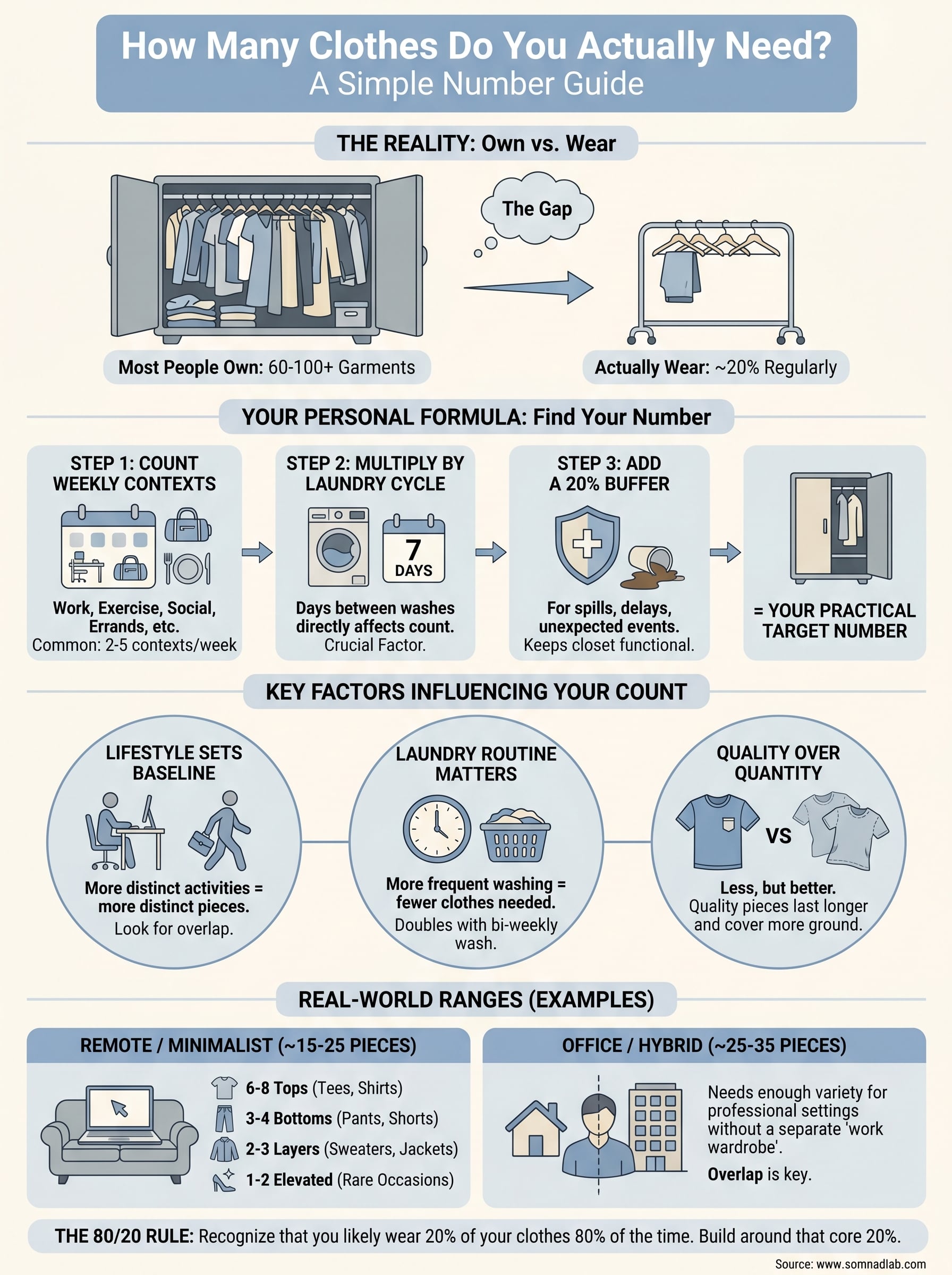
Open your closet right now and count what's in there. If you're like most Americans, you own somewhere between 60 and 100 garments, and you wear maybe 20% of them on a regular basis. That gap between what you own and what you actually wear is exactly why so many people end up searching how many clothes do you actually need.
The answer isn't one magic number. It depends on your lifestyle, your climate, and how much you're willing to invest in pieces that genuinely hold up. But here's what we've learned building SÖMNAD around the idea of "less, but better": most people can dress well with far fewer items than they think, as long as those items earn their place. A 300g Supima cotton tee that keeps its shape after 50 washes replaces three cheap ones that won't survive the season. Fewer pieces, higher standards.
This guide breaks down realistic wardrobe numbers by category, gives you a simple framework to audit what you already own, and helps you figure out the right count for your life, not someone else's Instagram-perfect capsule. Whether you're mid-closet purge or starting fresh, you'll leave with a clear, practical target to work toward.
Why "enough clothes" is not a fixed number
When someone asks how many clothes do you actually need, the honest answer is: it depends on your life, not a universal rule. A flight attendant living out of a carry-on has completely different needs than a corporate lawyer cycling through five formal outfits per week. The "right" wardrobe size is always personal, which is why any article telling everyone to own exactly 37 pieces misses the point entirely.
The goal isn't a specific number. It's a wardrobe where every item pulls its weight.
Your lifestyle sets the baseline
Your daily activities determine how many distinct contexts your wardrobe needs to cover. If you work from home, commute to an office occasionally, hit the gym, and attend dinners out, you're dressing for four scenarios. If you freelance and rarely leave the house, two or three contexts may cover 90% of your actual week. Count your real-world situations first, then build from there.
The more your contexts overlap, the fewer clothes you need. A well-made relaxed tee that works at your desk, on a coffee run, and under a blazer for a casual dinner replaces three separate pieces that each only handle one situation. That overlap is exactly where smart wardrobe building begins, and most people underestimate how much ground a single versatile piece can cover.
Your laundry routine matters more than you think
How often you wash directly controls your minimum item count. If you do laundry every week, you need roughly seven days of core basics. If you wash every two weeks, that number doubles. Most people never factor this in and end up with far more clothes than their laundry schedule actually requires.
A practical fix: wash more frequently if you want a smaller wardrobe. Or invest in pieces built from materials that stay fresh longer, so you can wear them more times between washes. Either move cuts your required item count without making your closet feel inadequate.
Your budget changes the math
Higher-quality pieces mean you need fewer total items because each one lasts longer and performs better across more situations. A single well-made tee that survives two years of regular wear replaces multiple cheaper versions that fade, stretch, or pill out after a few months. Your cost-per-wear drops significantly, and your closet stays small without feeling sparse.
A simple formula to find your number
Instead of guessing, use your own life as the input. The formula below gives you a concrete starting point based on what you actually do each week. Run through the three steps and you'll have a realistic personal target in minutes.

Step 1: Count your weekly contexts
List every distinct situation you dress for in a typical week, being honest about your real schedule rather than an ideal one. Most people land between two and five contexts when they look at their week clearly. Common examples include:
- Work (office, remote, or field-based)
- Exercise and active use
- Casual errands and weekends
- Social dinners or evening events
Step 2: Multiply by your laundry cycle
Take your context count and multiply by the number of days between your laundry runs. If you wash every seven days and dress for three contexts, your baseline is roughly 10 to 15 core items before any extras are considered. Shorter laundry cycles allow for a smaller wardrobe, which is worth keeping in mind.
Your laundry cycle is the single most overlooked factor in figuring out how many clothes do you actually need.
Step 3: Add a small buffer
Life isn't perfectly predictable, and your wardrobe should account for that. Add 20% to your baseline total to handle spills, an unexpected invitation, or a delayed laundry day. If your baseline lands at 20 items, your practical target sits around 24. That buffer keeps your closet functional without letting it balloon back to its previous cluttered state.
Once you have that number, write it down and use it as your ceiling during your next closet edit. Staying close to your target makes future decluttering decisions faster and less stressful.
Quick number ranges for common lifestyles
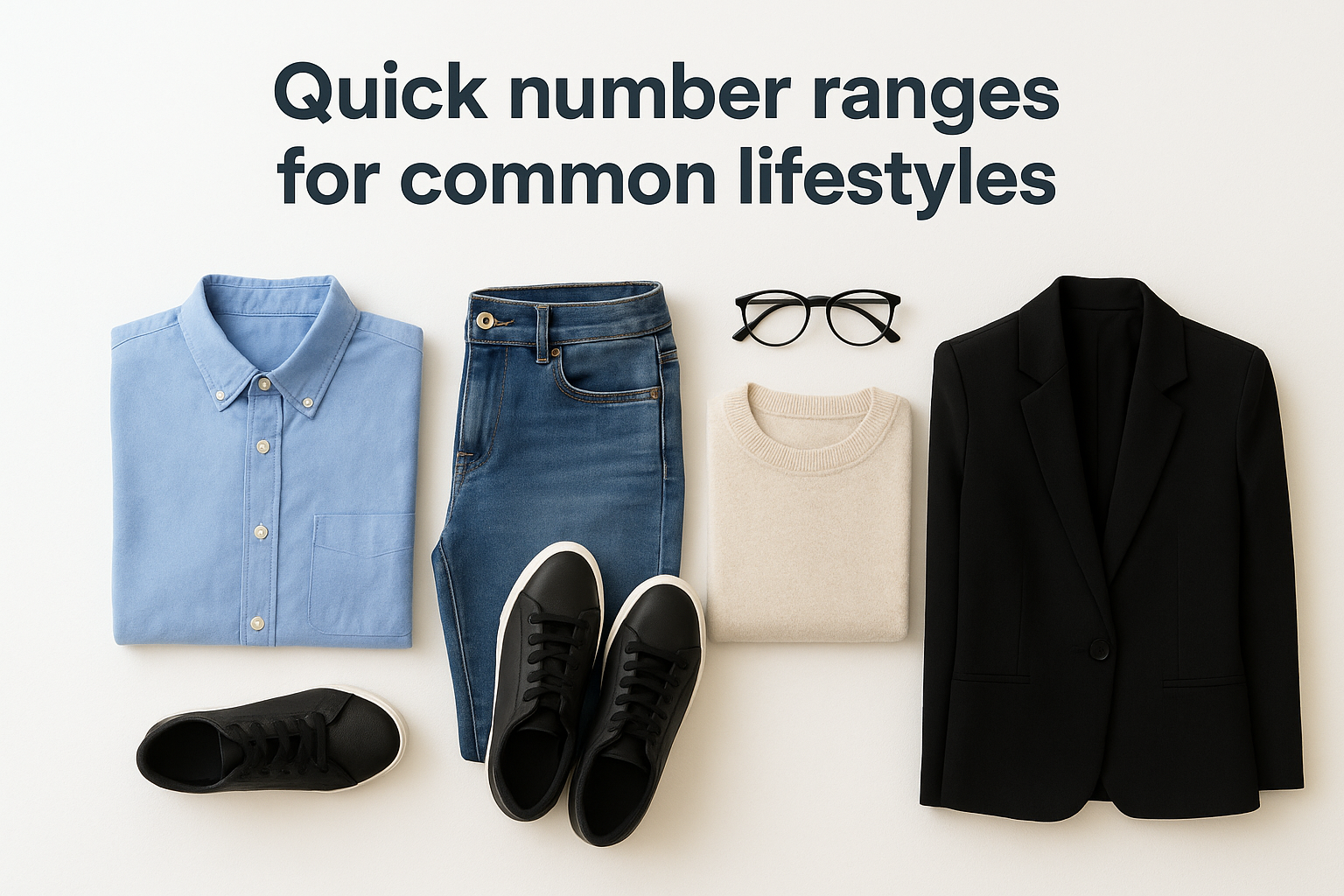
The formula gives you a personal target, but real-world benchmarks help you calibrate where that number should actually land. Below are practical ranges based on common lifestyle patterns. If you're still working out how many clothes do you actually need, matching your situation to one of these profiles gives you a concrete number to start from rather than guessing.
Remote workers and minimalists
If you work from home most days and keep a simple social calendar, your wardrobe can stay very lean. Most people in this category function well with 15 to 25 total pieces, covering basics, a couple of layers, and one or two slightly elevated options for the occasional in-person commitment.
A smaller wardrobe only works when the pieces you keep are genuinely versatile and built to last.
A rough breakdown for this lifestyle looks like:
- 6 to 8 tops
- 3 to 4 bottoms
- 2 to 3 layers or light outerwear
- 1 to 2 elevated options for rare occasions
Office and hybrid workers
Splitting time between home and an office pushes your requirements up slightly. You need enough variety to meet professional expectations without building a separate "work wardrobe" that doubles your total count. A range of 25 to 35 pieces handles most hybrid schedules comfortably, assuming your core basics pull double duty across contexts.
Your exact number shifts based on how much overlap exists between your work and personal pieces. The more your basics cross contexts, the closer to 25 you can realistically stay without feeling underprepared.
Build a small wardrobe that still feels like you
Cutting your wardrobe down to a tight number doesn't mean dressing like everyone else. The goal is to keep fewer items, not to strip away your personal style. A small wardrobe still has room for the colors, cuts, and textures that reflect how you actually want to show up, so long as each piece you keep genuinely works with the rest.
Start with what you actually reach for
The quickest way to build a wardrobe that feels like yours is to pay attention to what you're already wearing. Before you buy anything new, spend two weeks noting which items you grab first and which ones you keep skipping. The ones you skip consistently are the ones quietly crowding out the ones you love.
A small wardrobe that fits your actual life will always feel more like "you" than a large one full of things you never wear.
Your most-reached-for pieces become your foundation items, and everything else you keep should work alongside them. This approach answers how many clothes do you actually need in a personal way, because your behavior does the filtering for you.
Add personality through fit and texture
Fit and fabric carry more personality than most people realize. A relaxed tee in a heavyweight cotton reads differently from a slim-cut one in a lighter material, even in the same color. These small distinctions let you build a wardrobe that feels distinctly yours without adding extra pieces.
Lean into the details you consistently notice yourself drawn to, whether that's a particular cut, weight, or color palette, and make those the thread that ties your whole wardrobe together.
Popular wardrobe rules and when to use them
Several well-known frameworks exist to help people figure out how many clothes do you actually need. Each rule has a specific use case, and knowing when to apply which one makes them far more useful than following them blindly.
Project 333
Project 333 challenges you to dress with 33 items or fewer for 3 months, excluding underwear, sleepwear, and workout gear. It works best as a short-term reset when your closet feels overwhelming and you need a forcing function to identify what you actually reach for. After the three months, the pieces you never missed become natural candidates to remove permanently.
Use Project 333 as a diagnostic tool, not a permanent lifestyle rule, unless it genuinely fits your life.
The 1-in-1-out rule
This rule requires you to remove one item every time you add a new one, which keeps your total count flat over time. It works best once your wardrobe is already close to your target size, because it prevents gradual creep rather than solving an existing excess. If your closet is already bloated, use the formula in the earlier section first, then apply this rule to maintain your number going forward.
The 80/20 rule
Most people wear 20% of their clothes 80% of the time, and this pattern shows up consistently regardless of wardrobe size. Recognizing it helps you identify your actual foundation items quickly. Once you know which pieces make up that reliable 20%, you can build your smaller wardrobe around them and let the rest go without hesitation.
Next steps
You now have a clear answer to how many clothes do you actually need: start with your real lifestyle, run the formula, and use your laundry cycle as your anchor. The exact number lands differently for everyone, but the process for finding it stays the same. No rule from a magazine or social media account can replace that personal step.
Pick one action from this guide and do it today. Count your weekly contexts, identify the pieces you reach for most, and set a ceiling number to work toward. Small, specific moves beat vague intentions every time. Your wardrobe gets easier to manage the moment you give it a clear upper limit.
When you're ready to replace worn-out basics with pieces that genuinely hold their ground, start with what you wear most. A well-made foundational tee in a heavyweight fabric earns its place in any tight wardrobe. Browse SÖMNAD's premium everyday essentials and see what "less, but better" looks like in practice.