


Most guys own way more clothes than they actually wear. A closet full of impulse buys, ill-fitting shirts, and pieces that never quite go together, yet somehow, nothing feels right on any given morning. If you've hit that point, learning how to build a minimalist men's wardrobe isn't about restricting yourself. It's about making every piece count.
The idea is straightforward: own fewer items, but make sure each one earns its spot. A minimalist wardrobe built on quality basics means you spend less time deciding what to wear, less money replacing cheap clothes that fall apart, and more time looking consistently put together. That's not a trend, it's a practical system that actually works.
At SÖMNAD, this philosophy is the foundation of everything we make. Premium everyday essentials, built from fabrics like 300g Supima cotton, constructed to hold their shape wash after wash, and designed without logos or unnecessary detail. Less, but better. It's the same principle that drives a well-built minimalist wardrobe, and it's exactly what this guide is about.
Below, you'll find a complete, step-by-step breakdown of how to strip your closet down to what matters and rebuild it with intention. From identifying your core pieces to choosing the right fabrics and fits, this guide gives you a clear path from cluttered to curated, starting today.
What a minimalist wardrobe is and why it works
A minimalist wardrobe is not about living out of a single bag or wearing the same outfit every day. It's a deliberate selection of clothing items that all work together, chosen for fit, fabric quality, and versatility, so every piece you own is one you actually reach for. The goal isn't restriction. It's intentional curation: fewer total pieces that cover more ground than a bloated closet ever could.
What "minimalist" actually means in practice
Most people assume minimalism means going to an extreme, but that's not how it plays out in a real wardrobe. A minimalist wardrobe typically contains somewhere between 30 and 50 pieces for a full year of dressing, including everything from outerwear to shoes. What defines it is not the number but the coherence: each item pairs naturally with the others, nothing sits untouched for months, and there's a clear reason every piece is there. Think of it less as a capsule collection and more as a curated toolkit where every tool has a specific job and earns its place.
The real test of a minimalist wardrobe is simple: can you put together five distinct outfits in under two minutes without thinking? If yes, your wardrobe is working. If not, you have more pieces than you need but fewer that actually function.
Why fewer pieces give you more
A crowded closet creates what researchers call decision fatigue, the mental drain of making too many small choices before your day even starts. When you understand how to build a minimalist men's wardrobe the right way, you eliminate that friction entirely. Every morning becomes faster because every combination already works. You're not hunting for a shirt that happens to go with those trousers. The whole system is designed upfront to function as one unit.
Beyond the daily routine, a well-built minimalist wardrobe saves real money over time. When you stop buying cheap pieces that wear out quickly or never quite fit right, you stop replacing them constantly. A single well-made tee in a heavyweight fabric like 300g Supima cotton holds its shape and color through repeated washing far longer than three cheaper alternatives ever would. You spend more per item but less overall, and you stop filling your closet with clothes you never actually wear.
The difference between minimalist and boring
One concern most people have when they first consider going minimal is that they'll end up looking flat or repetitive. That won't happen if you choose your pieces with intention. A minimalist wardrobe is built on restraint in quantity, not creativity. You're working with a tight color palette and clean silhouettes that let the fabric and fit carry the visual weight, rather than relying on loud prints or excess detail to create interest.
The result is clothing that reads as effortlessly put-together rather than overthought. People who consistently dress well rarely have enormous wardrobes. They've identified what works for their body and lifestyle, and they stick to that system. A minimalist wardrobe gives you that same clarity, and this guide walks you through building it from the ground up.
Step 1. Audit your closet and define your needs
Before you buy anything new, you need a clear picture of what you're actually working with. Pull every item out of your closet and look at it honestly. Most people skip this step, then build a minimal wardrobe on top of a cluttered one, which defeats the purpose entirely. A thorough audit forces real clarity: what you reach for consistently, what you've been avoiding for months, and what's occupying space without earning it.
Pull everything out and sort it ruthlessly
Lay every garment flat or hang it individually, separated from the rest. Then sort into three piles: keep, donate or sell, and unsure. An item earns a spot in the keep pile only if it fits well right now, is in solid condition, and you've worn it within the last six months. Put the unsure pieces in a bag and set them aside. If you haven't reached for them in 30 days, they're gone. Use this table to guide your decisions:
| Question | Yes | No |
|---|---|---|
| Does it fit well right now? | Keep | Remove |
| Have you worn it in the last 6 months? | Keep | Remove |
| Is it in good condition with no damage? | Keep | Remove |
| Does it work with 3 or more other pieces you own? | Keep | Remove |
If an item only works under three specific conditions (a particular season, a particular occasion, a particular pair of shoes), it's too situational to hold a place in a wardrobe built for efficiency.
Define what your life actually requires
Once you've cleared the clutter, map your real lifestyle before adding anything back. Someone who works remotely most of the week has completely different clothing needs than someone who meets clients in person daily. Write down every environment you dress for and estimate how often you're actually in each one.
Your breakdown might look like this:
- Everyday casual (home, errands, weekend): 60% of your week
- Smart casual (dinners, social occasions): 25% of your week
- Formal or business (meetings, travel): 15% of your week
Those percentages directly determine how many pieces each category deserves in your wardrobe. Knowing how to build a minimalist men's wardrobe that actually holds up long-term starts here, because a collection that doesn't reflect your real routine will leave gaps no matter how carefully chosen each individual piece is.
Step 2. Pick a tight color palette and silhouettes
Once you know what your wardrobe needs to cover, the next decision is color. This is where most minimalist wardrobes succeed or fail. If your colors don't work together, every combination becomes a separate puzzle rather than a natural outcome of a system. A tight palette of four to six colors means every top you own works with every bottom you own, which is the backbone of how to build a minimalist men's wardrobe that actually functions day to day.
Build your base with neutrals
Start with three anchor neutrals and build outward from there. Neutral colors sit quietly in any outfit and never compete with each other, which is exactly what you want when your wardrobe is built around interchangeable pieces. From those anchors, you can add one or two muted accent colors that still coordinate without creating combinations that require thought.
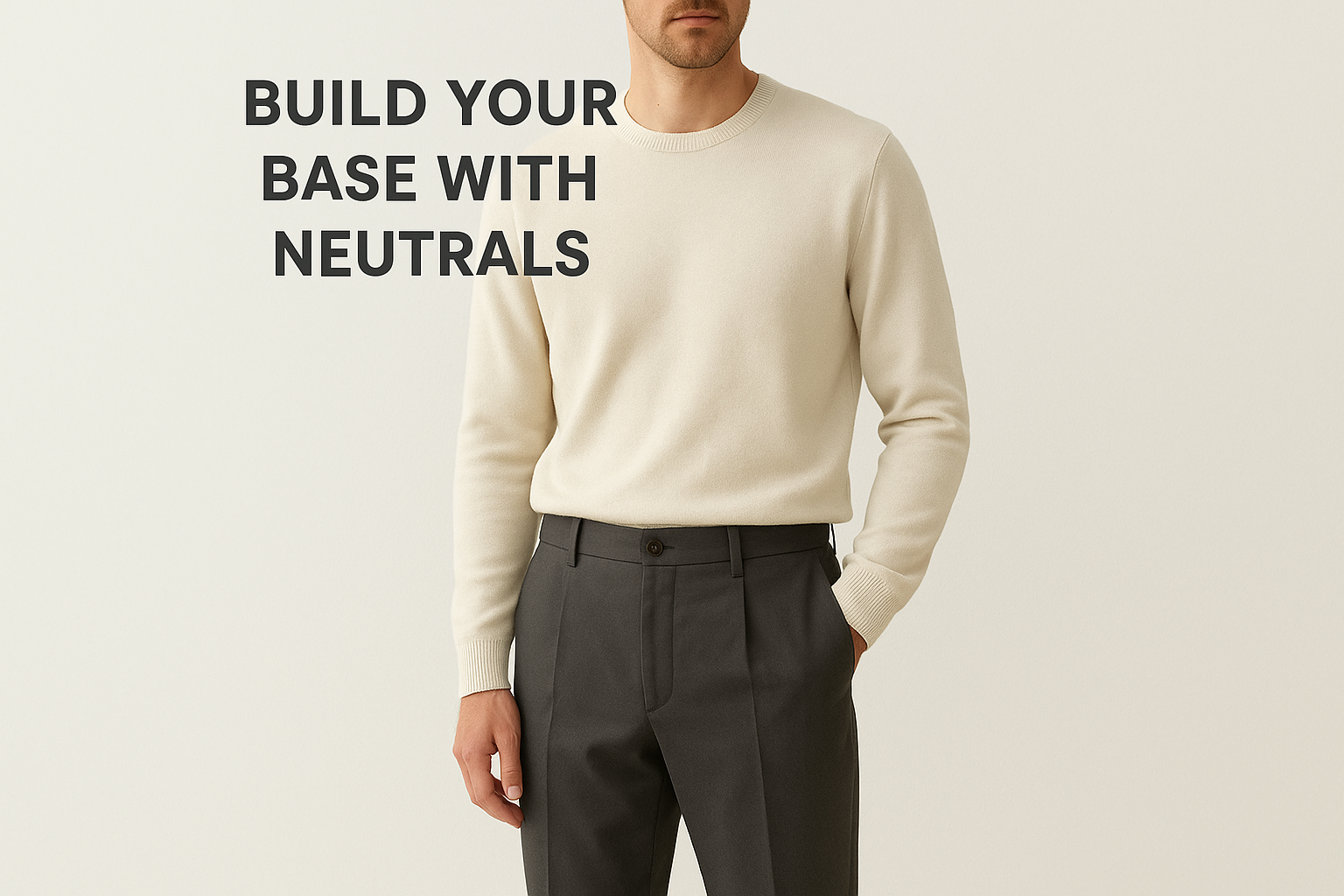
A workable palette looks like this:
| Role | Color Options |
|---|---|
| Anchor neutral 1 | White, off-white, or cream |
| Anchor neutral 2 | Black, charcoal, or dark navy |
| Anchor neutral 3 | Grey or light navy |
| Accent 1 | Olive, tan, or slate blue |
| Accent 2 (optional) | Burgundy, camel, or forest green |
Every color you add to your wardrobe should work with at least three other pieces already in it, otherwise it creates dead ends that pull you back into decision fatigue.
Choose silhouettes that layer well
Your silhouette choices matter as much as your colors. A clean, consistent fit profile across your wardrobe means pieces stack easily, literally and visually. Stick to one fit category per garment type: one trouser cut, one tee fit, one shirt silhouette. Mixing a slim-fit trouser with a relaxed tee works intentionally, but three different trouser cuts creates visual noise that undermines the whole system.
For most builds, a slightly relaxed but tailored silhouette works best across the widest range of occasions. Clean shoulders, no excess fabric pooling at the hem, and a body that sits comfortably without looking oversized. That profile reads as intentional whether you're running errands or heading to a dinner, which is exactly the versatility a minimal wardrobe is built to deliver.
Step 3. Build your core tops and tees
Tops are the most visible part of any outfit and the category where most minimalist wardrobes fall apart. Buying too many or choosing poorly constructed pieces means your system breaks down at the foundation. When you understand how to build a minimalist men's wardrobe properly, tops are where you invest the most thought, because they anchor every combination you put together.
How many tops you actually need
Most men need far fewer tops than they think. A well-built minimal wardrobe runs on five to seven tops total, covering the full spectrum from relaxed casual to smart casual without overlap or redundancy. That number feels small until you realize that every top should work with every bottom you own, which multiplies your usable combinations significantly.
Here's a practical starting template:
| Top Type | Quantity | Color Recommendation |
|---|---|---|
| Heavyweight crew-neck tee | 3 | White, black, grey |
| Long-sleeve base layer | 1-2 | White or navy |
| Clean Oxford or linen shirt | 1 | White or light blue |
| Lightweight knit or sweater | 1 | Charcoal or oatmeal |
What to look for in fabric and fit
Fabric determines how long a top stays in your rotation. A lightweight, thin tee loses its shape quickly, fades after a dozen washes, and creates dead weight in your wardrobe within a season. Instead, look for heavyweight options, specifically tees in the 250g to 320g range, made from long-staple cotton like Supima or Pima. These fabrics maintain their structure, color, and drape through repeated washing in a way that cheaper alternatives simply don't.
Fit matters just as much. Your tee should sit cleanly at the shoulder, with the seam landing right at the edge of your shoulder bone, not drooping down your arm. The body length should cover your waistband with a small amount of hem visible, and the chest should have enough room to move without pulling. No billowing fabric at the sides, no excess length that bunches when you sit. That clean, controlled profile is what separates a well-chosen basic from a garment that undermines the rest of your outfit.
If a tee requires ironing every wear or looks uneven after two washes, it has no place in a wardrobe built on simplicity and reliability.
Step 4. Add versatile bottoms and one smart jacket
Bottoms and outerwear pieces are where most minimalist wardrobes go wrong. Men either overcorrect by owning only one pair of trousers or undercut the system by adding five pairs with no clear overlap. The goal here is two to three bottoms and one structured jacket that collectively cover every situation your wardrobe needs to handle, from weekend errands to a last-minute dinner out.
Choose bottoms that cover the full range
Your bottoms need to bridge every context in your life without duplication. Two well-chosen trousers and one pair of dark jeans handle more ground together than four pairs of jeans in different washes ever could. The key is making sure each bottom pairs naturally with every top in your rotation, which means staying inside your established color palette and avoiding anything too specific in texture or pattern.
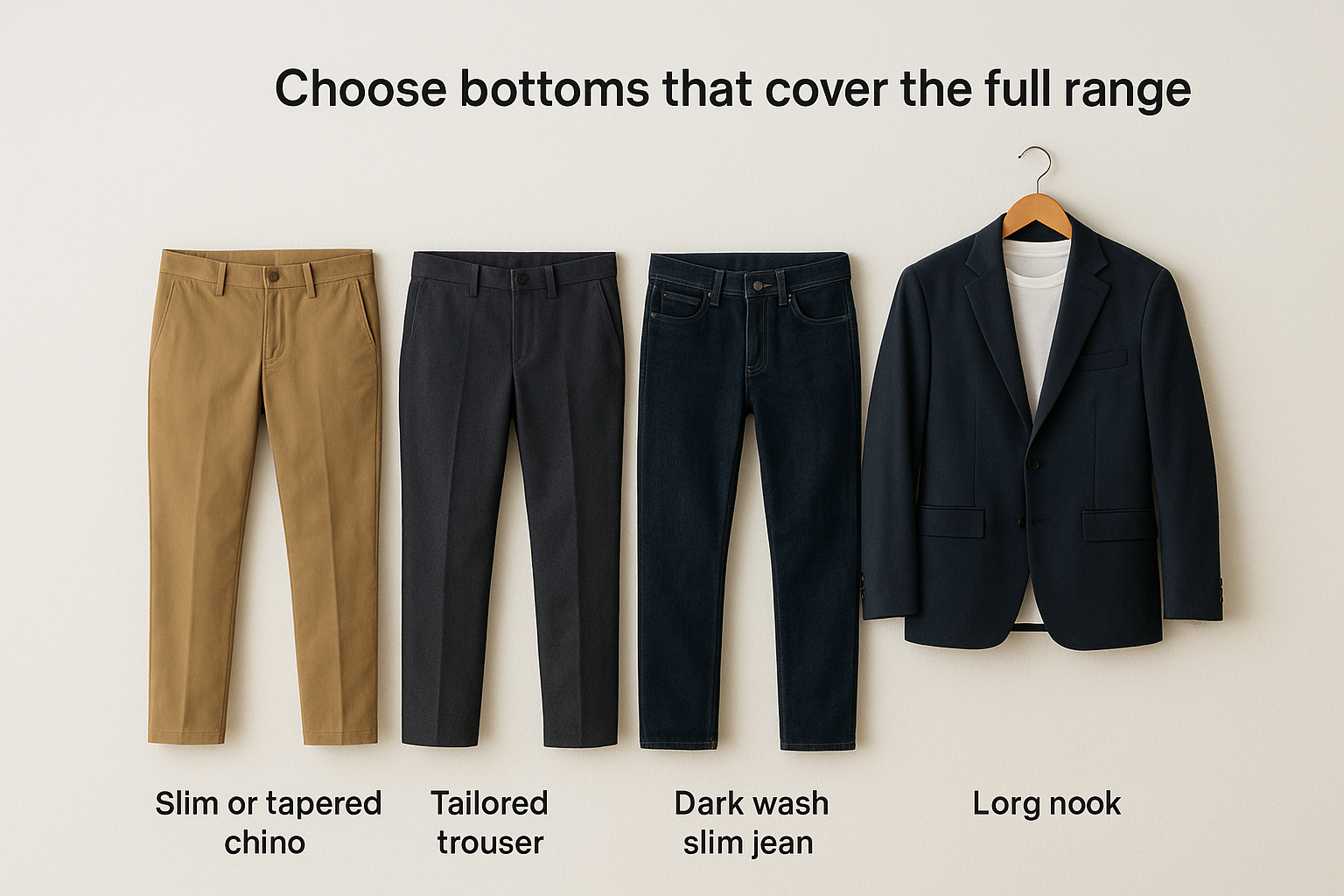
A practical three-piece bottom setup looks like this:
| Bottom | Fit | Color |
|---|---|---|
| Slim or tapered chino | Clean, no cargo pockets | Khaki or olive |
| Tailored trouser | Straight or slightly tapered | Charcoal or navy |
| Dark wash slim jean | No distressing | Indigo or black |
If a bottom only works with one specific top or requires a particular shoe to look right, it's too narrow to hold a place in a wardrobe built around versatility.
One jacket that does the work of three
When you understand how to build a minimalist men's wardrobe that functions across seasons, the jacket slot becomes one of the most valuable positions in your rotation. You want one structured, unlined jacket, either a cotton or wool-blend harrington or an unstructured blazer in a neutral tone, that layers cleanly over a tee or a shirt without looking overdressed in either context.
Look for a jacket in navy, charcoal, or olive that hits at the hip, carries minimal external detailing, and sits cleanly at the shoulder. That single piece elevates a plain tee and dark jeans into a pulled-together outfit without requiring a complete change of clothes. Pick one and commit to it fully. A second jacket almost always creates redundancy rather than meaningful coverage in a wardrobe this focused.
Step 5. Lock in shoes, outerwear, and the rules to maintain it
Shoes and outerwear are the final two variables in a complete minimal system, and they're also the easiest places to over-buy. Most men accumulate shoes they barely wear and coats for occasions that almost never come. When you understand how to build a minimalist men's wardrobe that holds together long-term, you treat footwear and outerwear the same way you treat everything else: every piece needs to pull clear, consistent weight across your whole rotation before it earns a spot.
Two shoes that cover every situation
You need two pairs of shoes, not five. A clean, low-profile leather sneaker or white cup-sole shoe handles casual days, errands, and most smart-casual scenarios without effort. A simple leather derby or Chelsea boot in tan or dark brown covers anything that requires a step up in formality. Both pairs should sit inside your established color palette and work with every bottom you own, so no combination dead-ends at your feet.
| Shoe Type | Color | Situations It Covers |
|---|---|---|
| Low-profile leather sneaker | White or grey | Casual, smart casual |
| Leather derby or Chelsea boot | Tan or dark brown | Smart casual, formal |
One outerwear piece that earns its keep
Your outerwear slot works exactly like your jacket slot: one well-chosen piece does more work than two mediocre ones. A structured wool overcoat or a waxed cotton field jacket in olive or charcoal layers cleanly over your entire top and jacket rotation without creating bulk. Pick a silhouette that hits mid-thigh and keeps a clean shoulder line. That single piece carries you across three seasons with the right layering underneath, which is all a minimal wardrobe needs from any one item.
Buying a second coat "just in case" is exactly how minimal wardrobes start drifting back toward clutter. Commit to one and use it fully.
The rules that keep the whole system working
Building the wardrobe is only half the work. Maintaining it requires three rules applied consistently: replace worn items like-for-like rather than adding new categories, remove one piece before any new one enters your rotation, and reassess the full wardrobe every six months using the same audit from Step 1. Those three habits prevent the slow accumulation that undoes most minimalist systems and keep your wardrobe tight, functional, and genuinely easy to use every day.
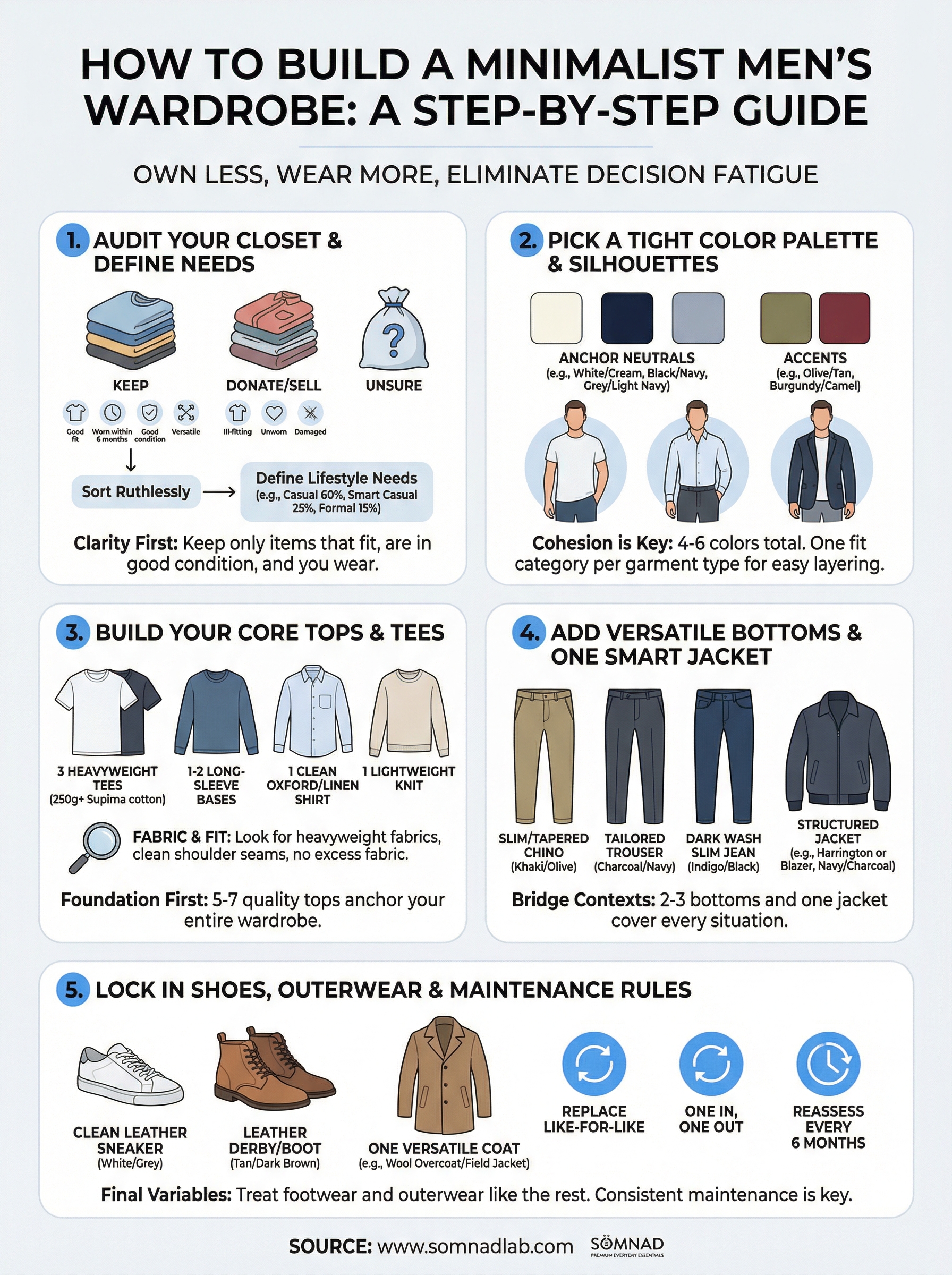
Next steps
You now have a complete, actionable system for how to build a minimalist men's wardrobe from scratch. The five steps above give you everything you need: a clear audit process, a workable color palette, a focused selection of tops, bottoms, and outerwear, and the maintenance habits that keep the whole system tight over time. The hardest part is starting, but once you complete the audit in Step 1, every decision that follows becomes significantly faster and more obvious.
Start this week, not next month. Clear your closet tonight, identify the real gaps in your rotation, and replace cheap or worn-out basics with pieces built to hold their shape through repeated wear. Every item at SÖMNAD is designed specifically for this kind of wardrobe: premium Supima cotton construction, clean silhouettes, and no excess detail, so each piece earns its place from the first wear and keeps earning it for years after.