


Your closet is full, but you still stand there every morning thinking you have nothing to wear. That's the real sign it's time to learn how to simplify your wardrobe, not just fold sweaters into neater piles. Most closets are packed with clothes bought on impulse, worn twice, then forgotten, and that clutter costs you time and decision energy you don't get back.
Simplifying isn't about owning ten items and calling it minimalism. It's about building a functional collection of clothes you actually reach for, made from materials that hold up wash after wash. That means auditing what you own, cutting what doesn't earn its space, and replacing weak pieces with fewer, better basics that layer well and last years instead of months.
In this guide, we'll walk through the exact steps: sorting your current closet honestly, identifying the core pieces every simplified wardrobe needs, and knowing what to look for when you shop again, starting with fabric weight, construction, and fit over logos. By the end, you'll have a clear system for keeping your closet lean without sacrificing style or comfort.
What simplifying your wardrobe really means
People hear "simplify your wardrobe" and picture a bare closet with five gray t-shirts and nothing else. That's not the goal, and chasing it usually backfires within a month when you're bored of your own clothes. Real simplification means cutting the noise, not the substance. You keep the pieces that fit well, wear well, and mix easily, and you let go of everything that's just taking up hanger space out of guilt or habit.
Think about the last time you got dressed in under two minutes and actually liked what you had on. That's the target state. A simplified wardrobe removes the friction between you and getting dressed, because every item in it works. Nothing is a maybe. Nothing needs an iron you don't own or a dry cleaner you never visit. The clothes earn their spot through daily usefulness, not sentimental value or how good the deal was when you bought them.
A simplified wardrobe isn't about owning less for its own sake, it's about owning nothing that doesn't earn its place.
This approach also changes how you shop going forward. Instead of buying six mediocre basics a year, you buy one or two excellent ones. A 300g Supima cotton tee, for example, holds its shape and color through fifty washes in a way a thin fast-fashion shirt never will, so it stops needing replacement every few months. That's the quiet math behind minimalist dressing: fewer purchases, higher cost per item, but far lower cost over the years you actually wear the piece.
Simplifying also means being honest about your actual life, not the version you wish you had. If you work from home four days a week, you don't need twelve dress shirts. If you never wear color, stop buying it
Step 1. Take inventory of everything you own
Before you cut anything, you need to see everything. Pull every piece of clothing out of your closet, drawers, and that box under your bed, then lay it all out on your bed or floor. Most people underestimate what they own by 30 to 40 percent because half of it lives in the back of a drawer, forgotten. You can't simplify a wardrobe you haven't fully counted.
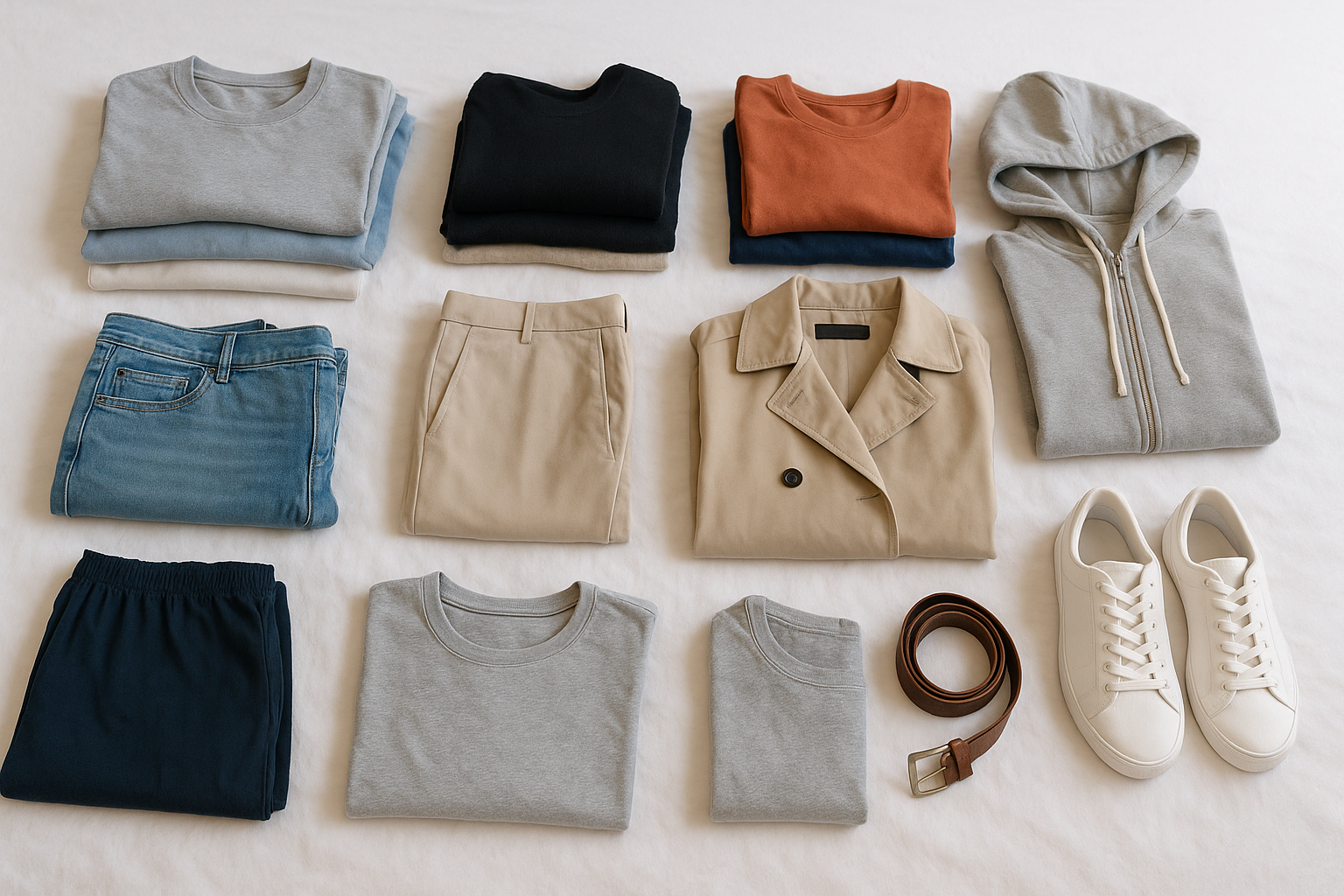
Separate by category first
Group everything by type before you judge a single item. This keeps you from making emotional decisions piece by piece and shows you where the real excess sits.
- Tops (tees, shirts, sweaters)
- Bottoms (jeans, trousers, shorts)
- Outerwear
- Loungewear and sleepwear
- Shoes and accessories
You can't fix a wardrobe you haven't fully counted.
Counting reveals patterns fast. You'll often find nine nearly identical black tees and zero good pairs of pants. That imbalance is exactly what an honest wardrobe audit exposes, and it's the information you'll use in the next step to decide what actually deserves to stay.
Step 2. Sort each piece into keep, donate, or repair
Now that everything's laid out, go through each piece one at a time and ask three questions: Have you worn it in the last twelve months? Does it fit right now, not six pounds ago or from now? Is it made well enough to last another year? If you hesitate on any of those, that's your answer already. Decisive sorting beats a slow maybe pile that just becomes clutter again in three months.
Create three physical piles, and don't let a fourth "maybe" pile sneak in. Maybe piles are how closets get full again.
KEEP: worn recently, fits well, no visible wear
DONATE: fits someone else better, unworn 12+ months, still in good shape
REPAIR: good bones, but needs a button, hem, or wash
If you're debating whether to keep something, that hesitation is your answer.
Be strict with the keep pile especially. This is where sentimental attachment does the most damage, since a shirt from an old trip or a gift from someone you love doesn't automatically earn closet space. Function comes first. The repair pile should be small and specific, not a dumping ground for things you're avoiding dealing with. If a piece needs more than a quick fix, it's probably a donate.
Step 3. Build a versatile capsule around your essentials
Once your keep pile is set, look at what's actually there. A capsule wardrobe isn't a fixed number of items, it's a small set of pieces that all work together, so any top pairs with any bottom without a second thought. Start by counting how many outfits your keep pile actually makes. If nine tops and four bottoms only produce six real outfits, you have overlap, not variety.
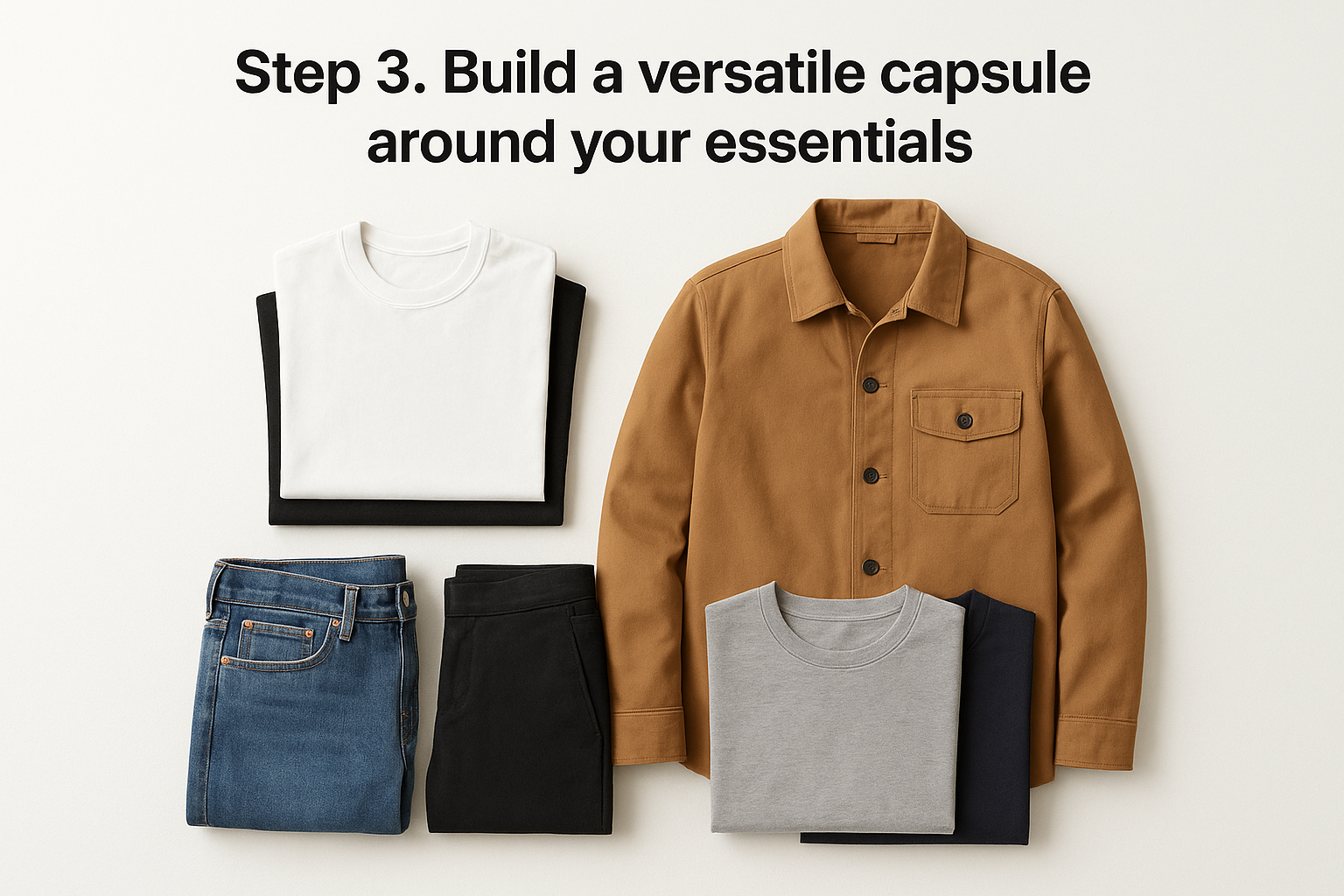
Anchor around neutral basics
Build outward from a core of neutral, well-made staples rather than trend pieces. Neutrals stretch further because they layer with almost everything else you own.
- 3 to 5 tees in cotton weights that hold shape (300g Supima cotton works well here)
- 2 pairs of pants that fit right now
- 1 versatile jacket or overshirt
- A handful of layering pieces in colors that already match your existing pants
A capsule wardrobe isn't about counting items, it's about maximizing how many good outfits they create.
Fill gaps, don't add clutter
Once your core is set, only add pieces that solve a real gap, like a missing neutral layer for cold mornings. Skip anything that only works with one outfit. Versatile essentials should multiply your options, not just add to the pile.
Step 4. Set rules to keep your wardrobe simple
A capsule wardrobe stays simple only if you protect it from new clutter. Set a few personal rules now, before you shop again, so old habits don't quietly rebuild the mess you just cleared out. Rules work better than willpower because they remove the decision in the moment you're tempted.
Try a one-in, one-out rule
Every time you bring in something new, something old has to leave. This single habit keeps your closet at a fixed size instead of creeping upward every season.
NEW ITEM IN → ONE ITEM OUT
No exceptions for "just this once" sale finds
The fastest way to stay simplified is to make every new purchase cost you an old one.
Buy fewer, better pieces
Set a quality threshold before you buy anything: check fabric weight, stitching, and how it holds up after a wash test if you can. A heavier cotton tee that resists pilling earns its spot; a thin one that stretches out by week three doesn't, no matter the price. This is where fewer purchases actually save you money over a year of wear.
Write your rules down somewhere visible, your phone notes app works fine. Rules you don't see, you don't follow.
A wardrobe that works for you
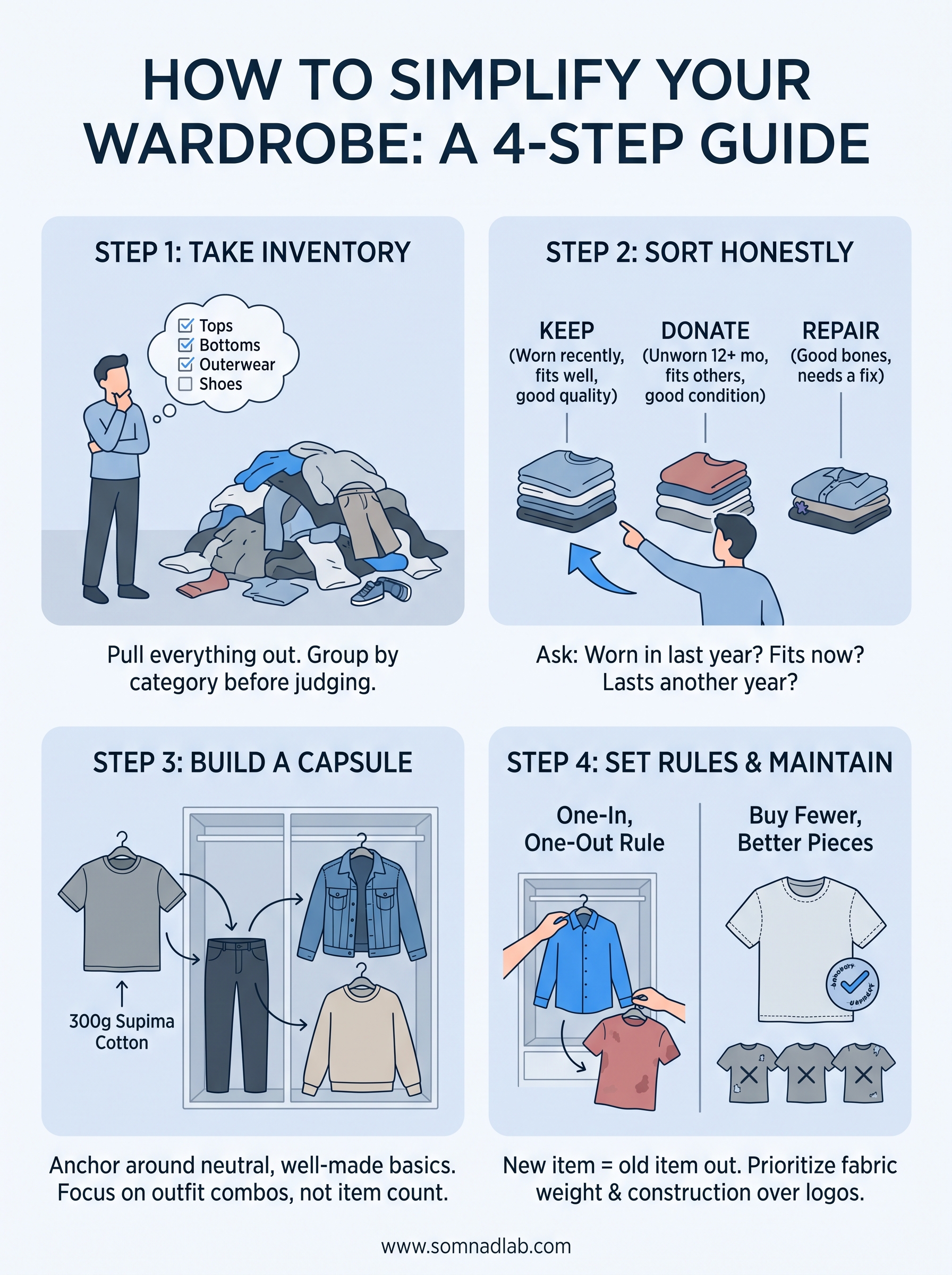
A simplified wardrobe isn't a one-time weekend project, it's a system you maintain. You've taken inventory, sorted honestly, built a capsule around pieces that actually earn their spot, and set rules that stop the clutter from creeping back. That's the whole method, and it works whether your closet has forty items or four hundred.
What changes now is how you shop. Every future purchase gets measured against what you already own, not against a sale price or a trend cycle. Fabric quality and construction matter more than logos, and a heavier cotton tee that survives fifty washes beats three thin ones that don't survive ten.
If you're ready to replace weak basics with pieces built to last, start with SÖMNAD's essentials and give your simplified closet the foundation it deserves.