


Men (2022) landed on streaming with the kind of divisive buzz that makes people search for answers before, during, and after watching it. If you just finished the film confused, or you're deciding whether to press play tonight, you're in the right place. Alex Garland's psychological horror doesn't hand you easy explanations, and that's exactly why so many viewers end up here looking for clarity.
This article breaks down what actually happens in Men, who plays each role, and what that unsettling final act really means. You'll get a full plot rundown, a look at the cast including Jessie Buckley's central performance, and a straightforward take on the ending without the vague film-school language that usually clouds these breakdowns.
We'll also cover where you can stream Men right now, so you're not stuck hunting across five different platforms. Whether you want the quick answer on the symbolism or a scene-by-scene walkthrough of the finale, this guide gives you both, laid out in plain terms so you can actually use it.
Why Men struck such a nerve with horror fans
Garland built his reputation on smart, slow-burn science fiction with Ex Machina and Annihilation, so when he pivoted to full-blown horror, audiences showed up expecting something cerebral. Men delivers that, but it also delivers a level of body horror and visceral discomfort that caught a lot of viewers off guard. That gap between expectation and execution is a big part of why the film became such a talking point the moment it hit theaters in 2022.
A folk horror setup with modern teeth
The film borrows heavily from classic folk horror, an isolated English village, a lone outsider, ancient symbols carved into stone and stained glass. Fans of that genre recognized the DNA instantly, but Garland twists it. Instead of a cult or a pagan ritual driving the plot, the horror comes from something more mundane and more disturbing: the accumulated weight of male aggression, entitlement, and gaslighting directed at one woman. That reframing is what separates Men from a straightforward folk horror throwback and turns it into something people wanted to argue about online.
One actor, every man in the village
The single choice that generated the most conversation is casting Rory Kinnear as nearly every male character Harper encounters, the vicar, the police officer, the pub landlord, a naked stranger in the woods, even a child. It's a bold structural decision, and it works because it makes the theme literal instead of implied. You're not left guessing whether the film is commenting on how interchangeable certain male behaviors can feel to a woman navigating them alone. It shows you, directly, scene after scene.
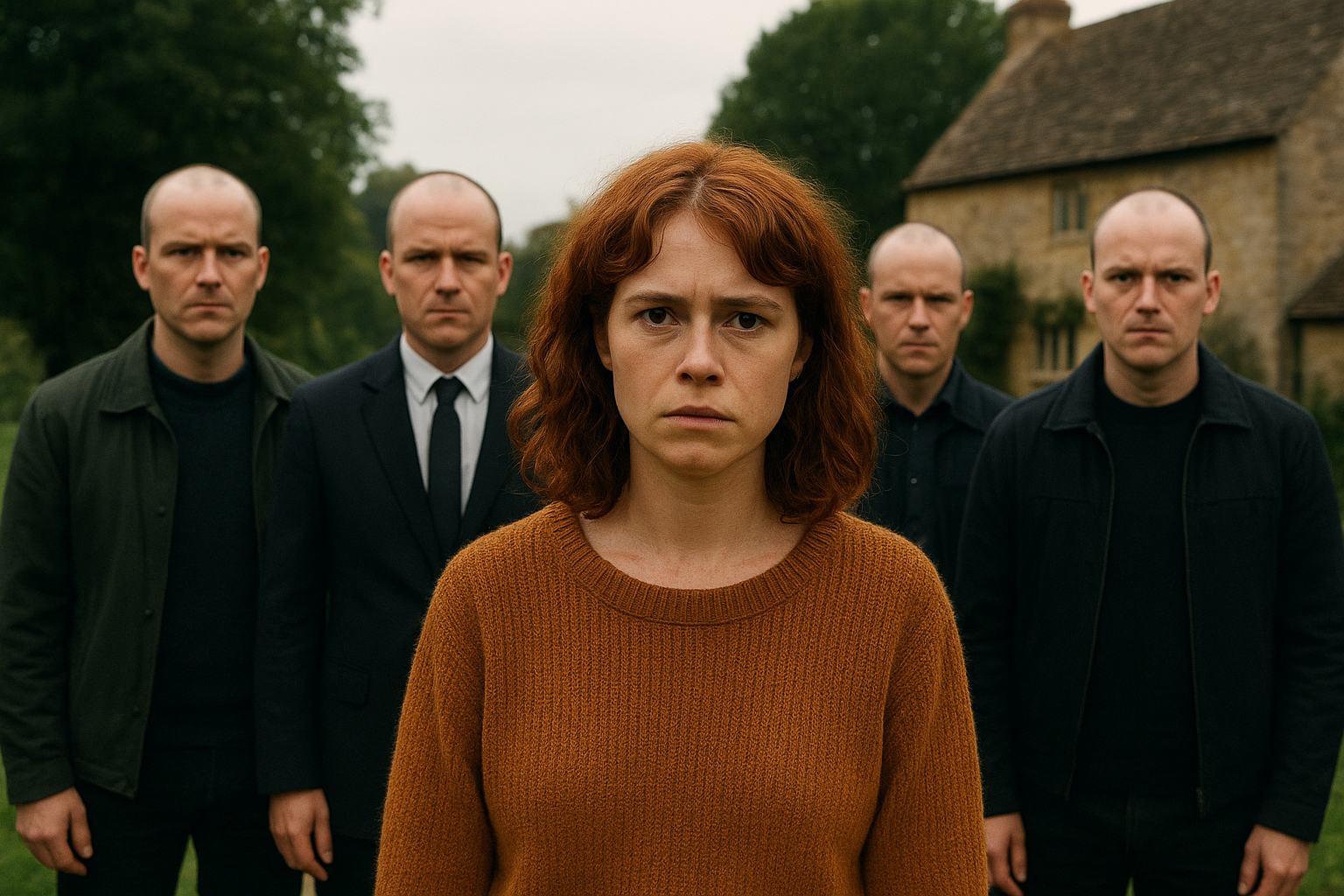
Men turns a subtle theme into a visible one by making every man on screen the same face.
A finale built to be dissected
The last act pushes body horror to an extreme that few mainstream horror releases attempt, with a sequence of transformation and birth that plays out almost wordlessly for several minutes. That sequence alone generated thousands of forum posts, video essays, and social media threads trying to pin down exactly what it meant. Some viewers found it a gutsy, unforgettable piece of filmmaking. Others felt it tipped into excess without adding meaning. Both reactions are valid, and that split is exactly why the film kept trending on streaming charts long after its theatrical run ended.
Why it keeps generating searches
Several factors combine to keep people typing questions about this film into search bars months and years after release:
- Ambiguous symbolism: apples, the Green Man figure, and the birth sequence all reward close reading, but the film never explains them outright.
- A single-actor gimmick that's genuinely unsettling rather than gimmicky, which makes people want to talk about how it was pulled off.
- A trauma narrative told through horror imagery instead of dialogue, so viewers piece together Harper's backstory gradually and often miss details on a first watch.
- Divisive critical reception, which naturally sends curious viewers looking for a second opinion before or after they watch.
Jessie Buckley's performance anchors all of it. She carries scenes of near-total silence with enough control that you feel every shift in Harper's fear and exhaustion without a single line of exposition. That performance, paired with a director unafraid to alienate part of his audience, is why Men still shows up in horror discussions years after its release, and why so many people arrive here still trying to sort out what they just watched.
How to watch Men right now
Streaming rights shift often, so the fastest way to watch Men tonight is to check a major aggregator like JustWatch or Google Play Movies before committing to a subscription you don't already have. As of now, Men is available to rent or buy digitally through platforms including Amazon Prime Video, Apple TV, Vudu, and YouTube. If you already have a Prime membership, renting through Amazon is usually the smoothest option since you're already logged in and it plays instantly in HD.
Where the film actually lives
Unlike movies bought outright by a single streaming service, Men was distributed by A24, and A24 titles tend to bounce between platforms depending on licensing deals. That means a subscription service carrying it today might drop it next quarter, while a new one picks it up. Rental and purchase options tend to stay stable longer than subscription availability, so if you want a guaranteed watch, renting is the safer bet.
| Option | Typical Cost | Availability |
|---|---|---|
| Digital rental (Amazon, Apple TV, Vudu) | $3.99-$5.99 | Consistently available |
| Digital purchase | $12.99-$14.99 | Consistently available |
| Subscription streaming | Included with plan | Rotates, check current listings |
| Physical media (Blu-ray/DVD) | $12-$20 | Available through major retailers |
If you want a guaranteed watch tonight, renting Men digitally beats gambling on subscription rotation.
A note on picture quality
Given how much of Men relies on visual detail, the stone carvings, the Green Man imagery, the shifting light in the tunnel scene, watching in the highest resolution your setup allows genuinely matters. A 4K rental on a decent TV catches symbolic details that get lost in a compressed stream on a laptop. If you're planning to rewatch the ending specifically to catch clues you missed the first time, this is worth the extra couple of dollars for the upgraded format.
Finding the film is easy enough once you know where to look, but confirming current availability before you settle in saves you the frustration of switching apps mid-search. Quick tip: search the title alongside your specific streaming apps rather than relying on a general search engine result, since those listings update faster than most search snippets. Once you've got it queued up, the plot itself rewards close attention from the opening minutes, which is exactly what we'll walk through next.
What happens in Men: a full plot summary
Harper Marlowe, played by Jessie Buckley, rents a countryside cottage in rural England after her husband James dies in a fall from their apartment window during a violent argument. She's grieving, but she's also carrying guilt, since flashbacks reveal James threatened to kill himself if she left him, right before the fall that may or may not have been an accident. The isolated retreat is meant to be a place to heal, but from the moment Harper arrives, something feels off about the village and the people in it.
Harper arrives at the cottage
Geoffrey, the landlord, greets her with a mix of charm and condescension that sets the tone for every male character she meets afterward. She explores the surrounding woods and finds an old railway tunnel, where she experiments with echoing her own voice, a moment of peace that gets interrupted when a naked man appears, following her back toward the cottage. That encounter kicks off a slow accumulation of threat: a menacing boy in a Green Man mask, a dismissive vicar who blames her for James's death, and a police officer who fails to take the stalking seriously.
Every man Harper meets in the village wears a different job but the same face, and the same disregard for her fear.
Strange encounters escalate
Garland uses these repeated interactions to build unease without relying on jump scares. Instead, dread comes from accumulated dismissal, the sense that no one in this village will actually help her. The naked stranger breaks into the cottage garden more than once, and each authority figure Harper turns to responds with some version of doubt, judgment, or outright hostility. By the time night falls fully, the film has established that Harper is essentially alone against a force that keeps changing shape but never changes intent.
The night everything breaks
The final stretch abandons restraint entirely. The stalker breaks into the cottage, and what follows is a sequence of body horror transformation rarely seen in mainstream horror: the intruder gives birth to another version of himself, over and over, each iteration another face played by Rory Kinnear, eventually culminating in James himself emerging and confronting Harper directly. It's a wordless, escalating sequence that trades traditional scares for something closer to a fever dream, setting up everything the ending needs to resolve, or refuse to resolve, in the film's final minutes.
Meet the cast behind Men's unsettling village
Only two actors carry the entire film, which is unusual for a movie with this many named characters. That small footprint is deliberate: Alex Garland wanted the cast list itself to reinforce the theme, so the village feels populated while actually being controlled by a single performer wearing different faces. Here's who's actually on screen and what each performance adds to the film.
Jessie Buckley as Harper Marlowe
Buckley plays Harper, the grieving widow at the center of the story, and the film rests almost entirely on her ability to carry scenes with little to no dialogue. Jessie Buckley's performance relies on physical tension, hesitant breathing, and controlled panic rather than exposition, which is a harder acting challenge than it looks on screen. If you know her from I'm Thinking of Ending Things or Wild Rose, this role asks for something different: restraint under sustained dread rather than emotional outbursts. She's the audience's only anchor in a village designed to feel unstable, and that anchoring is what keeps the film from collapsing into pure abstraction.
Rory Kinnear's multi-role performance
Kinnear plays every male character Harper encounters in the village, a technical and physical feat achieved through prosthetics, digital face-replacement, and distinct vocal choices for each role. This isn't a gimmick tacked on for marketing; it's the film's central argument made visible.
One actor playing every man in the village turns a theme about male aggression into something you can actually watch happen.
| Character | Role in the story |
|---|---|
| Geoffrey | The cottage landlord, charming but condescending |
| The naked stranger | Stalks Harper through the woods and garden |
| The vicar | Dismisses Harper's grief and shifts blame onto her |
| The police officer | Fails to take the stalking threat seriously |
| The boy in the Green Man mask | A younger, mocking echo of the same hostility |
| James (final act) | Harper's late husband, reappearing in the birth sequence |
The rest of the crew behind the camera
Paapa Essiedu appears briefly as James in flashback footage before Kinnear takes over the role in the film's final stretch, giving the character's death and reappearance a jarring visual contrast. Garland wrote, directed, and shaped the film's editing rhythm himself, which explains why the pacing feels so deliberate even when the plot withholds answers. Behind the scenes, cinematographer Rob Hardy shot the English countryside to look inviting in daylight and suffocating after dark, a visual shift that does as much storytelling work as the cast itself.
The ending of Men explained
Garland doesn't wrap Men up with a neat bow, and that's the point. The film's closing minutes ask you to sit with discomfort rather than hand you a tidy resolution, which is exactly why so many viewers pause the movie and start typing questions into a search bar before the credits even finish rolling.
The birth sequence, step by step
The intruder who breaks into the cottage doesn't die in any conventional sense. Instead, he gives birth to another version of himself through his wounds, and that new figure gives birth to the next, each one played by Rory Kinnear in a different guise: the vicar, the police officer, the boy in the mask, until James himself finally emerges. It plays out almost in real time, wordless and deliberately uncomfortable, forcing you to watch the transformation rather than cutting away from it.
The birth sequence isn't shock for its own sake, it's the film showing you that every man Harper met that day was always the same threat wearing a new face.
What James's final appearance means
When James finally steps out of the sequence and sits across from Harper, he doesn't attack her. He asks why she couldn't have loved him enough to stop him from falling, echoing the guilt-tripping and blame he used on her while alive. That moment reframes the entire village encounter: every man Harper met that day, the landlord, the vicar, the stalker, was a variation on the same manipulative pattern James used against her before his death.
Harper's response and the final shot
Harper doesn't scream or fight in that final confrontation. She simply tells James she doesn't forgive him, a quiet but firm rejection of the guilt he's been trying to place on her since the opening flashback. The film cuts to the next morning, sunlight through the cottage windows, and a friend named Riley arriving to check on her. Harper looks exhausted but present, suggesting she's survived the night, even if the film refuses to confirm whether any of it was real, supernatural, or a manifestation of grief and trauma.
Why Garland leaves it open
That ambiguity is deliberate. Garland has said in interviews that he wanted the horror to work as metaphor first and literal plot second, which is why the ending resists a single, confirmed interpretation. Whether you read it as a ghost story, a psychological breakdown, or a folk horror ritual, the emotional throughline stays the same: Harper survives a night built entirely from the accumulated weight of male entitlement.
How critics and audiences reacted to Men
Critics landed all over the map on Men, and that split shows up clearly once you look past the aggregate scores. On Rotten Tomatoes, the film sits in the low-70s among critics but drops noticeably with general audiences, a gap that usually signals a movie doing something more polarizing than a simple quality issue. Reviewers praised Garland's visual craft and Jessie Buckley's performance almost universally, while disagreeing sharply on whether the finale's body horror earned its runtime or overstayed its welcome.
The critical divide in numbers
Giving you the raw comparison helps more than a paragraph of hedging:
| Source | Score | General sentiment |
|---|---|---|
| Rotten Tomatoes (critics) | ~71% | Mostly positive, praises ambition |
| Rotten Tomatoes (audience) | ~42% | Mixed to negative, finale draws complaints |
| Metacritic | 68/100 | "Generally favorable" but with notable outliers |
| Letterboxd average | 3.1/5 | Wide spread, many 5-star and 1-star reviews |
A film that scores well with critics but splits audiences almost always means the ending is doing something risky.
What critics praised
Most professional reviews single out three things: Rob Hardy's cinematography, Rory Kinnear's technical range across multiple roles, and Garland's willingness to commit fully to an unsettling metaphor instead of softening it for a wider audience. Several reviewers compared the film favorably to folk horror classics while noting that Men updates the genre's concerns for a modern conversation about male entitlement and gaslighting. Publications that champion arthouse horror tended to rate it higher, while outlets writing for a broader mainstream audience were more likely to flag the ending as excessive.
What audiences pushed back on
Ordinary moviegoers were far less forgiving of the birth sequence specifically. Common complaints center on the sequence running too long, feeling more shocking than meaningful, and leaving the film's message so open-ended that some viewers walked away without a clear takeaway. Others found the single-actor casting distracting once the novelty wore off, arguing it drew attention to the technique rather than the theme. That said, plenty of audience reviews defend the exact same choices as the film's strongest asset, which is part of why forum threads about Men rarely reach consensus even years after release.
Why the split matters if you're deciding to watch
Knowing this divide going in sets your expectations correctly. If you enjoy horror that prioritizes symbolism over tidy resolution, you'll likely land on the critics' side. If you want your horror films to answer their own questions by the credits, temper your expectations before pressing play tonight.
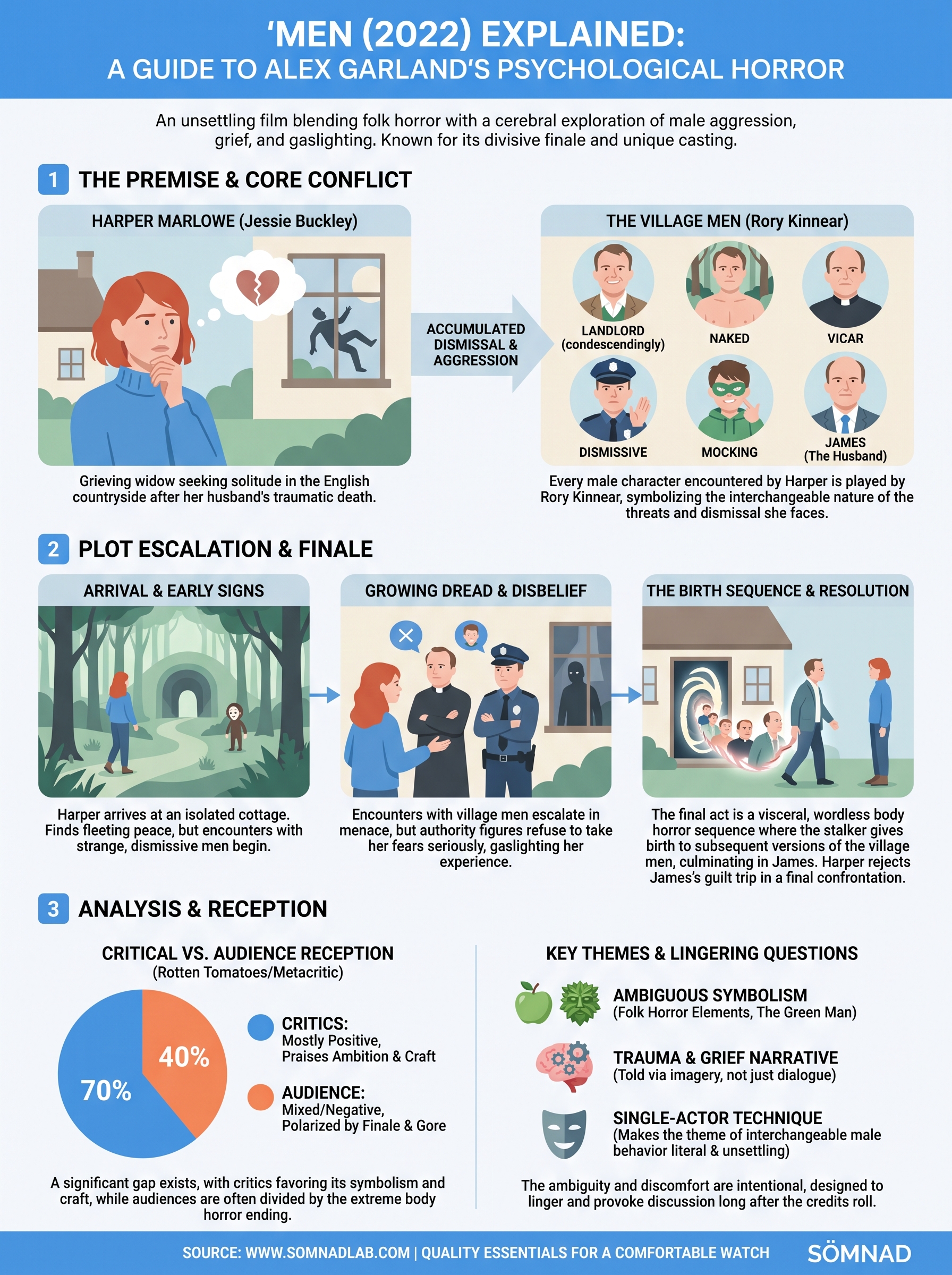
A film that lingers long after the credits
Men earns its reputation the hard way, through discomfort rather than jump scares. Garland trusts you to sit with ambiguity, and Buckley's performance gives that ambiguity real emotional weight instead of empty mystery. Whether you land on the critics' side or the audience's side, you won't forget the birth sequence, and you'll probably watch the ending twice just to catch what you missed the first time.
That's really the mark of good horror: it stays with you after the credits roll, the same way a well-made wardrobe staple outlasts whatever trend pulled you toward it. If tonight's plan is a quiet night in with a film that rewards close attention, settle into something built the same way, with quality over noise and no unnecessary flash. Browse SÖMNAD's complete collection of everyday essentials and get comfortable before you press play.