


You're standing in front of your closet on a humid morning, trying to figure out which shirt won't leave you sweaty by 9 a.m. Cotton has always been the safe answer, but it's not the only one anymore, and it might not even be the best one. So is lyocell breathable? Yes, and the reason comes down to how the fiber itself is built, not just how it's woven.
Lyocell is made from wood pulp cellulose, and its fiber structure is naturally more absorbent and porous than cotton. That means it pulls moisture away from your skin faster and lets air move through the fabric instead of trapping heat against you. In side-by-side wear tests, lyocell outperforms cotton in humidity control, which is exactly why it feels noticeably cooler on a 90-degree afternoon.
We work with fabric like this daily at SÖMNAD, so this article breaks down the science behind lyocell's breathability, how it stacks up against cotton and other basics, and the specific lyocell t shirt benefits that make it worth adding to your warm-weather rotation.
Why lyocell's breathability outperforms cotton in hot weather
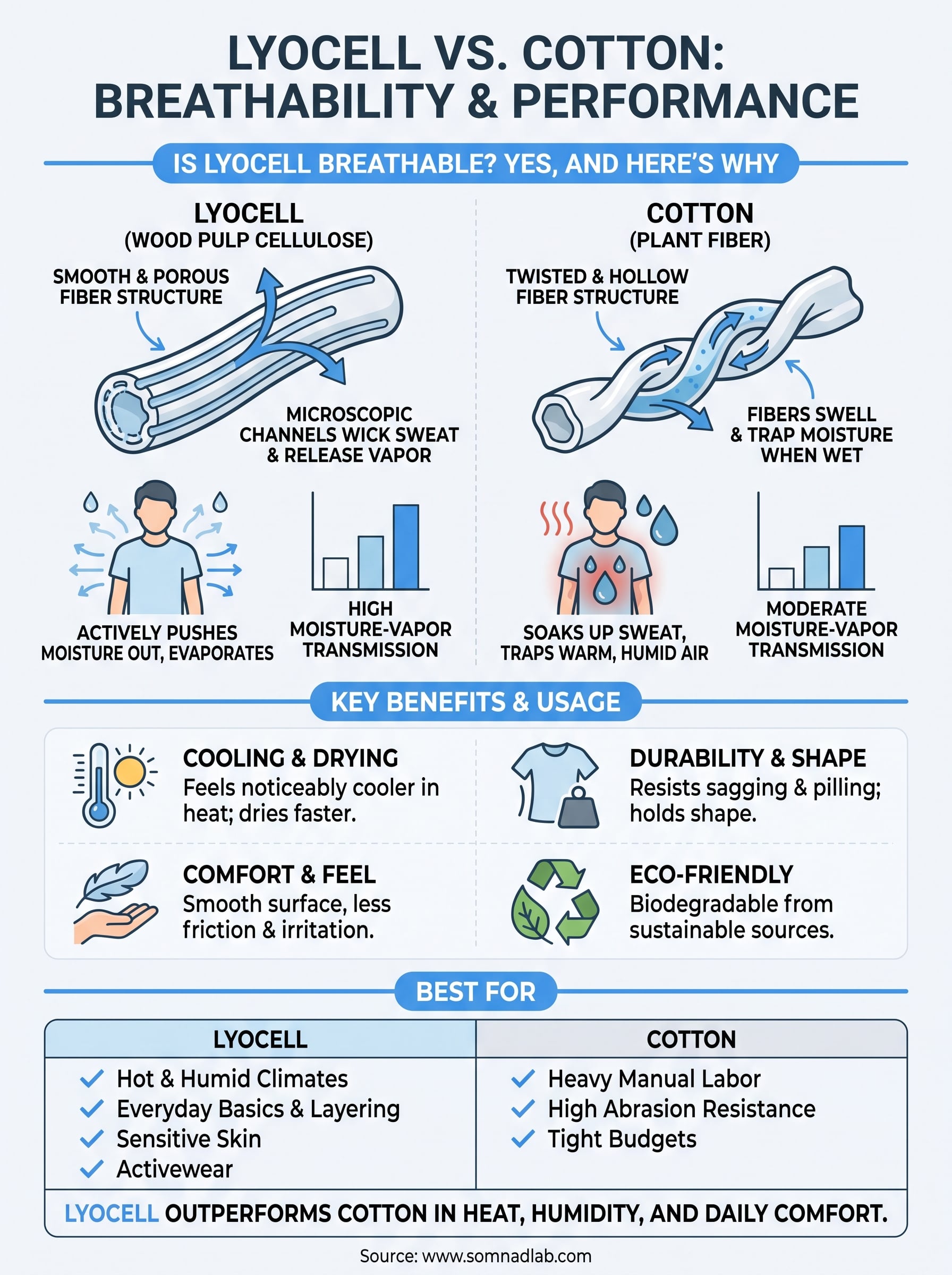
Understanding why lyocell breathes better starts at the microscopic level. Cotton fibers are twisted, uneven ribbons with a hollow core that holds onto moisture once it's absorbed. Lyocell fibers, by contrast, are extruded in a closed-loop process that produces a smooth, uniform filament with a fibrillated surface, tiny microscopic channels that wick sweat outward and release it as vapor rather than storing it against your skin. That structural difference is the whole answer to whether is lyocell breathable holds up under real conditions, and it does.
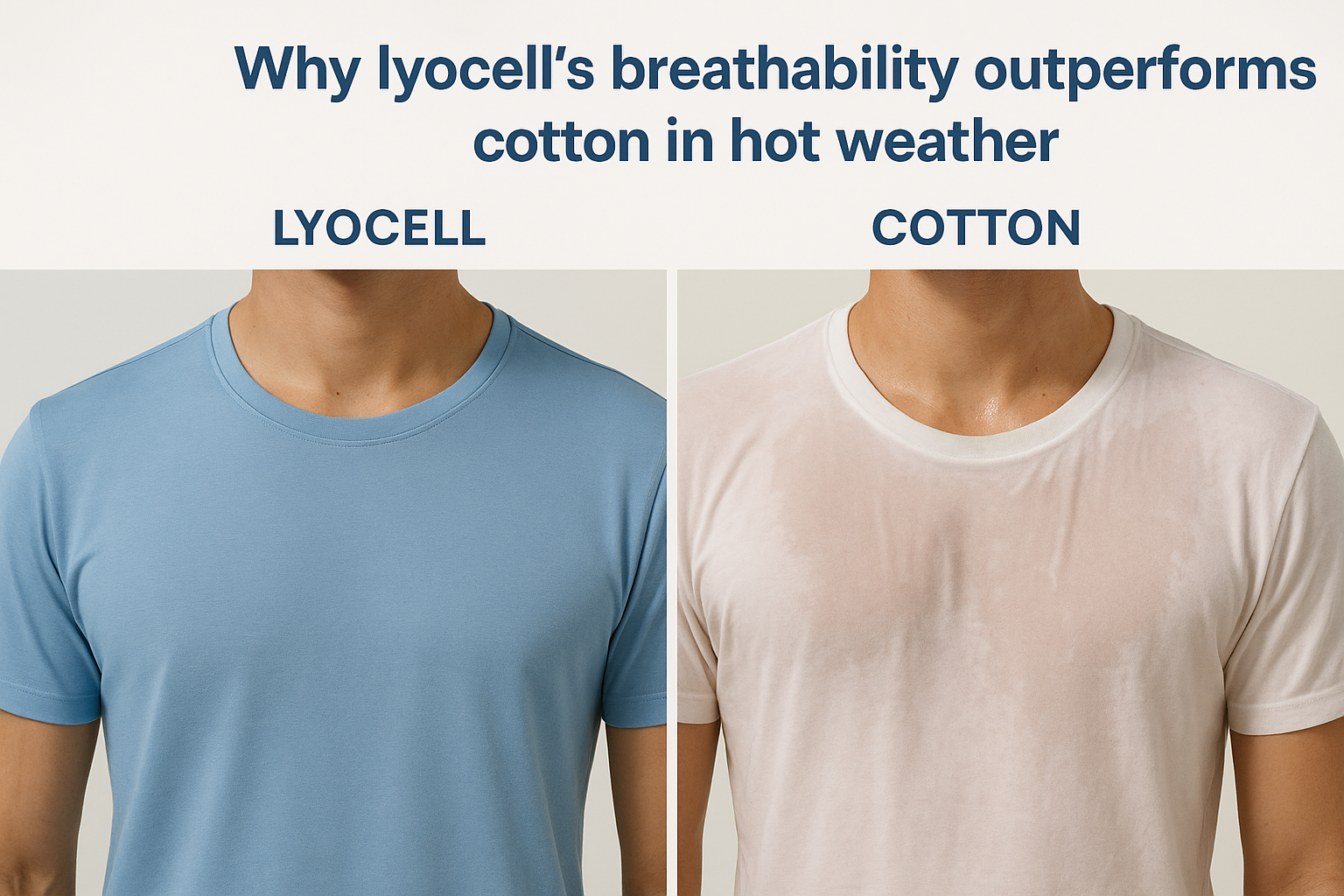
Actual lab data backs this up. In moisture-vapor transmission tests, lyocell consistently moves water vapor through the fabric faster than cotton, which is why a lyocell shirt dries out during a workout while a cotton one stays damp and heavy.
Lyocell doesn't just soak up sweat, it actively pushes moisture out and lets it evaporate, so you stay drier for longer.
Heat retention plays a role too. Cotton fibers swell when wet, closing off the tiny gaps between threads and trapping warm, humid air close to your body. Lyocell fibers keep more consistent spacing even when damp, so airflow through the weave stays open. That's the mechanical reason lyocell feels cooler on skin during a heat wave, not just a marketing claim.
| Property | Lyocell | Cotton |
|---|---|---|
| Moisture-vapor transmission | High | Moderate |
| Feel when wet | Stays lighter, less clingy | Heavier, damp longer |
| Airflow retention when sweating | Maintains structure | Fibers swell, restrict flow |
| Drying speed | Faster | Slower |
Additionally, the smoother fiber surface means less friction against skin, so even when you're sweating heavily, lyocell doesn't cling and chafe the way a soaked cotton tee often does. According to research from the U.S. Department of Agriculture on cellulose fiber structures, this porosity is a direct product of the wood-pulp source material, not a coating or finish applied afterward, which means the breathability is baked into the fiber and won't wash out over time.
How to choose and care for the most breathable lyocell pieces
Finding lyocell that actually delivers on breathability starts with the label, not the marketing copy. Look for 100% lyocell or a high-lyocell blend rather than a fabric that lists it as a minor add-in behind polyester or rayon, since a small percentage won't move enough moisture to matter. Weight matters too, a lightweight lyocell weave in the 130-160 gsm range breathes best for hot climates, while heavier lyocell knits trade some airflow for structure and drape.
What to check before you buy
Run through this quick checklist when you're comparing options:
- Fiber content listed as majority or pure lyocell
- Fabric weight under 160 gsm for warm-weather wear
- Loose or open weave rather than a dense, tight knit
- No heavy synthetic coating that blocks vapor transfer
Washing without wrecking the fiber
Care routines can undo lyocell's natural advantage if you're not careful. High heat and harsh detergents break down the fibrillated surface that gives lyocell its wicking power, so machine wash cold on a gentle cycle and skip the dryer's high-heat setting whenever possible.
Treat lyocell gently in the wash, and it keeps working hard for you in the heat.
Air drying preserves the fiber structure longer than tumble drying, and it also cuts down on shrinkage. If you're building out a warm-weather rotation, our own approach to fabric selection at SÖMNAD's collections page follows the same logic, prioritizing fiber quality over shortcuts that fade fast.
Lyocell t-shirt benefits beyond breathability
Softness is the first thing you notice when you pull on a lyocell tee, and it comes from that same smooth fiber surface that handles moisture so well. There's no rough texture to break in over months of washing, so a lyocell shirt feels finished the day it arrives, not after ten wears. Lyocell t shirt benefits extend well past staying cool, though, and they add up to a fabric that earns its place in a minimalist wardrobe.
Durability stands out next. Because lyocell fibers keep their shape even when wet, garments resist the sagging and pilling that cotton tees develop after repeated washes, which means fewer replacements and less waste over time.
A shirt that still holds its shape after fifty washes is worth more than one that fades after ten.
Here's what else lyocell brings to a basic tee:
- Biodegradable sourcing from wood pulp, unlike synthetic blends that shed microplastics
- Wrinkle resistance that keeps a clean look without ironing
- Hypoallergenic properties, since the smooth fiber irritates sensitive skin less than rougher cottons
- Consistent drape that holds a tailored fit through the day
Given all this, it's clear why lyocell shows up in premium basics rather than fast-fashion racks. The fiber does more work per wear, which is exactly the kind of quality-over-quantity thinking that makes a tee worth keeping in rotation for years instead of one summer.
Where lyocell wins and where cotton still makes sense
Heat and humidity are where lyocell pulls ahead, but that doesn't mean cotton belongs in the donation pile. Cotton still makes sense for heavier-duty wear, workwear, denim, and anything that takes constant abrasion, since its fiber structure holds up better against rough friction than lyocell's smoother surface. Budget matters too. Cotton production costs less at scale, so a basic cotton tee will almost always undercut lyocell on price.
Situations change the calculus, though. Gym sessions, humid commutes, layering under a blazer in summer, these are exactly where lyocell's cooling advantage shows up in daily life instead of a lab report. If you sweat through cotton by lunch, lyocell keeps you dry through a full workday.
Pick the fiber for the job, not just the price tag.
Think of it this way:
| Use case | Better fiber | Why |
|---|---|---|
| Hot, humid climates | Lyocell | Faster moisture-vapor transfer |
| Heavy manual labor | Cotton | Higher abrasion resistance |
| Everyday basics, layering | Lyocell | Cooler feel, less clinging |
| Tight budget, bulk buying | Cotton | Lower production cost |
| Sensitive skin | Lyocell | Smoother fiber, less irritation |
Given these tradeoffs, most warm-weather wardrobes benefit from leaning lyocell for the pieces worn closest to skin, while saving cotton for items built to take a beating.
What this means for your closet
So the answer to is lyocell breathable isn't a maybe, it's a yes backed by fiber structure, not marketing copy. The wood-pulp origin gives lyocell microscopic channels that cotton simply doesn't have, and that's why it pulls ahead in heat, humidity, and everyday comfort. You don't need to overhaul your entire wardrobe overnight, but the next time you're replacing a worn-out tee, swap in lyocell for the pieces that sit against your skin all day.
Cotton still earns its keep for rugged wear, but for basics, layering, and hot-weather rotation, lyocell does more with less fuss. Fewer replacements and better performance add up over a year of wear, which is the whole point of buying fewer, better things. Ready to feel the difference for yourself? Browse SÖMNAD's collection and put a lyocell tee into your rotation this week.